Aleksandra Kosiorek: The sea has always been a space of openness for us, and that will not change
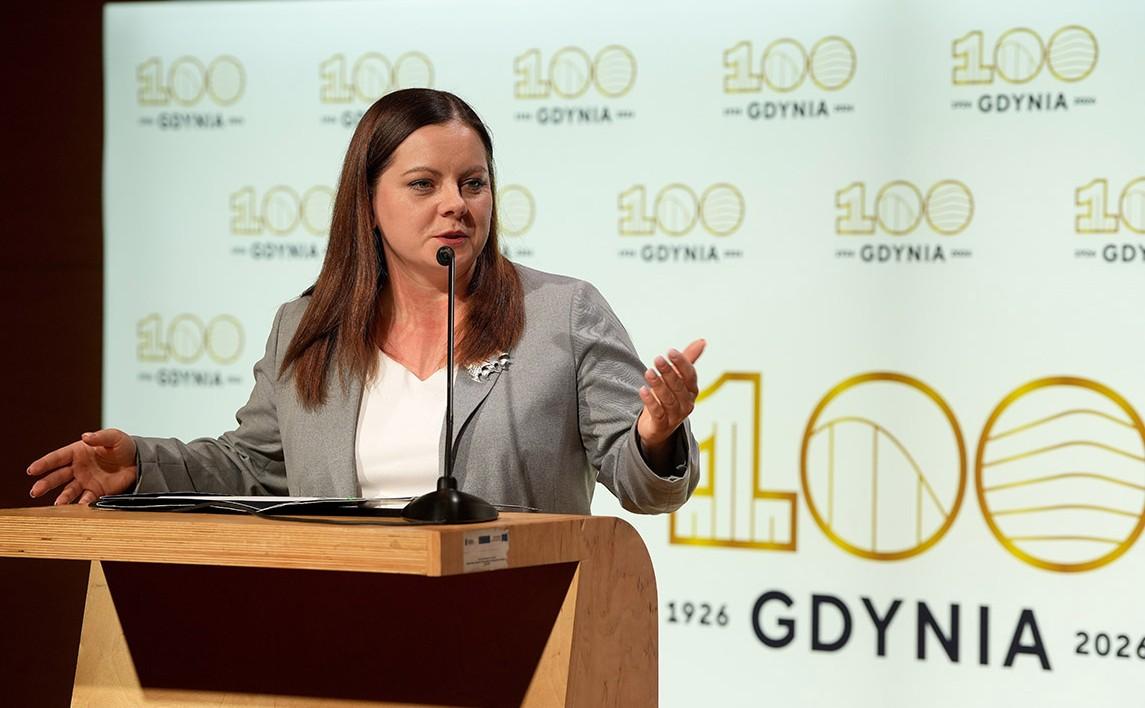
A hundred years ago, Gdynia was founded as a modern city built "for the port". Today, it continues to develop according to that strategic logic, albeit on a broader scale. - The sea has always been a space of openness for us, says Gdynia’s mayor, Aleksandra Kosiorek, in an interview with Gazeta Morska. - Today, the port is not only about the economy but also about technology, safety, and an industrial ecosystem that shapes both the city and the region.
only here business marine lifestyle opinions and comments pomerania local governance tricity news09 april 2026 | 15:14 | Source: Gazeta Morska | Prepared by: Kamil Kusier | Print
fot. Mirosław Pieślak / Miasto Gdynia
Was Gdynia one of the largest modernization projects of the Second Polish Republic, built essentially “for the port”? After 100 years, is the city still developing according to the same strategic logic?
Aleksandra Kosiorek, Mayor of Gdynia: You could say so, although today we interpret that logic more broadly than we did a century ago. In the 1920s, the construction of the port acted as a catalyst that, within just over a decade, increased the population from fewer than 1,200 to over 120,000. Today, Gdynia has around 240,000 residents, and in 2025 the Port of Gdynia handled 25.7 million tonnes of cargo and, for the first time in its history, surpassed one million TEU in container throughput.
The port remains one of the key drivers of growth—directly and indirectly generating tens of thousands of jobs across the region. The difference is that today the city is no longer developing solely around cargo handling, but also around logistics, offshore industry, maritime technologies, and the defense sector. This represents an evolution of the same strategy rather than a departure from it.
In the past, the port stimulated urban development, demographic growth, and the economy of Gdynia. Today, it is increasingly described as a separate ecosystem. Is it still a symbiotic relationship, or are we dealing with parallel worlds—especially in terms of population dynamics and urban expansion?
The relationship between the city and the port has become more complex. The port is now a global organism—operating within logistics networks that span from Asia to Scandinavia—yet it remains a key pillar of the local economy.
In recent years, Gdynia’s population growth has slowed and stabilized, while the port continues to expand dynamically, with infrastructure projects valued in the billions of zlotys. These are not parallel worlds. Rather, they are two systems with different growth dynamics that must remain closely synchronized—particularly in terms of spatial planning and transport connectivity.
Gdynia is one of the few ports in Europe that has physically remained in the very heart of the city. In the 21st century, is this a strategic advantage or an increasing development constraint?
I believe it is both. In Europe, only a limited number of ports—such as those in Hamburg or Antwerp—operate in such close proximity to the city center. In Gdynia, the distance between port quays and the downtown area is measured in hundreds of meters rather than kilometers.
This is a significant advantage in terms of both image and functionality—the port is visible, tangible, and embedded in the urban fabric. At the same time, it creates spatial and environmental pressures. Port expansion becomes more complex and costly. That is why we are investing in road infrastructure upgrades, improved rail access, and low-emission technologies to minimize the impact of this close proximity on local residents.
Over the past 30 years, the Port of Gdynia has evolved alongside global logistics, containerization, and privatization. At which points did the city and port make the most of these changes, and where are the greatest costs of this transformation visible today?
I should note that I am not an expert in this field, but it seems that a key milestone was the adoption of containerization and integration into global supply chains in the 1990s and 2000s. The dynamic growth in container throughput and the development of terminal infrastructure were strategic decisions.
The costs of this transformation include, among others, the loss of some traditional jobs in conventional port industries, as well as increasing infrastructure pressure—noise, heavy truck traffic, and emissions. These challenges are being addressed through investments in rail access, the planned construction of the Red Road, and the modernization of the Kwiatkowski Flyover.
The Baltic Sea is no longer a peripheral basin—it is re-emerging as a space of geopolitics, energy, and security. How does this shift change the strategic importance of Gdynia for the state?
Since 2022, the importance of the Baltic Sea has increased significantly. Gdynia—as a city with a strong base of the Polish Navy and defense industry—plays an important role in the national security system.
The presence of the Naval Academy, the Naval Port, and the development of the defense sector clustered around PGZ Stocznia Wojenna all reinforce the city’s strategic relevance. The port is no longer just economic infrastructure—it is becoming a component of national resilience.
Today, the Port of Gdynia competes not only with Gdańsk but with the entire Baltic region. What can it realistically leverage to stay competitive?
First and foremost—specialization, flexibility, and proximity to Scandinavian markets.
We have a modern ferry terminal that supports a well-performing and continuously developing connection with Karlskrona in Sweden. The terminal also has capacity for an additional operator. Gdynia can remain competitive in the segments of general cargo, Ro-Ro, project cargo, and offshore logistics.
Key to the port’s further growth will be investments in the so-called Outer Port, as well as the digitalization of logistics processes.
Many experts argue that Poland still lacks a coherent maritime policy. To what extent can Gdynia pursue its own independent maritime strategy?
Maritime policy remains the domain of the state, but the city can actively develop a local ecosystem—through spatial planning, education, support for industrial clusters, and cooperation with universities that provide a skilled workforce for the port, shipbuilding, and offshore sectors.
In practice, we implement a maritime strategy by integrating the port, the shipbuilding industry, and the educational base.
Offshore wind, wind farm servicing, and maritime energy are shaping a new wave of the economy. Is Gdynia structurally prepared for it?
Structurally, we are well prepared. Gdynia offers installation quays, as well as a strong production and engineering base. Companies such as CRIST are already building installation vessels for the offshore sector.
It is estimated that the Polish offshore wind sector could generate tens of thousands of jobs by 2040, and Gdynia aims to position itself as one of its key service hubs.
From PGZ Stocznia Wojenna, through NAUTA, to CRIST and other yards—Gdynia today has one of the strongest shipbuilding clusters in Poland. What role should this industry play in the city’s development in the coming decades?
The shipbuilding industry is not only part of our heritage, but also one of the key pillars of the future. Today, Gdynia is home to strong players—such as those mentioned—which together form an ecosystem employing several thousand people and generating a significant share of local industrial value added.
In the coming decades, the sector should evolve toward high-margin, technologically advanced projects: specialized vessels, offshore units, structures for offshore wind energy, and systems for defense and security. We do not aim to compete on price—we aim to compete on competence. Shipyards are expected to become the core of maritime technologies: from design, through construction and systems integration, to servicing and modernization.
It is also a stabilizing force for the local economy—an industry that provides long-term employment and supports local companies across the supply chain.
European port cities are today investing in maritime technologies, digitalization, and green ports. Where does Gdynia position itself in this global transformation?
Gdynia is an active part of this transformation. The Port of Gdynia handles tens of millions of tonnes of cargo annually and is steadily investing in process automation, digital cargo management, and low-emission infrastructure.
We aim to be a medium-sized European port that leads the Baltic Sea region in terms of quality, safety, and advanced technologies—not just cargo volume.
Historically, the sea has been a source of social mobility in Gdynia. Does it still provide young people with real career paths in the 21st century?
Absolutely—but today, that path looks different. The maritime sector is no longer just about working on board ships. It now includes engineering, automation, IT, logistics, cybersecurity, and the design of autonomous vessels and offshore systems.
The maritime sector in the Tricity area provides employment for tens of thousands of people. Salaries in technical and offshore industries are among the most competitive in the country. For young people, this represents a real, well-paid, and international career—without the need to relocate abroad permanently. The Gdynia Maritime University educates several thousand students who go on to work for global logistics and offshore companies.
An increasing number of maritime university graduates are moving to Scandinavia and Germany. What does this say about Gdynia’s competitiveness as a labor market, and what is the city’s plan to retain young residents?
Well, this is a natural phenomenon in an open Europe. Scandinavian and German markets offer higher nominal salaries. But competitiveness is not just about wages—it also involves quality of life, housing availability, public spaces, culture, and safety.
Gdynia focuses on: developing well-paid technology and offshore sectors, city-business-university cooperation through internship programs, housing policy and improving rental accessibility, and support for maritime and tech startups.
We want young people to gain international experience, but also have attractive conditions to return and grow their careers here.
Gdynia has a unique concentration of maritime education institutions—the Naval Academy, the Maritime University, technical schools, vocational programs, and research facilities. Can the city today effectively turn this educational potential into economic and innovative advantage?
Our goal is to shorten the gap between the laboratory and industry. We support R&D projects, university collaboration with shipyards and offshore companies, and the development of simulation and testing centers. Gdynia’s advantage can be a full competence chain—from education, through research, to industrial implementation—all within a single city.
Ports are becoming both logistics hubs and elements of the security system. How does this dual role change the way the city thinks about development?
Today, the port is critical infrastructure—both economically and strategically. In the context of the Baltic’s geopolitical situation, the importance of defense functions and supply security is growing.
For the city, this means strengthening infrastructure resilience, spatial planning with security in mind, close cooperation with national authorities and the military, and investments in road and rail access to the port. Regarding rail, recent massive investments in port rail infrastructure are already yielding results. Now the focus is on constructing the critically important Red Road and redeveloping the Kwiatkowski Flyover, which is the main access route not only to Gdynia’s northern districts but also to the BCT container terminal, PGZ Stocznia Wojenna, and the Naval Port in Oksywie.
I am pleased to note that progress has finally accelerated: state funding is secured, plans are in place, and a variant has been chosen for one section of the Red Road. In mid-February, Gdynia signed an agreement with GDDKiA on the framework for cooperation in preparing the Kwiatkowski Flyover redevelopment.
In many port cities, tension is growing between quality of life and industrial functions. How is Gdynia trying to reconcile these two worlds?
This is one of the biggest challenges for port cities. We focus on reducing environmental nuisances, investing in green spaces and public areas, maintaining dialogue with residents of neighborhoods adjacent to the port, and modernizing road infrastructure to divert heavy traffic away from the city center.
We want industry to be modern, clean, and technology-driven, rather than disruptive. A 21st-century port city must be both productive and livable.
In practice, how is a city designed today where the port and downtown coexist in the same space, without the possibility of physical separation?
In Gdynia, this is a particular challenge—historically, the port and the city center developed in parallel. Key measures include precise spatial planning, buffering industrial functions, expanding public transport, and phasing port investments.
We cannot physically separate these two worlds, but we can organize them in a way that minimizes conflicts and maximizes benefits.
What part of Gdynia’s maritime DNA will be most important in its next century?
Courage in modernization. Gdynia was born as a project of modernity in the Second Polish Republic. Today, we need that same courage in energy, digital, and technological transformation. The sea has always been a space of openness for us—for trade, ideas, and people. That will not change.
If you had to describe in one sentence what Gdynia should be in the next century, what role should the sea play in that vision?
Gdynia should be a modern, safe, and green port city in the Baltic Sea region, where the sea is not a boundary but a strategic resource for development, technology, and international cooperation.
see also
Buy us a coffee, and we’ll invest in great maritime journalism! Support Gazeta Morska and help us sail forward – click here!
Kamil Kusier
redaktor naczelny
comments
Add the first comment
see also
StartupHack 3.0 at GPNT: Space and maritime technologies at the core of innovation
Polish technology powers zero-emission public transport. AREX secures largest municipal contract
Defence.Hub strengthens capabilities in technologies supporting maritime infrastructure security
Hanseatic Global Terminals takes full ownership of Florida International Terminal
Gdańsk to launch Baltic Sea monitoring center
Türkiye advances indigenous GNSS ambitions: what FGN-100-D3 means for the maritime sector
Lithium at the core. TKMS and E3 Lithium align on Canada’s submarine ambitions
Błażej Konkol appointed vice president for infrastructure at the Port of Gdańsk Authority
WB Group expands into Romania, strengthening presence in the Black Sea region
The most important piece of ice in the world. The political crisis around Greenland and its consequences
ADVERTISEMENT
ADVERTISEMENT