Gdańsk University of Technology develops ultrasonic system for ship condition assessment
A research team led by Prof. Beata Zima from the Faculty of Mechanical Engineering and Ship Technology at Gdańsk University of Technology is developing an innovative system to monitor the structural integrity of ships using ultrasonic technology. The project has received funding under the LIDER program, run by the National Centre for Research and Development (NCBR), with a grant amount of PLN 1.74 million.
education maritime economy pomerania ports shipbuilding industry tricity news30 may 2025 | 13:18 | Source: Gazeta Morska | Prepared by: Kamil Kusier | Print
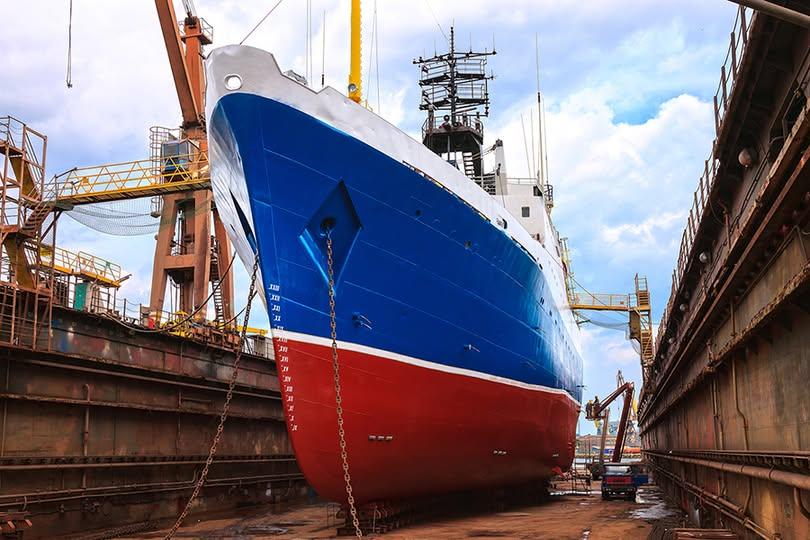
fot. Politechnika Gdańska
The system aims to support ship inspectors in evaluating the degree of hull corrosion by enabling broader, more accurate surface diagnostics with fewer measurements. Currently, thickness measurements of ship plating are taken manually and locally—sometimes hundreds of thousands of times per vessel—offering only a rough estimate of actual corrosion spread. During this time, vessels remain docked, generating operational downtime.
- Our method uses ultrasonic waves that behave much like ripples created by a stone dropped in water, explains Prof. Beata Zima. - In an undamaged plate, waves propagate symmetrically. When corrosion is present, this wavefront becomes disturbed, allowing us to map the state of the structure over a larger area from a single signal.
The technique builds on prior basic research funded by the National Science Centre. The team demonstrated that ultrasonic wave behavior changes significantly in plates with uneven thickness or corroded layers. Their approach allows statistical mapping of material degradation, offering a broader yet reliable overview of the condition of hull structures.
While the system currently focuses on steel hull structures, its application may extend to composite materials used in yacht construction, where ultrasonic diagnostics could detect other types of damage.
The interdisciplinary team includes researchers from Gdańsk University of Technology’s faculties of Mechanical Engineering and Ship Technology and Electronics, Telecommunications and Informatics, as well as scientists from the Institute of Fluid-Flow Machinery of the Polish Academy of Sciences.
The LIDER program supports young researchers (up to 7 years after earning a PhD) in leading their own R&D projects with strong implementation potential. The ultrasonic system, once prototyped and validated, may become a practical tool for improving ship maintenance efficiency and reducing inspection downtime in the maritime sector.
see also
Buy us a coffee, and we’ll invest in great maritime journalism! Support Gazeta Morska and help us sail forward – click here!
Kamil Kusier
redaktor naczelny
gallery

comments
Add the first comment
see also
MON, Arka Gdynia and AMW sign letter of intent supporting "Green Industrial District - Kashubia" project
Naval Academy cadets take military oath in Gdynia
Advanced ROV trials conducted at CTO to validate subsea technologies for offshore applications
University of Gdańsk and PGZ Naval Shipyard join forces for innovation and security
Naval Academy in Gdynia and Ecole Navale join forces. A new phase of international military cooperation
Shipbuilding industry is awesome. Stability. When shifting mass takes control away
Polish Naval Academy and Institute of Fluid-Flow Machinery establish research partnership
PIRANIA underwater inspection vehicle: Gdańsk University of Technology and Radmor join forces
Gdynia honors top athletes of 2025 and century-old sports legends
Polish Naval Academy students advance unmanned maritime systems
ADVERTISEMENT
ADVERTISEMENT