









Polish student-built rescue USV passes first open-water trials
URWIS, an unmanned surface vessel developed by students of Gdańsk University of Technology (Politechnika Gdańska) to support water rescue teams, has completed its first trials on open water. The tests took place on 17 July on Lake Kałębie in Osiek, northern Poland.
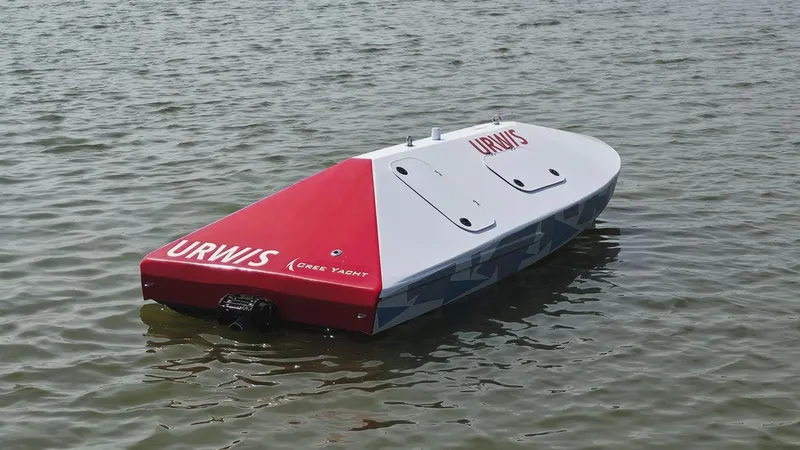
In brief
The URWIS unmanned surface vessel, built by students of Gdańsk University of Technology, underwent its first open-water tests on 17 July on Lake Kałębie in Osiek. The trials checked hull watertightness, propulsion operation, manoeuvrability and remote control via the GSM network. The creators of URWIS, Maksym Domkowski, Julian Baron and Łukasz Gede-Niewiadomski, plan a more powerful drive, a camera, an autonomous system and a towed life raft. The project is being developed under the Uczelnie Przyszłości programme of the National Centre for Research and Development, in which teams can receive up to 20 thousand zlotys.
From the model basin to the lake
The trials marked the first time the craft operated outside laboratory conditions. Until now, the team had verified hull watertightness, draught and stability in the university's model basin. On open water, the students tested the integrity of the structure, propulsion performance, manoeuvrability and the remote control system. The vessel ran across the lake, executed turns and responded to operator commands.
- We can consider the first trials a success. The vessel sails and turns, and today's runs gave us plenty of conclusions for the next round of changes, said Maksym Domkowski, one of the creators of URWIS.
The tests also highlighted areas for further development. The team plans to fit a more powerful propulsion unit and install a camera to help the operator monitor the route and steer the craft with greater precision.
GSM control today, autonomy tomorrow
URWIS is currently controlled over a GSM network through a dedicated application written by the students. The target concept goes considerably further: the vessel is to reach a designated point autonomously, avoiding obstacles along the way, before handing over control to a lifeguard in the final phase of a rescue. The team also intends to equip the craft with a towed rescue raft that a person in the water can climb onto while awaiting assistance.
The approach reflects a wider trend in water rescue, where unmanned surface vessels are used to cut the time needed to reach a casualty and to reduce risk to rescuers, who enter the water only when necessary.
A student project with national funding
The project is being developed by Maksym Domkowski, Julian Baron and Łukasz Gede-Niewiadomski, students of the Faculty of Mechanical Engineering and Ship Technology at Gdańsk University of Technology. Work on URWIS has been under way for more than six months.
The vessel is being built under the Universities of the Future (Uczelnie Przyszłości) programme, led by Poland's National Centre for Research and Development (NCBR) and financed by the European Funds for Social Development programme, with coordination provided by the university's Young Scientists Office. The scheme allows students to pursue their own concepts with mentor support, specialist micro-courses and individually tailored study arrangements. Teams can receive up to PLN 20,000 (around EUR 4,700) towards their projects.
In the coming months, the URWIS team will focus on an autonomous control system, replacement of selected components and further trials on the water.
Source: Gazeta Morska · Compiled by: Michał Iwański
Related articles
 Safety and rescue Polish SAR’s new rescue vessel Mistral launched at Kewatec in Finland
 Safety and rescue Icelandic Coast Guard and police delegation visits Polish Border Guard’s Maritime Division
 Safety and rescue Polish Navy helicopter evacuates man from Baltic platform 100 km off Władysławowo
 Navy and defence SNMG2 joins Allied warships in PASSEX as Italy's Mare Aperto 2026 gets under way
 Safety and rescue From lightships to solar power: 160 years of the Grundkallen light station
 Education 254 people, manikins and life rafts: Maritime University of Szczecin joins national CPR record attempt
Comments (0)
The discussion is moderated by the editors: a comment appears after review. Your e-mail address is not published.
Nobody has commented on this article yet.