









Polish Senate Calls for Reform of National Water Rescue System
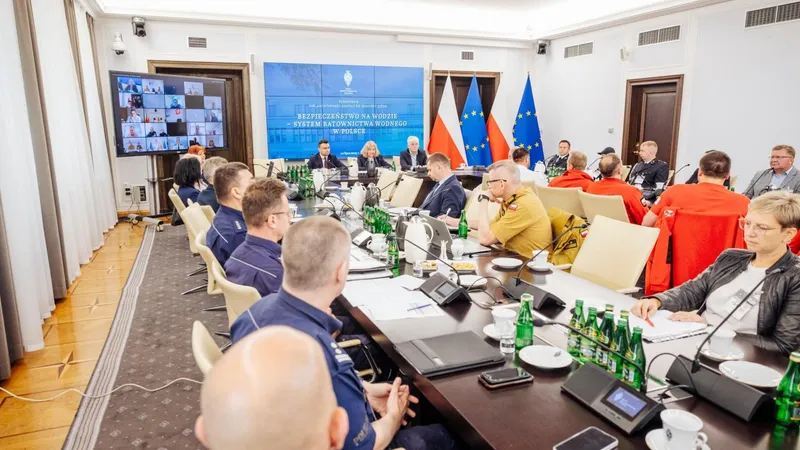
On July 10, 2025, the Polish Senate hosted a pivotal meeting of the Parliamentary Team for the Protection of Lakes, focusing on the growing challenges of water safety and rescue operations in Poland. The session, titled “Safety on the Water – The Water Rescue System in Poland”, brought together lawmakers, rescue services, law enforcement, and government officials to assess the effectiveness of the current system and identify areas requiring urgent reform.
In brief
The Parliamentary Group for the Protection of Lakes met on 10 July 2025 in the Senate of the Republic of Poland to discuss reform of the water rescue system, finding the 2011 act on the safety of persons in water areas out of step with reality. Inspector Piotr Lubaszko of the Police reported that around 450 people drown in Poland every year, and that water safety is guarded by around 200 police officers in permanent posts and six water rescue centres. Senator Jolanta Piotrowska recalled the drowning of three teenagers in Warmia and Masuria. Participants called for a working group involving parliamentarians and the Ministry of the Interior.
Senator Jolanta Piotrowska, chair of the parliamentary team, opened the discussion by stressing the gravity of the issue: - Every year, hundreds of people drown in Poland. This summer began with a tragic incident involving the deaths of three teenagers in the Warmian-Masurian region. The senator emphasized the need for both systemic evaluation and actionable legislative change, particularly in light of outdated regulations and inadequate funding.
A Three-Pillar Rescue System
Poland’s water rescue framework is built on three pillars:
- Dedicated professional services, including the Volunteer Water Rescue Service (WOPR), Police, and State Fire Service.
- Volunteer-based organizations supported by the government.
- Local governments responsible for ensuring safety in recreational water areas.
However, panelists pointed out that financial instability, lack of staffing continuity, and legislative gaps are eroding the effectiveness of this system. Some municipalities reportedly fail to meet their obligations regarding water safety, while rescue organizations struggle to maintain readiness year-round on limited, often seasonal budgets.
Voices from the Field: Equipment Gaps, Staffing Shortages, Prevention Needs
Member of Parliament Maciej Wróbel underlined the need for a multi-dimensional approach to water safety, focusing on modern equipment, permanent, well-trained rescue teams, and a stable funding model, potentially modeled on the Tatra Mountain Rescue Service (TOPR), which enjoys consistent governmental support.
According to Chief Inspector Piotr Lubaszko of the National Police, there are currently six water rescue centers operating nationwide. Around 200 full-time officers are involved in water safety, supplemented by seasonal units. Training programs, including those at the Police Training Centre in Legionowo, help prepare both permanent and seasonal personnel. Lubaszko stressed the importance of public education and prevention, although he acknowledged these are long-term efforts with slow but vital results.
- Roughly 450 people drown in Poland each year, most commonly in lakes, rivers, and unsupervised swimming areas, said Chief Inspector Piotr Lubaszko. - Lack of life jackets, risky behavior, and alcohol are the leading factors.
Time for Legislative Action
Representatives from regional rescue units such as the Masurian Volunteer Rescue Service described how experienced rescuers are leaving the profession due to poor pay and lack of stable contracts. Despite their high level of professionalism and dedication, underfunding threatens the sustainability of these critical services.
The meeting concluded with a consensus that Poland’s 2011 Water Safety Act is outdated and no longer fit for purpose. Participants called for the creation of a special task force, involving lawmakers and the Ministry of the Interior, to develop modernized legislation and a new funding strategy. The proposed working group would also be tasked with conducting a comprehensive risk assessment of Poland’s water bodies and devising strategies for year-round operational readiness.
Additionally, panelists underscored the need for nationwide water safety campaigns and swimming education programs for children.
The Senate session underscored that Poland’s water rescue infrastructure, while robust in parts, faces serious challenges—chief among them being fragmented funding and seasonal instability. For a country with extensive inland waterways, lakes, and coastal zones, comprehensive reform is not optional—it is essential.
If Poland is to curb the number of drownings and build public trust in its rescue services, legislative modernization, structural coherence, and financial commitment must follow swiftly.
Source: Gazeta Morska · Compiled by: Kamil Kusier
Related articles
 Safety and rescue Polish SAR’s new rescue vessel Mistral launched at Kewatec in Finland
 Safety and rescue Icelandic Coast Guard and police delegation visits Polish Border Guard’s Maritime Division
 Safety and rescue Polish Navy helicopter evacuates man from Baltic platform 100 km off Władysławowo
 Navy and defence SNMG2 joins Allied warships in PASSEX as Italy's Mare Aperto 2026 gets under way
 Safety and rescue From lightships to solar power: 160 years of the Grundkallen light station
 Education 254 people, manikins and life rafts: Maritime University of Szczecin joins national CPR record attempt
Comments (0)
The discussion is moderated by the editors: a comment appears after review. Your e-mail address is not published.
Nobody has commented on this article yet.