









Pirania completes first operational mission: Polish underwater drone validates capability in real-world condition
The first operational mission of the Pirania underwater drone represents a significant step forward in Poland’s capabilities for subsea monitoring and critical infrastructure protection. Developed by Gdańsk University of Technology in cooperation with RADMOR S.A., part of WB Group, the system has rapidly progressed from concept to field-validated solution within just five months.
In brief
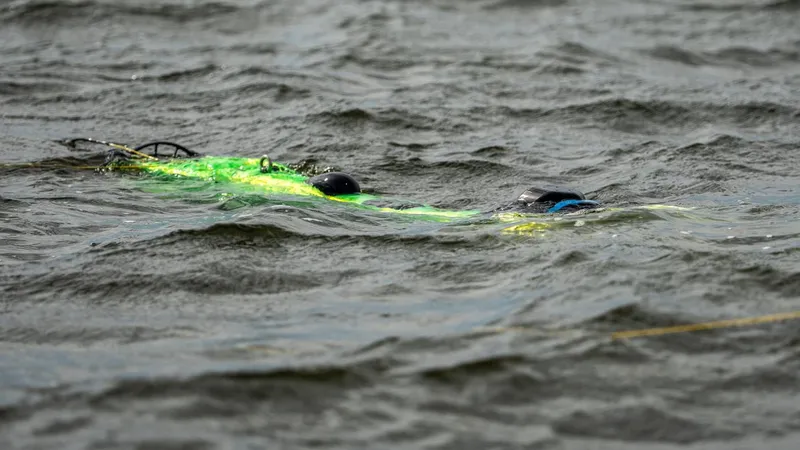
The Pirania underwater drone, developed by Gdańsk University of Technology together with Radmor of the WB Group, completed its first operational mission on 14 April in Sobieszewo. Pirania performed a full operational profile: launch, submersion, and the detection, imaging and identification of two objects, before returning safely to its starting point. The tests confirmed the operation of the communications, navigation and manoeuvring systems as well as the optical and sonar sensors. Pirania is a dual-use design and will be developed as a modular platform.
Operational validation in realistic conditions
The trial, conducted on 14 April in Sobieszewo, marked the first public demonstration of the system in a scenario closely reflecting real-world inspection operations. The vehicle successfully executed a full mission profile, including pre-dive system checks, launch from a slipway, controlled submersion, and subsea reconnaissance.
During the mission, the drone located, imaged, and identified two designated objects using onboard optical and sonar systems before safely returning to its launch point. The operation confirmed the functionality of key subsystems, including communication, navigation, maneuvering, and sensor integration.
Designed for critical subsea operations
Pirania is being developed as a remotely operated or semi-autonomous underwater vehicle dedicated to inspection and monitoring tasks. Its primary applications include surveillance of subsea infrastructure, seabed anomaly detection, and security operations in sensitive maritime areas.
Equipped with low-light cameras and advanced sonar solutions, the platform is capable of operating effectively in challenging underwater environments, including low visibility and complex seabed conditions typical of the Baltic Sea.
As noted by Prof. Krzysztof Wilde, Rector of Gdańsk University of Technology:
- Pirania’s successful first mission confirms our ability to translate academic expertise into practical solutions addressing current challenges. It is an important achievement for the university and a strong example of effective cooperation between science and industry.
Addressing evolving security requirements
The development of Pirania reflects increasing demand for maritime surveillance and protection of critical infrastructure, particularly in the context of rising hybrid threats and recent incidents affecting subsea assets across Europe.
Potential deployment scenarios include ports, offshore installations, anchorage areas, and strategic infrastructure located on the seabed of the Baltic. The system is designed as a dual-use platform, with applications spanning both civilian and security sectors, including potential cooperation with the Polish Navy.
Tomasz Sauer, Head of the Underwater Technology Laboratory, emphasized the practical significance of the trial:
- The key achievement for the team was completing the entire mission scenario and validating the vehicle’s core functionalities in real conditions. This was not a simulation, but a fully executed operational task.
Building on decades of expertise
The Pirania project builds on decades of subsea engineering experience at Gdańsk University of Technology, dating back to the 1980s. Notably, it leverages expertise gained from the development of the Głuptak system, long supplied to the Polish Navy.
This legacy has now been adapted and expanded toward inspection and monitoring applications aligned with current market needs. A key role in bridging research and commercialization has been played by the university’s PG Biznes Hub, facilitating cooperation between academia and industry.
According to Paweł Lulewicz, CEO of PG Biznes Hub:
- Pirania is an excellent example of how modern technology transfer should work. Strong academic competence, clearly defined market demand, and effective partnership enable rapid transition from concept to real-world validation.
Modular platform with market potential
Looking ahead, Pirania is being developed as a modular platform tailored to specific user requirements. The final configuration may include a range of sonar and imaging systems, as well as additional operational components such as manipulators and specialized sensors.
Bartłomiej Zając, CEO of RADMOR S.A., underlined the strategic importance of the project:
- We are developing solutions that enhance the security of Poland, its maritime borders, and the Baltic Sea. By leveraging advanced technologies, we can more effectively detect and identify threats hidden beneath the water surface.
Outlook for the maritime sector
The successful trial of Pirania highlights the growing potential of Poland’s maritime technology sector, particularly in the field of unmanned and autonomous systems. As offshore infrastructure expands and security concerns intensify, demand for such solutions is expected to increase significantly.
Pirania has the potential to become a key component of future maritime monitoring systems, both domestically and across the European market, supporting not only security operations but also environmental monitoring and infrastructure maintenance.
Source: Gazeta Morska · Compiled by: Kamil Kusier
Related articles
 Safety and rescue Polish SAR’s new rescue vessel Mistral launched at Kewatec in Finland
 Safety and rescue Icelandic Coast Guard and police delegation visits Polish Border Guard’s Maritime Division
 Safety and rescue Polish Navy helicopter evacuates man from Baltic platform 100 km off Władysławowo
 Navy and defence SNMG2 joins Allied warships in PASSEX as Italy's Mare Aperto 2026 gets under way
 Safety and rescue From lightships to solar power: 160 years of the Grundkallen light station
 Education 254 people, manikins and life rafts: Maritime University of Szczecin joins national CPR record attempt
Comments (0)
The discussion is moderated by the editors: a comment appears after review. Your e-mail address is not published.
Nobody has commented on this article yet.