









Patriotism-driven economy as a hope for unmanned systems. Drones, industry and security at the center of the forum
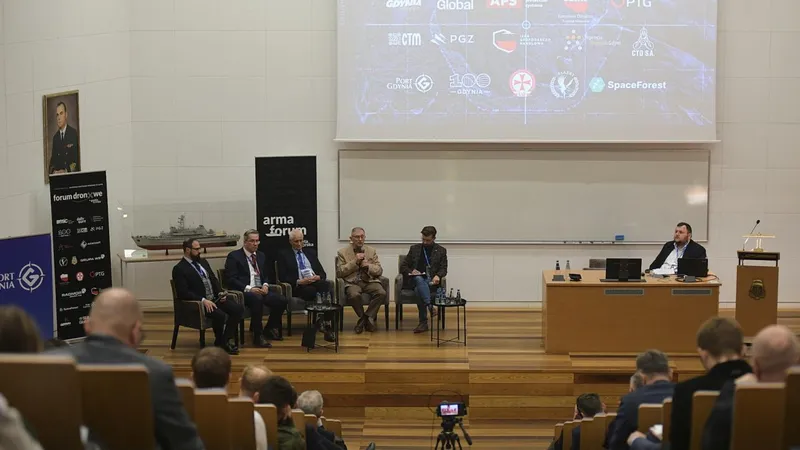
The AMW UAV Forum, held at the Polish Naval Academy in Gdynia, brought together representatives of the Armed Forces of the Republic of Poland, the defence industry, academia, and public institutions. The event has become one of the key points in this year’s debate on the future of unmanned systems in Poland and Europe.
In brief
The AMW UAV Forum at the Polish Naval Academy in Gdynia gathered representatives of the Armed Forces of the Republic of Poland, the defence industry, academia and public institutions to debate the future of unmanned systems. Panels shifted the focus from standalone platforms to integrated multi-domain ecosystems, system-of-systems architectures, sensor fusion, artificial intelligence and counter-UAS protection of critical infrastructure. Participants stressed production scalability, standardisation and supply chain resilience as pillars of technological sovereignty. The ARMA Forum initiative was presented as a permanent cooperation platform.
Multi-domain transformation of unmanned systems
The forum confirmed that the unmanned systems sector is undergoing a profound transformation—from standalone platforms towards integrated, multi-domain ecosystems operating across air, land, and maritime environments. Discussions increasingly focused not only on technology itself, but on the broader architecture of its deployment in the context of modern conflicts and accelerating operational demands.
System integration and operational networking
A recurring theme throughout the debates was the growing importance of system integration, where unmanned platforms act as nodes within a wider network linking reconnaissance, strike capabilities, and data processing. The experience of ongoing armed conflicts continues to significantly shorten innovation cycles, where rapid adaptation and iterative development are becoming as critical as technological sophistication itself.
Industrial capacity and production scalability
Considerable attention was given to industrial capacity and production scalability. Participants highlighted the shift from prototype-driven development to serial production, the importance of standardisation, and the structural constraints posed by supply chain dependencies and access to critical components. In this context, resilience and localisation of production were repeatedly identified as key factors shaping technological sovereignty.
Patriotism-driven industrial strategy
Against this backdrop, the concept of a patriotism-driven economy gained prominence—understood as a strategic approach to strengthening national capabilities in design, production, and integration within the unmanned systems domain. The development of domestic UAV, UGV, and USV ecosystems was increasingly framed as a cornerstone of technological sovereignty and operational resilience.
System-of-systems and multi-domain integration
Another major discussion point was multi-domain integration and the evolving “system-of-systems” approach, enabling coordinated operations across air, land, and maritime domains through shared command architectures and real-time data exchange. Interoperability, sensor fusion, and decision automation were identified as critical enablers of future operational effectiveness.
Artificial intelligence and autonomy
The forum also addressed the growing role of artificial intelligence and autonomy in unmanned systems, particularly in reconnaissance, data analysis, and decision support. At the same time, participants stressed the need to maintain a balance between automation and human oversight in operational decision-making processes.
Counter-UAS and critical infrastructure protection
Significant focus was placed on emerging threats linked to the rapid proliferation of unmanned platforms. Discussions covered the evolution of counter-UAS systems, challenges in detecting low-signature and low-altitude targets, and the need for layered protection architectures for critical infrastructure in both military and civilian domains.
The event concluded with a call for deeper integration of the unmanned systems community and the establishment of durable cooperation mechanisms between the military, industry, and academia. In this context, the ARMA Forum initiative was presented as a future platform for continuous exchange of expertise, strategic recommendations, and cross-sector collaboration in the unmanned domain.
A full post-event report covering all panels of the AMW UAV Forum will be published soon in both written and video formats, providing detailed insights, key expert conclusions, and a structured overview of the most important trends shaping the future of the unmanned systems sector.
Source: Gazeta Morska · Compiled by: Kamil Kusier
Related articles
 Safety and rescue Polish SAR’s new rescue vessel Mistral launched at Kewatec in Finland
 Safety and rescue Icelandic Coast Guard and police delegation visits Polish Border Guard’s Maritime Division
 Safety and rescue Polish Navy helicopter evacuates man from Baltic platform 100 km off Władysławowo
 Navy and defence SNMG2 joins Allied warships in PASSEX as Italy's Mare Aperto 2026 gets under way
 Safety and rescue From lightships to solar power: 160 years of the Grundkallen light station
 Education 254 people, manikins and life rafts: Maritime University of Szczecin joins national CPR record attempt
Comments (0)
The discussion is moderated by the editors: a comment appears after review. Your e-mail address is not published.
Nobody has commented on this article yet.