









Operation number 429. Polish SAR has already passed its whole 2025 total, with three months of the year still to go
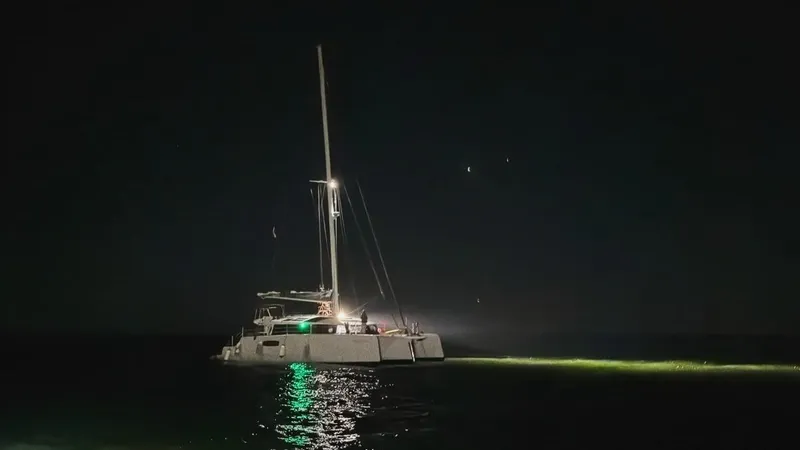
Towing a yacht with a failed engine, a task that on 27 September sent the rescue boat R102 from the Łeba station and the rescue vessel Monsun to sea, was the 429th operation of Poland's Maritime Search and Rescue Service this year. With that call-out the service exceeded its total number of operations for the whole of 2025. Three months of the year remain, and the autumn storms are still ahead. The service's director, Sebastian Kluska, has asked openly whether the all-time record of more than 444 operations in a single year will fall, adding that everything points that way.
In brief
The Maritime Search and Rescue Service carried out its four hundred and twenty-ninth operation of the year on 27 September, exceeding the number of operations in the whole of 2025. The operation was the towing of a yacht with a damaged engine by the R102 boat from the Łeba station and the rescue ship Monsun. Maritime Search and Rescue Service director Sebastian Kluska said everything points to an all-time record of more than 444 operations in a single year.
An ordinary operation, an extraordinary number
The intervention itself was among the most common in the service's statistics. A yacht with a disabled engine, unable to return to port on its own, needed a tow. Two units were assigned: the fast rescue boat R102 and the vessel Monsun, which earlier this season ran a multi-day operation on a yacht aground near Ulinia.
It is events like these, rather than spectacular disasters, that make up the annual tally. Propulsion failures, groundings, craft blown offshore, missing kayakers and board users, medical calls from ships. Each means putting to sea, often in conditions in which nobody else does.
Why the numbers keep rising
The growth in operations has several overlapping causes. The sailing and motorboating season is getting longer, and more leisure craft are on the Baltic, many in the hands of people with limited experience. Traffic linked to the construction of offshore wind farms and the servicing of infrastructure is increasing. More people take up water sports close to shore, where an offshore wind can carry them out within minutes.
Reporting has changed too. A mobile phone in every pocket means incidents are known about sooner and more often, and the threshold at which someone calls for help is lower than a decade ago.
The result is that a service with a fixed headcount and a set number of units handles more calls every year.
Łeba at full stretch
The Łeba station is among the busiest on the coast this season. In August its crews and Monsun ran a multi-day operation on a motor yacht aground, refloated with the help of the rescue vessel Orkan from Ustka and excavator operators. Days before operation 429 the station hosted rescuers from France, Finland, Estonia, Iceland and Norway under an IMRF exchange and trained with them in searching for people in the water.
The same Monsun that towed a yacht on 27 September is now in the area where the Maritime Office in Słupsk is dealing with beaches polluted by a petroleum substance. Combating pollution at sea is among the service's tasks, so its units may be needed for two entirely different jobs at once.
New vessels on the way
The record pace comes as the service renews its fleet. In 2025 it signed a contract with the Finnish yard Kewatec AluBoat for six new rescue units, and further vessels, Mistral and Powiew, are under construction in a project co-financed by the EU transport projects centre CUPT.
New equipment will shorten response times and widen the conditions in which rescuers can operate. It will not change one thing: the number of operations is rising faster than the number of people who carry them out. If the record falls, it will be down to the same crews who worked the previous one.
Source: Gazeta Morska · Compiled by: Kamil Kusier
Related articles
 Safety and rescue Polish SAR’s new rescue vessel Mistral launched at Kewatec in Finland
 Safety and rescue Icelandic Coast Guard and police delegation visits Polish Border Guard’s Maritime Division
 Safety and rescue Polish Navy helicopter evacuates man from Baltic platform 100 km off Władysławowo
 Navy and defence SNMG2 joins Allied warships in PASSEX as Italy's Mare Aperto 2026 gets under way
 Safety and rescue From lightships to solar power: 160 years of the Grundkallen light station
 Education 254 people, manikins and life rafts: Maritime University of Szczecin joins national CPR record attempt
Comments (0)
The discussion is moderated by the editors: a comment appears after review. Your e-mail address is not published.
Nobody has commented on this article yet.