









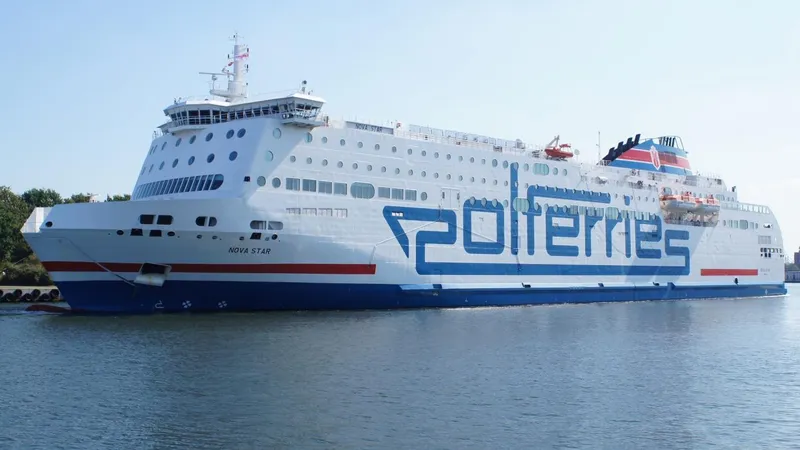
Nova Star diverted back to Gdańsk after fuel system failure
The Nova Star ro-pax ferry operating on the Gdańsk–Nynäshamn route for Polferries was forced to abandon its Saturday sailing after a malfunction occurred in one of its four main engines. The incident took place roughly two hours into the voyage, off the Hel Peninsula. According to the operator, a failure in a high-pressure component of the fuel supply system prompted the decision to return to Gdańsk for inspection and repairs.
In brief
The Polferries ferry Nova Star interrupted its voyage from Gdańsk to Nynäshamn in Sweden after about two hours of sailing, off the Hel Peninsula, following a failure of one of its four main engines. A component of the high-pressure fuel supply system was damaged, and 115 passengers were on board the Nova Star. Two tugs were dispatched to the ferry and assisted the vessel in the Gulf of Gdańsk area all the way to the quay. Polferries offered passengers a change of travel date or a ticket refund and announced a full overhaul of the injection system.
A total of 115 passengers were on board. Although the vessel retained manoeuvrability, the master requested tug assistance as a precaution – a standard measure when propulsion redundancy is partially reduced. Upon return to port, Polferries offered passengers rebooking options or full refunds, while those staying aboard were provided with accommodation and meals during the delay.
Nature of the failure
Initial assessments indicate a malfunction in a high-pressure fuel system component of one main engine. Failures of this type require detailed diagnostics due to the precision tolerances of injection systems and the risk of secondary damage if operation continues under abnormal conditions. Returning to Gdańsk ensured access to appropriate technical support and spare parts.
Tug assistance and port operation
The swift response of the Port of Gdańsk played a key role in the safe return of the vessel. Two harbour tugs were deployed to meet Nova Star in the approaches and escort the ferry to its berth. Even though the vessel remained manoeuvrable, tug support significantly increased the safety margin during the approach and final turning phases. Coordination between the bridge team, tug crews and the Harbour Master’s Office enabled a stable, controlled and incident-free berthing.
Next steps for the operator
Polferries has initiated a full inspection of the affected engine’s fuel system and complementary checks on the remaining propulsion units. The ferry will resume regular operations once the necessary repairs are completed and full operational readiness is confirmed.
Source: Gazeta Morska · Compiled by: Oskar Wojciechowski
Related articles
 Safety and rescue Polish SAR’s new rescue vessel Mistral launched at Kewatec in Finland
 Safety and rescue Icelandic Coast Guard and police delegation visits Polish Border Guard’s Maritime Division
 Safety and rescue Polish Navy helicopter evacuates man from Baltic platform 100 km off Władysławowo
 Navy and defence SNMG2 joins Allied warships in PASSEX as Italy's Mare Aperto 2026 gets under way
 Safety and rescue From lightships to solar power: 160 years of the Grundkallen light station
 Education 254 people, manikins and life rafts: Maritime University of Szczecin joins national CPR record attempt
Comments (0)
The discussion is moderated by the editors: a comment appears after review. Your e-mail address is not published.
Nobody has commented on this article yet.