









Norwegian frigate and Svalbard governor's vessel drill emergency towing in the Arctic
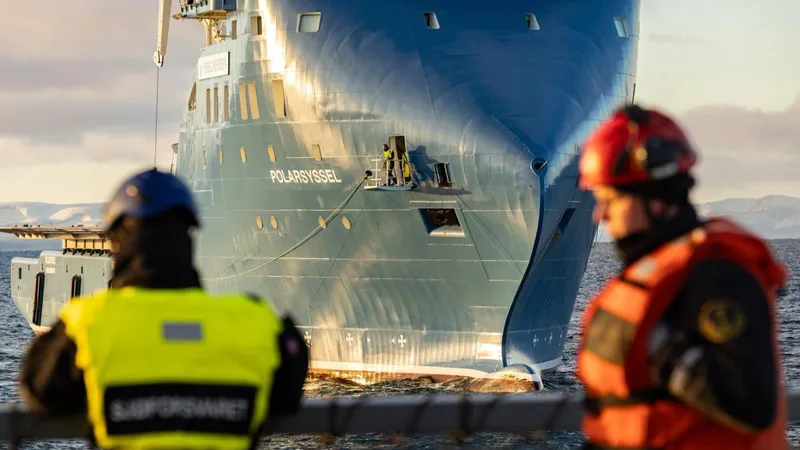
The Royal Norwegian Navy frigate KNM Fridtjof Nansen and MS Polarsyssel, the chartered service vessel of the Governor of Svalbard, have trained in mutual towing in the waters around the archipelago. The drill addresses a scenario every operator in the high north plans for: a ship losing propulsion in Arctic conditions, with the nearest tug hundreds of miles away. The Norwegian Navy placed the exercise firmly within total defence, stressing that the defence of Norway extends well beyond the armed forces.
In brief
Mutual towing was practised in the waters around Svalbard by the Norwegian frigate KNM Fridtjof Nansen and MS Polarsyssel, the service vessel of the Governor of Svalbard. The drill was meant to strengthen civil-military cooperation in case of propulsion loss in the Arctic, where the nearest support is hundreds of miles away. The Svalbard Treaty of 1920 bans naval bases on the archipelago, so the Norwegian navy sends a larger warship there once a year. Sjøforsvaret said both vessels together strengthen Norway's total defence in the Arctic.
An Aegis frigate and a multi-role state vessel
Fridtjof Nansen is the lead ship of five Aegis-equipped frigates built for Norway by Navantia in Ferrol, Spain, optimised for anti-submarine warfare and air defence. Four remain in service after KNM Helge Ingstad sank following a collision with a tanker in 2018. Under a long-standing decision of the Norwegian parliament, the navy has sent one major warship to Svalbard every year since the 1970s.
Polarsyssel is chartered by the Governor of Svalbard (Sysselmesteren), who serves as chief of police, rescue authority and environmental authority on the archipelago. The ice-class vessel carries a helideck and a towing winch and is tasked with search and rescue, inspections and oil spill preparedness. A new five-year charter for the Governor began in January 2026. Alongside Norwegian Coast Guard units, it is one of very few state vessels in an area where support is measured in hundreds of nautical miles.
During the joint training, the two ships practised towing each other. The Norwegian Navy described towing as a key skill when a vessel gets into difficulty in demanding Arctic waters, with the aim of strengthening civil-military cooperation and preparing both crews for the unexpected.
- Together they strengthen total defence and Norway's ability to ensure security in the Arctic - the Royal Norwegian Navy said.
Presence without a garrison
The 1920 Svalbard Treaty grants Norway sovereignty over the archipelago but bars naval bases, fortifications and any use for warlike purposes. Poland is among the parties to the treaty and has operated the Polish Polar Station Hornsund since 1957. Norwegian state presence therefore rests on the Governor, the Coast Guard and civilian services, with the navy rotating through to train alongside them, since in a crisis they will be first on scene.
Russia has long disputed Norway's interpretation of the treaty, and Russian activity around the archipelago is increasing. Oslo's response is competence rather than a show of force, which the treaty would not allow. A frigate that can work seamlessly with the governor's vessel signals state presence without a garrison.
What Baltic operators can take from it
Norway's totalforsvaret, like Sweden's totalförsvar, links the armed forces, civil agencies, ports, shipping companies and residents into one system built on procedures and regular drills. Poland has set out a comparable framework in its civil protection and civil defence act, in force since 2025. At sea, the Polish Navy, the maritime offices, the Maritime Search and Rescue Service, the Border Guard's Maritime Division, ports and shipowners each run their own procedures, with joint scenarios mostly embedded in large international exercises.
Recent Baltic incidents show where routine joint drills pay off: damaged subsea cables, uninsured shadow fleet tankers close to the coast, heavy fuel oil on beaches and wartime ordnance recovered during marine construction works. Each required military and civilian responders to work together. For shipowners and P&I clubs, the practical issue is emergency towing capacity and how quickly a state asset can establish a tow on a disabled ship. Poland's Miecznik frigate programme, whose first ship ORP Wicher was launched in August, and new SAR units give the opportunity to build such routines from day one.
Source: Gazeta Morska · Compiled by: Kamil Kusier
Related articles
 Safety and rescue Polish SAR’s new rescue vessel Mistral launched at Kewatec in Finland
 Safety and rescue Icelandic Coast Guard and police delegation visits Polish Border Guard’s Maritime Division
 Safety and rescue Polish Navy helicopter evacuates man from Baltic platform 100 km off Władysławowo
 Navy and defence SNMG2 joins Allied warships in PASSEX as Italy's Mare Aperto 2026 gets under way
 Safety and rescue From lightships to solar power: 160 years of the Grundkallen light station
 Education 254 people, manikins and life rafts: Maritime University of Szczecin joins national CPR record attempt
Comments (0)
The discussion is moderated by the editors: a comment appears after review. Your e-mail address is not published.
Nobody has commented on this article yet.