









Night helicopter callout to the ferry Ambition
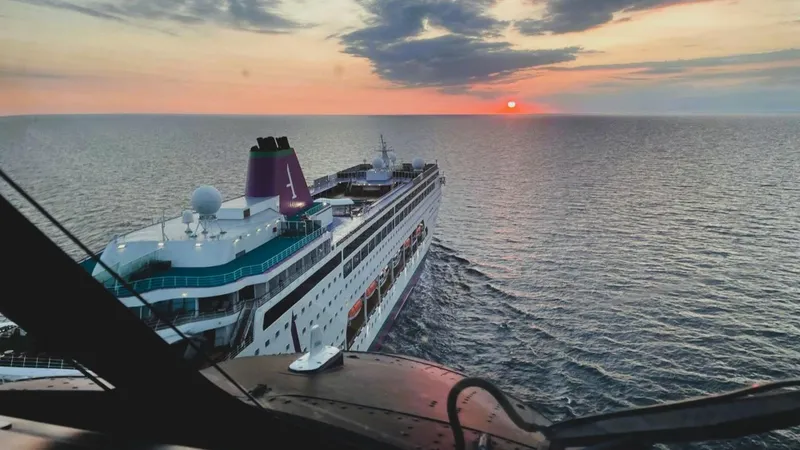
A W-3 WARM crew from the Polish Naval Aviation Brigade was scrambled overnight to the ferry Ambition, where a woman on board required medical help. After an assessment by a rescue swimmer lowered onto the deck, the crew determined that air transport was not possible.
In brief
A W-3 WARM helicopter of the Naval Aviation Brigade took off at 2:36 to the ferry Ambition, where a woman needed help. At 3:00 the helicopter lowered a rescuer onto the deck of the ferry Ambition, but air transport was deemed impossible due to the patient's weight, estimated by the doctor at around 200 kilograms, and dimensions that prevented placing her in a stretcher. Combat readiness was restored at 3:50. Since the start of 2026 naval aviators have carried out 16 medical missions over the Baltic, and the brigade's total number of rescue missions stands at 842.
The crew reached readiness state one and lifted off at 02:36. During the transit they maintained continuous communication with RESCUE GDYNIA, POLRATOK and air traffic services.
At 03:00 the helicopter reached the vessel's position and lowered a rescue swimmer onto the ferry's deck. According to the brigade, the decision that an airlift could not be carried out was determined by the specific medical circumstances: the patient's mass, put by a doctor at around 200 kilograms, and dimensions that prevented her being secured safely in the stretcher.
At 03:50 the crew had restored operational readiness.
Why the patient could not be lifted
The limiting factor in cases like this is not the hoist's capacity but whether the casualty can be immobilised. Stretchers used in helicopter rescue have fixed dimensions and harnesses designed around a given body circumference. During a hoist the load rotates, swings and takes the rotor downwash, so a patient who cannot be strapped in would face greater danger than by remaining on the ship.
Cabin space also matters. The W-3 WARM is a medium helicopter in which the stretcher must be locked down while the swimmer and medical personnel need access to the patient throughout the flight.
In maritime rescue, a mission that ends without an evacuation is not treated as a failure. A rescue swimmer is put on the deck precisely so that the assessment is made on scene rather than from the cabin.
What happens in such cases
Where an airlift is not possible, the vessel can be directed to the nearest port with an ambulance crew waiting on the quay. A rescue vessel can also come alongside and take the patient off by sea. Until the ship berths, care rests with the vessel's personnel in radio contact with a doctor ashore, with the maritime rescue coordination centre, in this case RESCUE GDYNIA, coordinating throughout.
The brigade does not state how the patient's case concluded, or what route the ferry was on.
Statistics
Since the start of 2026, Polish naval aviators have flown 16 medical missions over the Baltic. The brigade's cumulative total stands at 842 rescue missions. Both figures are one higher than in the previous communiqué, meaning this sortie was counted as a medical mission despite ending without an evacuation.
Source: Gazeta Morska · Compiled by: Michał Iwański
Related articles
 Safety and rescue Polish SAR’s new rescue vessel Mistral launched at Kewatec in Finland
 Safety and rescue Icelandic Coast Guard and police delegation visits Polish Border Guard’s Maritime Division
 Safety and rescue Polish Navy helicopter evacuates man from Baltic platform 100 km off Władysławowo
 Navy and defence SNMG2 joins Allied warships in PASSEX as Italy's Mare Aperto 2026 gets under way
 Safety and rescue From lightships to solar power: 160 years of the Grundkallen light station
 Education 254 people, manikins and life rafts: Maritime University of Szczecin joins national CPR record attempt
Comments (0)
The discussion is moderated by the editors: a comment appears after review. Your e-mail address is not published.
Nobody has commented on this article yet.