









NCL Salten grounds again in Norway. Third incident raises structural safety questions
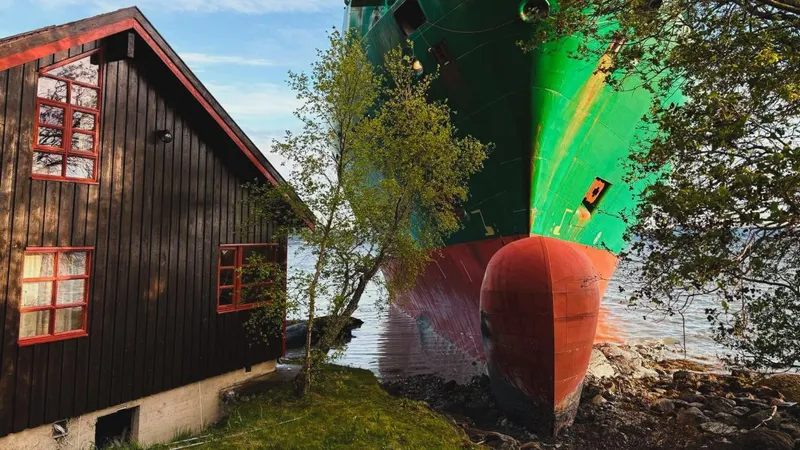
A few days ago, the container ship NCL Salten ran aground in Norway’s Trondheimsfjord, stopping just meters from a residential property near the village of Byneset, outside Trondheim. This marks the vessel’s third grounding in Norwegian waters in as many years, following previous incidents in Hadsel (2023) and Ålesund (2024).
In brief
The container ship NCL Salten ran aground in the Trondheimsfjorden fjord near Byneset outside Trondheim, a few metres from residential buildings. The direct cause was the second officer falling asleep during a solo watch, and the officer has been charged with neglecting navigational duties. None of the 16 crew members was injured and no fuel leaked, but the ship remains stuck after unsuccessful attempts to tow it off. NCL Salten, built in 2002, sails under the flag of Cyprus, is 135 metres long and has a capacity of 886 TEU.
Fatigue and procedural oversight
Norwegian maritime authorities reported that the second officer fell asleep during a solo night watch, which caused the vessel to veer off course and strike the shoreline. He has been charged with negligent navigation, and the vessel’s captain is under investigation, as per routine protocol. Officials are now reviewing compliance with rules on bridge manning levels and crew work/rest hours.
No injuries were reported among the 16 crew members—a multinational team including Norwegians, Lithuanians, Ukrainians, and Russians—and no fuel leakage occurred. However, the ship damaged a heat pump power line on private property and remains grounded. Initial salvage attempts using tugboats failed, and the Norwegian Coastal Administration is conducting geotechnical assessments ahead of a renewed operation to refloat the ship.
A ship with a track record
Built in 2002 and sailing under the flag of Cyprus, the NCL Salten is a 135-meter feeder container ship with a capacity of 886 TEU and 234 reefer plugs. The vessel is owned by Lithuanian firm Baltnautic and operated by North Sea Container Line (NCL). At the time of the incident, it was en route to the port of Orkanger.
Short-sea shipping under pressure
The grounding once again draws attention to systemic stress in the European short-sea shipping sector, particularly in high-risk areas like the Norwegian fjords. These routes require heightened vigilance due to navigational complexity and their proximity to residential zones.
The Salten case may trigger a broader industry discussion on bridge resource management, enforcement of rest hour regulations, and the digital monitoring of fatigue in feeder operations. It also underscores the importance of rigorous safety culture in a sector under growing operational and economic pressure.
Source: Gazeta Morska · Compiled by: Kamil Kusier
Related articles
 Safety and rescue Polish SAR’s new rescue vessel Mistral launched at Kewatec in Finland
 Safety and rescue Icelandic Coast Guard and police delegation visits Polish Border Guard’s Maritime Division
 Safety and rescue Polish Navy helicopter evacuates man from Baltic platform 100 km off Władysławowo
 Navy and defence SNMG2 joins Allied warships in PASSEX as Italy's Mare Aperto 2026 gets under way
 Safety and rescue From lightships to solar power: 160 years of the Grundkallen light station
 Education 254 people, manikins and life rafts: Maritime University of Szczecin joins national CPR record attempt
Comments (0)
The discussion is moderated by the editors: a comment appears after review. Your e-mail address is not published.
Nobody has commented on this article yet.