









Naval Group delivers the first defence and intervention frigate to the French Navy
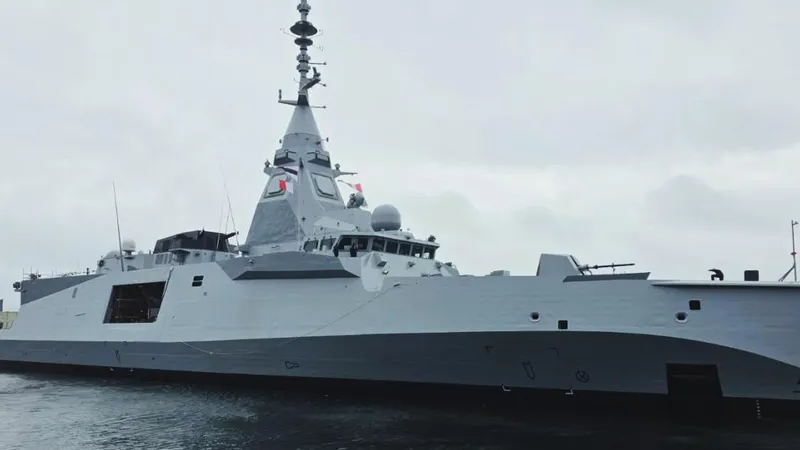
Naval Group has officially delivered the first Defence and Intervention Frigate (FDI), Amiral Ronarc’h, to Brest. Ordered by the French Defence Procurement Agency (DGA) on behalf of the French Navy, this is the first of five frigates under a major programme designed to strengthen the fleet’s operational capabilities and mark a new era in France’s naval renewal.
In brief
The frigate Amiral Ronarc'h has arrived at its base in Brest as the first of five FDI-type vessels being built by Naval Group. The order was placed by the French armament agency DGA on behalf of the Marine Nationale, and the ship has a displacement of 4,500 tons, a length of 122 m, a speed of 27 knots and a crew of 125 plus 28 passengers. The second frigate, HS Kimon for Greece, is undergoing sea trials and is to be delivered at the end of 2025, and the next vessel for the French navy will enter service in 2027.
- The delivery of Amiral Ronarc’h, the first ship in the FDI series, is a major milestone for Naval Group. This new generation of high-end, multi-mission frigates will soon enter operational service and significantly enhance the capabilities of our French Navy thanks to its outstanding performance, already proven during sea trials. We are fully committed to this strategic programme and proud to deliver it for the French fleet, said Pierre Éric Pommellet, Chairman and CEO of Naval Group.
FDI – a new-generation frigate ready for high-intensity naval operations
The FDI (Frégate de Défense et d’Intervention) represents the next generation of first-rank, multi-role combat ships, succeeding the FREMM-class. Designed to counter all modern threats — from air, surface and subsurface targets to asymmetric and cyber threats — it combines state-of-the-art digital, sensor and data-processing technologies.
This highly versatile vessel can operate autonomously or within a task force, offering adaptability to a wide range of maritime environments, including open oceans and complex archipelagic zones. During her 14 weeks of sea trials in the Atlantic, Amiral Ronarc’h demonstrated excellent seaworthiness, maintaining performance in sea state 6 conditions.
The ship’s advanced automation systems enable operation with a reduced crew while ensuring high availability and maintainability. The FDI’s operational capabilities are comparable to the French Navy’s FREMM frigates, which have achieved an 80% availability rate over the past decade. Built to NATO standards, the vessel ensures full interoperability with allied navies.
A modern industrial process – up to two frigates per year
Naval Group’s Lorient shipyard has implemented a modern and efficient production process, allowing for the construction of up to two FDI frigates annually.
Five frigates are currently under construction for both the French Navy and the Hellenic Navy, at various stages of completion. The second FDI, HS Kimon, built for Greece, is now undergoing sea trials and is scheduled for delivery at the end of 2025, followed by two additional Greek units in 2026. The next frigate for the French Navy will be delivered in 2027.
Each FDI represents approximately one million hours of production and one million hours of design and development, engaging around 1,200 Naval Group employees and 400 subcontractors.
FDI main specifications
- Displacement: 4,500 tonnes
- Length: 122 m
- Beam: 18 m
- Speed: 27 knots
- Endurance: 45 days
- Complement: 125 crew + 28 passengers
Source: Gazeta Morska · Compiled by: Kamil Kusier
Related articles
 Navy and defence ORP Gopło will not be preserved intact. Prototype laminate minesweeper passes to Poland's Military Property Agency
 Navy and defence HMS Prince of Wales takes on ammunition in Norway. First resupply outside the UK
 Navy and defence ORP Mewa marks four months with SNMCMG1. Poland's first Kormoran II deployment runs to year-end
 Shipbuilding industry Ex-Enterprise towed to Mobile under $418.5m contract. Test case for Nimitz-class disposal begins
 Navy and defence Norwegian submarine Utstein completes NATO patrol guarding offshore oil and undersea infrastructure
 History Polish Naval Museum in Gdynia opens its doors on Independence Day, 11 November
Comments (0)
The discussion is moderated by the editors: a comment appears after review. Your e-mail address is not published.
Nobody has commented on this article yet.