









Medical evacuation from Wind Osprey underway as winter keeps Polish SAR services under pressure
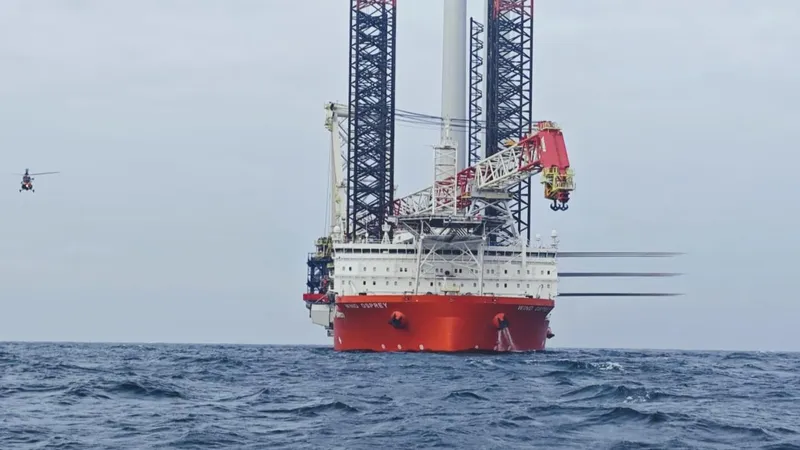
On Sunday at 07:50, the Maritime Rescue Coordination Centre (MRCC) received a distress call from the vessel Wind Osprey, requesting an urgent medical evacuation of a crew member with a suspected heart attack.
In brief
The Maritime Rescue Coordination Centre received a distress signal from the vessel Wind Osprey in the Baltic Sea at 7:50 on Sunday and launched a medical evacuation of a crew member with a suspected heart attack. The rescue vessel m/s Huragan from the Maritime Rescue Station in Łeba and a Polish Navy helicopter from Darłowo were dispatched to the operation. Sebastian Kluska, director of the Polish Maritime Search and Rescue Service, noted that winter has brought an increase in interventions, including false calls.
According to Sebastian Kluska, Director of the Polish Maritime Search and Rescue Service (MSPiR SAR), the decision to deploy rescue assets was taken immediately after the alert was received.
- Following an operational assessment, the duty officer dispatched the rescue vessel m/s Huragan from the Maritime Rescue Station in Łeba, along with a search and rescue helicopter from Darłowo, operated by the Polish Navy, Sebastian Kluska said.
At the time of reporting, the operation was still ongoing, with SAR personnel already on board the vessel.
Exceptionally demanding winter season
This winter has proven to be particularly demanding for maritime rescue services along the Polish coast, with low temperatures, ice formation and rapidly changing weather conditions significantly increasing the number of emergency responses.
- It has been an extremely busy winter for our crews. We are responding almost daily to incidents both at sea and in coastal areas, Sebastian Kluska noted.
Just a day earlier, a serious accident occurred on the beach in Mikoszewo, where a man fell from winter ice ridges formed along the shoreline. In recent weeks, SAR units have also repeatedly assisted individuals who became stranded on the frozen waters of the Gulf of Puck and the Gulf of Gdańsk, as well as in the area of Rewa Cape, often after underestimating the dangers posed by unstable ice.
False alerts remain a serious concern
Alongside genuine emergencies, SAR services continue to face the challenge of false distress calls, which unnecessarily tie up critical rescue resources.
- Every report is treated as a potential life-threatening situation. Unfortunately, we also deal with irresponsible hoaxes, such as a recent call reporting a ‘child under the ice’, which turned out to be a prank by children, the SAR Director said. - Such incidents not only generate significant costs but also risk delaying assistance to those who may genuinely be in danger.
Polish maritime rescue authorities continue to urge the public to exercise caution during winter conditions and to refrain from activities that could endanger life or divert emergency services from real emergencies.
Source: Gazeta Morska · Compiled by: Kamil Kusier
Related articles
 Safety and rescue Polish SAR’s new rescue vessel Mistral launched at Kewatec in Finland
 Safety and rescue Icelandic Coast Guard and police delegation visits Polish Border Guard’s Maritime Division
 Safety and rescue Polish Navy helicopter evacuates man from Baltic platform 100 km off Władysławowo
 Navy and defence SNMG2 joins Allied warships in PASSEX as Italy's Mare Aperto 2026 gets under way
 Safety and rescue From lightships to solar power: 160 years of the Grundkallen light station
 Education 254 people, manikins and life rafts: Maritime University of Szczecin joins national CPR record attempt
Comments (0)
The discussion is moderated by the editors: a comment appears after review. Your e-mail address is not published.
Nobody has commented on this article yet.