









Marines without an amphibious ready group. LCF-24, USS San Antonio and boardings in the eastern Pacific
US Marines of Littoral Combat Force-24 and sailors of the amphibious transport dock USS San Antonio (LPD 17) are conducting maritime interdiction operations in the eastern Pacific against vessels suspected of drug trafficking. At the turn of August and September, boarding teams stopped, searched and sank a floating refuelling station belonging to the Ecuadorian cartel Los Choneros, in coordination with the government of Ecuador. Behind those actions stands a new model for employing marines: a dispersed force of more than 1,300 personnel without a classic amphibious ready group, which after a year of Operation Southern Spear is becoming the standard in the US Southern Command area of responsibility.
In brief
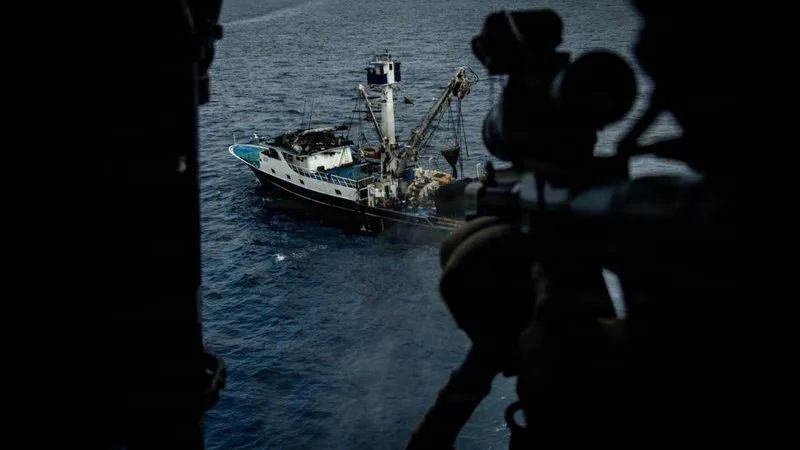
Marines from Littoral Combat Force-24 and sailors from USS San Antonio (LPD 17) stopped, searched and sank a floating fuel station of the Ecuadorian Los Choneros cartel in the eastern Pacific. The operation on 2 and 3 September was carried out from RHIB boats under cover of UH-1Y Venom and MH-60 Seahawk helicopters, the people on board were handed over to Ecuadorian authorities, and on 28 August the team carried out its first boarding off Ecuador. Littoral Combat Force-24 numbers more than 1,300 marines and sailors and operates without a classic amphibious group, from single San Antonio-class ships and land nodes in Puerto Rico.
The US Marine Corps published this week images of training and operations by the Maritime Raid Force, the boarding element of LCF-24, involving Recon Marines. The statement, like every one in this campaign, stresses that the forces are deployed to the SOUTHCOM area to support the priorities of the President and the Department of War, as the Pentagon has been called since last year, in disrupting drug trafficking, deterring malign actors and protecting the homeland through persistent presence.
A MEU without an ARG
Littoral Combat Force-24 is the 24th Marine Expeditionary Unit in a new form. A classic MEU is around 2,200 marines embarked on a three-ship Amphibious Ready Group that sails together and operates as a whole. LCF-24 numbers more than 1,300 marines and sailors and is spread across the region: it has a headquarters and shore-based nodes, including in Puerto Rico, while its sub-units operate from single San Antonio-class amphibious transport docks. In the spring that was USS Fort Lauderdale (LPD 28) in the Caribbean; since August it has been USS San Antonio (LPD 17) in the eastern Pacific.
The unit took over in May from the 22nd MEU, which had operated for nearly ten months from the USS Iwo Jima amphibious ready group. It serves as SOUTHCOM's immediate crisis response force with four missions: maritime interdiction, embassy reinforcement, tactical recovery of aircraft personnel and humanitarian assistance. SOUTHCOM commander General Francis L. Donovan, himself a Marine, said on that occasion that the Western Hemisphere is no longer a permissive environment for narco-terrorists, criminal syndicates or their state sponsors.
Boarding first, rockets second
Operation Southern Spear, the US campaign against maritime drug trafficking, was associated in its first year mainly with air strikes on fast boats in the Caribbean, after which there was nothing left to search. LCF-24 has introduced a different model, demonstrated in the Pacific in late August and early September.
On 28 August marines and sailors from USS San Antonio boarded a suspect vessel in international waters off Ecuador, the group's first direct action after entering the Pacific. On 2 and 3 September a team in rigid-hull inflatable boats, covered by a UH-1Y Venom and an MH-60 Seahawk, stopped, searched and secured a vessel that military intelligence identified as a floating fuel station for Los Choneros' high-speed smuggling boats. The people on board were handed over to the Ecuadorian authorities and the vessel was sunk, including with rockets fired from the helicopter. SOUTHCOM stressed that the interdiction passed without incident and in close coordination with Quito.
The difference from the earlier strikes is fundamental. Before the vessel was destroyed, the boarding team recovered its cargo, communications equipment and navigation data, while an armed helicopter remained overhead throughout in case of resistance. That allows the cartel's logistics network to be mapped rather than merely a single boat removed. Los Choneros and Los Lobos, two Ecuadorian groups designated by the United States as terrorist organisations, base their Pacific smuggling precisely on long maritime corridors and floating refuelling points.
What it means for other navies
The LCF formula answers two problems that are not only American. The first is a shortage of ships: a three-ship amphibious ready group is an asset the US Navy cannot keep in every region all year round, so the marines are learning to operate from a single LPD, from shore nodes and with tiltrotor and rotary aviation that lets boarding teams be repositioned without a permanent base. The second is the nature of the threat: the adversary is not a fleet but a network of small, fast, cheap craft against which a classic amphibious landing is useless, while boarding and intelligence are everything.
Both problems are familiar in the Baltic. NATO navies in the region have no large amphibious groups, but they do face a shadow fleet, small craft around critical infrastructure and cargoes that need to be inspected rather than sunk. A model in which a boarding team operates from a single support ship, with a helicopter overhead and command nodes ashore, is closer to the needs of Poland's Border Guard and Navy than a full-scale American MEU. For Polish shipbuilders now designing support and patrol vessels it is also a pointer to what future platforms will be expected to offer: a helicopter deck, a slipway for boarding craft and space for a team able to search a vessel once it has been stopped.
Southern Spear is entering its second year. If the LCF-24 formula proves itself, subsequent MEUs will deploy the same way, and the lessons of the Pacific boardings will find their way into doctrine that America's allies will read closely, in the Baltic as well.
Source: Gazeta Morska · Compiled by: Kamil Kusier
Related articles
 Safety and rescue Polish SAR’s new rescue vessel Mistral launched at Kewatec in Finland
 Safety and rescue Icelandic Coast Guard and police delegation visits Polish Border Guard’s Maritime Division
 Safety and rescue Polish Navy helicopter evacuates man from Baltic platform 100 km off Władysławowo
 Navy and defence SNMG2 joins Allied warships in PASSEX as Italy's Mare Aperto 2026 gets under way
 Safety and rescue From lightships to solar power: 160 years of the Grundkallen light station
 Education 254 people, manikins and life rafts: Maritime University of Szczecin joins national CPR record attempt
Comments (0)
The discussion is moderated by the editors: a comment appears after review. Your e-mail address is not published.
Nobody has commented on this article yet.