









Korean shipbuilding alliance joins Poland’s ORKA submarine programme
Poland’s Navy faces one of the most significant modernisation programmes in decades. The ORKA programme, aimed at acquiring three advanced submarines, has attracted interest from leading shipbuilders across Europe and Asia. At the end of September 2025, a strategic move was announced: a joint offer from two South Korean heavyweights — Hanwha Ocean and HD Hyundai Heavy Industries (HHI).
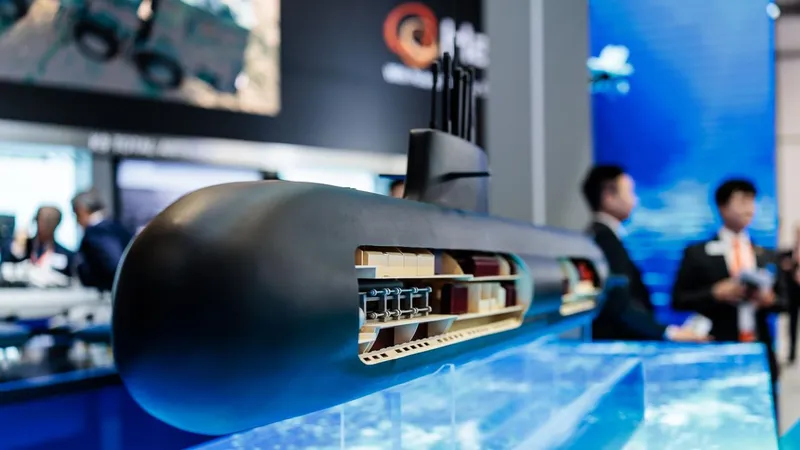
In brief
Hanwha Ocean and HD Hyundai Heavy Industries submitted a joint offer at the end of September 2025 for Poland's ORKA programme, which covers the purchase of three submarines. The Korean proposal includes a KSS-III Batch-2 submarine with vertical launchers, AIP propulsion and lithium-ion batteries, as well as a smaller HDS-2300 unit with a displacement of 2,300 tons designed for the shallow waters of the Baltic. The package is complemented by training with a bridging submarine, full MRO, technology transfer, a service centre in Gdynia, and credit mechanisms and export support. Interoperability with NATO systems remains a challenge.
This collaboration marks the first formal partnership between these two companies in an export programme, although they have previously worked together on domestic Korean KSS projects.
The Korean offer for ORKA
The joint bid covers an integrated package that includes:
- KSS-III Batch-2 (KSS-III PL) — a next-generation submarine equipped with Vertical Launch Systems (VLS), Air-Independent Propulsion (AIP), and lithium-ion batteries.
- HDS-2300 — a smaller, 2,300-ton platform optimised for operations in the confined waters of the Baltic Sea.
- Training facilities — including a dedicated training ship to prepare crews ahead of the submarines’ operational deployment.
- Full MRO and technology transfer — building a service and maintenance centre in Poland and partial localisation of production.
- Financing solutions — including export credit mechanisms to ease budgetary pressure on the Ministry of National Defence.
What sets the Korean proposal apart
The Hanwha Ocean and HD Hyundai HHI offer stands out primarily for its operational and technological experience. Both companies have successfully delivered KSS I–III class submarines to the Republic of Korea Navy, providing a proven track record of design, construction, and serial production — factors that reduce risk in large-scale naval programmes.
A key element of the Korean approach is conceptual flexibility. The offer includes two distinct platforms: the larger, ocean-going KSS-III PL and the smaller, Baltic-optimised HDS-2300. This gives Poland an opportunity to align the choice of vessel with strategic needs and the programme’s timeline.
Financially, Hanwha Ocean distinguishes itself by including a comprehensive financing package. Export credit support and other mechanisms could significantly reduce the fiscal burden of the ORKA programme and enhance its viability.
Finally, technology transfer is central to the proposal. Both companies have signalled cooperation with Polish shipyards, offering training programmes and engineering development. For Poland, this could mean a long-term boost to the domestic defence industry and partial localisation of submarine production — a critical factor in national technological sovereignty.
Strategic implications for Poland
The Korean bid offers Poland access to advanced submarine technology, supported by a long-term maintenance and training programme. Beyond the acquisition of modern platforms, the proposal promises capacity building for Poland’s shipbuilding sector.
However, challenges remain. Poland must ensure interoperability with NATO systems and address potential delays in establishing the proposed service infrastructure. The choice between the KSS-III PL and HDS-2300 platforms will hinge on balancing strategic reach, operational requirements, and the timeline for delivery.
The decision will have far-reaching consequences for the Polish Navy and the defence sector. The Hanwha Ocean–HD Hyundai HHI alliance presents not only a competitive technical offer but also a model of industrial cooperation that could shape Poland’s naval capabilities for decades to come.
Source: Gazeta Morska · Compiled by: Kamil Kusier
Related articles
 Safety and rescue Polish SAR’s new rescue vessel Mistral launched at Kewatec in Finland
 Safety and rescue Icelandic Coast Guard and police delegation visits Polish Border Guard’s Maritime Division
 Safety and rescue Polish Navy helicopter evacuates man from Baltic platform 100 km off Władysławowo
 Navy and defence SNMG2 joins Allied warships in PASSEX as Italy's Mare Aperto 2026 gets under way
 Safety and rescue From lightships to solar power: 160 years of the Grundkallen light station
 Education 254 people, manikins and life rafts: Maritime University of Szczecin joins national CPR record attempt
Comments (0)
The discussion is moderated by the editors: a comment appears after review. Your e-mail address is not published.
Nobody has commented on this article yet.