









Historic ensign of ORP Admiral Sierpinek publicly displayed after 84 years
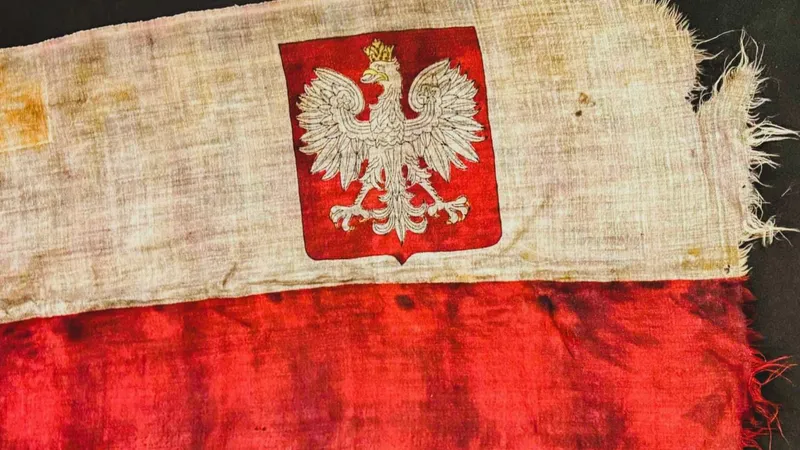
For the first time since 1939, the ensign of the staff ship ORP Admiral Sierpinek of the Pinsk Flotilla was presented to the public. The ceremony, held in Warsaw, was organized by the Jan Karski Institute of War Losses in cooperation with the Chancellery of the Prime Minister, the Office for War Veterans and Victims of Oppression, and the Military Historical Bureau.
In brief
The ensign of ORP Admirał Sierpinek, the staff ship of the Pinsk Flotilla, has been presented publicly in Warsaw for the first time since 1939. The ceremony was organised by the Jan Karski Institute of War Losses together with the Chancellery of the Prime Minister, the Office for Veterans and Victims of Oppression and the Military Historical Bureau. The flag, taken down when the ship was scuttled, was hidden by Leading Seaman Józef Strug, and the artefact was made available by his son Tomasz Strug. The Pinsk Flotilla, established in 1919, numbered nearly 900 sailors and officers at its peak.
A flag saved from 1939
The ensign was removed and hidden in September 1939 by Petty Officer Józef Strug, who served aboard Admiral Sierpinek. Just before the vessel was scuttled to prevent capture by advancing Soviet forces, Strug safeguarded the flag and carried it throughout the campaign, eventually taking part in the Battle of Kock alongside General Franciszek Kleeberg.
After the war, Strug settled in Gdynia, where he became a pioneer in Poland’s post-war marine salvage sector. The ensign, carefully preserved by him through the occupation and beyond, remained a treasured family relic. His son, Tomasz Strug, has now entrusted it to historians for public presentation.
- Although incomplete, the flag is an authentic witness of 1939 – a story passed directly from Józef Strug himself, said Dr. Bartosz Gondek, director of the Institute of War Losses.
Legacy of the Pinsk Flotilla
Formed in 1919, the Pinsk Flotilla operated on the Pripet and its tributaries, a region often described as the “Pinsk Sea.” Its mission was to secure inland waterways, protect river crossings, and support land operations. At its peak, the flotilla numbered around 900 sailors, officers, and support personnel.
ORP Admiral Sierpinek, commissioned in 1920, became the flotilla’s staff ship in 1929 after years of service with both the Pinsk and Vistula flotillas. Thoroughly refitted in 1935, she was deployed to the Bytnik Canal sector in 1939. On 17 September, facing Soviet encirclement and shallow waters, the ship was scuttled to deny her to the enemy – a fate she had already suffered once before, only to be salvaged, repaired, and returned to service.
Symbol of determination
Lech Parell, head of the Office for War Veterans, emphasized the flag’s symbolic value:
- This ensign embodies the determination of the sailors of the Pinsk Flotilla and their sacrifice in defense of Poland’s eastern frontiers.
Professor Grzegorz Motyka, director of the Military Historical Bureau, noted that the flotilla left behind very few physical artifacts.
- That makes the Admiral Sierpinek ensign particularly precious as a piece of naval heritage, he said.
Remembering a forgotten fleet
The presentation underscores the importance of authentic artifacts in telling the story of Poland’s interwar riverine forces. Though less known than the sea-going fleet, the Pinsk Flotilla played a crucial role in securing the eastern borders of the Second Republic.
The survival of the Admiral Sierpinek’s ensign – hidden, preserved, and now finally displayed – brings that history vividly back to life for a new generation.
Source: Gazeta Morska / PAP · Compiled by: Kamil Kusier
Related articles
 History Human remains found at Westerplatte. Polish bayonet and buttons point to a missing 1939 defender
 History Gdańsk conservator moves to expropriate the port workers’ Maritime Culture House in Nowy Port
 History Polish Naval Museum in Gdynia opens its doors on Independence Day, 11 November
 History Two Lancaster wrecks, one operation. The bombers fell over the Baltic laying mines still disarmed today
 History Seven dead in war, seven in peacetime. Błyskawica turns 90 and still flies the ensign
 Shipbuilding industry Batavia goes ashore. The Dutch show what to do with a ship no longer worth keeping afloat
Comments (0)
The discussion is moderated by the editors: a comment appears after review. Your e-mail address is not published.
Nobody has commented on this article yet.