









Greenland under an American umbrella. An agreement with no end date and an effective veto over China and Russia
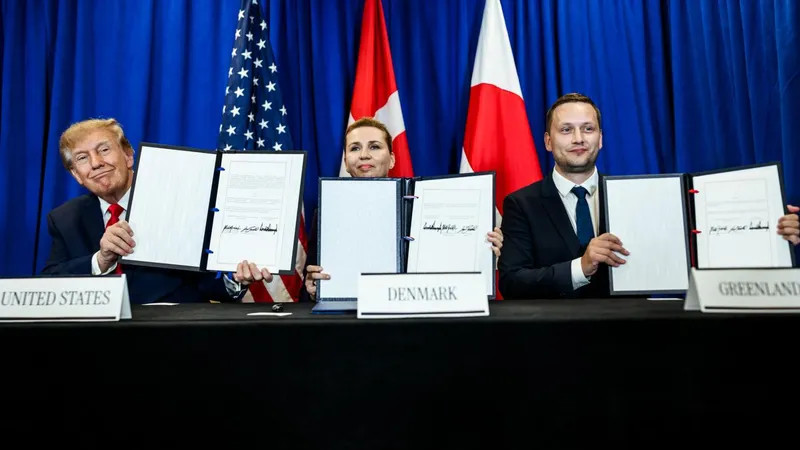
The United States, Denmark and Greenland signed an agreement on security in the Arctic and the North Atlantic in New York on 22 September. It was signed by President Donald Trump, Danish Prime Minister Mette Frederiksen and Greenland's Prime Minister Jens-Frederik Nielsen on the margins of the UN General Assembly. The deal opens the way for an expanded American military presence on the island and blocks access to it for states Washington regards as adversaries.
In brief
The agreement signed on 22 September in New York by Donald Trump, Mette Frederiksen and Jens-Frederik Nielsen gives the United States permanent basing rights in Greenland. The Greenland deal amends the defence agreement of 27 April 1951, has no end date and remains in force even if the island becomes independent. The agreement bars bases and sensitive investments by US adversaries without Washington's consent, in practice a veto on China and Russia. Mining concessions in Greenland remain under the control of Greenland's authorities.
Formally it is not a new treaty but an amendment and supplement to the defence agreement of 27 April 1951, concluded under the North Atlantic Treaty. In practice it is the most significant shift in the balance of the North Atlantic in decades.
What Washington gains
The agreement gives the United States permanent basing rights and the ability to expand defence infrastructure in Greenland. The Americans are to modernise and expand their activity at the Pituffik Space Base in the north-west, and President Trump announced the construction of two major military bases, pointing among others to Narsarsuaq in the south.
The second pillar of the deal is not about troops but about access. It bars adversaries of the United States from establishing bases, maintaining a military presence or making sensitive investments without Washington's approval, and excludes investors from outside NATO and the European Union from sectors deemed sensitive. In practice this gives the United States a veto over any Chinese or Russian foothold on the island.
The agreement has no end date. It also applies should Greenland choose independence, in which case the island would remain in NATO and assume Denmark's obligations under the deal.
What Copenhagen and Nuuk keep
The text recognises the sovereignty and territorial integrity of the Kingdom of Denmark and the Greenlandic people's right to self-determination. Mining concessions remain under Greenlandic authority, which matters given interest in the island's critical raw materials.
Greenland's prime minister said after the signing that the agreement recognises Greenlanders as a people with the right to self-determination and at the same time as part of shared Arctic security. Denmark stresses the alliance dimension, arguing that the deal anchors Arctic security in NATO rather than leaving it to Washington and Copenhagen alone, and supports stronger NATO engagement in the region in planning, presence, exercises and joint intelligence gathering.
The American narrative sounds different. President Trump spoke of lasting control over security on the island, and the White House presented the deal as a guarantee of permanent basing rights at no cost to the American taxpayer. That gap in language is one of the things to watch as the agreement is implemented.
Why Greenland
After 1945 the United States maintained a dozen or more installations and thousands of troops on the island. Today it is about 200 personnel at Pituffik, a base supporting missile warning, missile defence and space surveillance for the United States and NATO. The agreement reverses that trend.
The reason is geography. Greenland sits on the shortest line between North America and Russia and closes the western side of the GIUK gap, the passage between Greenland, Iceland and the United Kingdom through which Russian submarines move from the Barents Sea into the Atlantic. Whoever shapes conditions in the north-western Atlantic shapes how the Russian fleet can operate across the whole ocean.
Shipping matters too. About two thirds of the island lies inside the Arctic Circle, and retreating sea ice is opening further northern routes. The Arctic is ceasing to be purely a military theatre and becoming an economic area, with vessel traffic, fisheries and resource extraction.
What it means for the Baltic
Greenland and the Baltic are two ends of the same axis. Since NATO's enlargement to Finland and Sweden the Baltic has become a sea ringed by alliance members, while the North Atlantic and the Arctic are the route along which reinforcement from North America reaches it.
For Poland, an eastern flank state whose allied logistics run through the ports of the Tricity and Świnoujście, conditions in the North Atlantic bear directly on the security of those deliveries. A stronger American presence in Greenland shortens reaction times along that route and makes it harder for rivals to build footholds on it.
There is also a more direct thread. The clause excluding investors from outside NATO and the EU from sensitive sectors is the same mechanism increasingly discussed in Europe in relation to ports, terminals and subsea infrastructure. Greenland is the first case of it being written so plainly into an intergovernmental agreement.
The end of a two-year dispute
The deal closes a conflict that ran from January 2025, when Donald Trump began talking about the United States taking over Greenland and did not rule out the use of force. His remarks triggered protests in Nuuk and Copenhagen and unease across Europe, and in 2026 allies held exercises on the island involving more than a dozen nations.
The agreement does not settle everything. The schedule for the announced bases is not known, nor is how the consent mechanism for foreign investment will work in practice. It does settle the point that matters most from a European perspective: Greenland's future is to be governed by an agreement within NATO rather than by a change in the island's nationhood.
Source: Gazeta Morska · Compiled by: Kamil Kusier
Related articles
 Safety and rescue Polish SAR’s new rescue vessel Mistral launched at Kewatec in Finland
 Safety and rescue Icelandic Coast Guard and police delegation visits Polish Border Guard’s Maritime Division
 Safety and rescue Polish Navy helicopter evacuates man from Baltic platform 100 km off Władysławowo
 Navy and defence SNMG2 joins Allied warships in PASSEX as Italy's Mare Aperto 2026 gets under way
 Safety and rescue From lightships to solar power: 160 years of the Grundkallen light station
 Education 254 people, manikins and life rafts: Maritime University of Szczecin joins national CPR record attempt
Comments (0)
The discussion is moderated by the editors: a comment appears after review. Your e-mail address is not published.
Nobody has commented on this article yet.