









Green lights for maritime security. Gdańsk and Sopot mark Border Guard’s 35th anniversary
A series of green illuminations across Gdańsk and Sopot has highlighted the 35th anniversary of the Polish Border Guard, underlining the strategic role of maritime border protection in safeguarding ports, logistics corridors and critical coastal infrastructure.
In brief
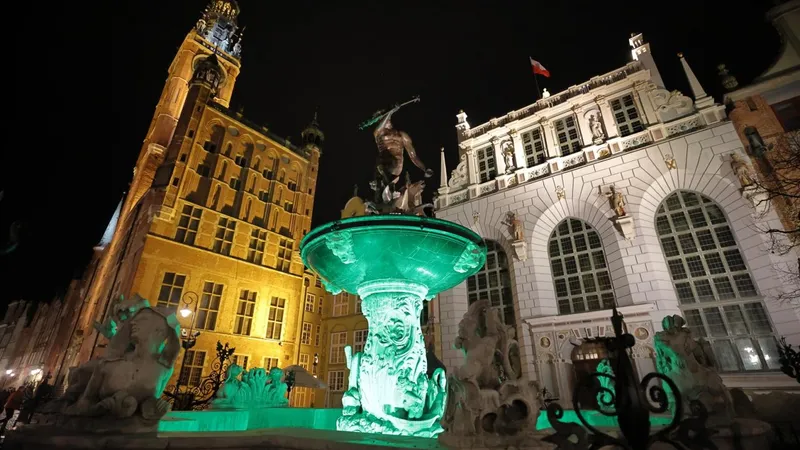
Gdańsk and Sopot lit selected city landmarks in green to mark the 35th anniversary of the Polish Border Guard. The illumination covered, from 12 to 16 May, the Neptune Fountain, the viaduct at Galeria Bałtycka, the Gdańsk sign on Ołowianka, the fountain at the European Solidarity Centre and St George's Church in Sopot. The Maritime Border Guard Unit, headquartered in Nowy Port, is responsible for protecting the maritime border, border traffic control in ports, and countering smuggling and hybrid threats.
Symbolic illumination with operational relevance
From 12 to 16 May, several landmark sites across the Tricity metropolitan area have been illuminated in green, the official colour associated with the Polish Border Guard.
The initiative includes Neptune’s Fountain, the viaduct near Galeria Bałtycka, the “Gdańsk” sign on Ołowianka Island, the fountain at the European Solidarity Centre, and St George’s Church in Sopot.
While symbolic in nature, the campaign also serves as a public recognition of officers responsible for protecting the EU’s external maritime borders and securing port operations.
Maritime Border Guard unit key to Baltic security
For Gdańsk, the anniversary has particular significance due to the presence of the Maritime Border Guard Regional Unit headquartered in Nowy Port.
The unit is responsible for maritime border protection, port traffic control, anti-smuggling operations, countering illegal migration and addressing emerging hybrid threats in coastal areas.
As supply chain security, LNG infrastructure protection and operational continuity gain importance, the Border Guard’s role increasingly extends beyond traditional border enforcement into the broader framework of economic and infrastructure security.
Security as a competitiveness factor for ports
Maritime analysts note that port competitiveness increasingly depends not only on infrastructure investments but also on institutional resilience and coordination between port authorities, municipalities and national security services.
In Gdańsk, cooperation with the Border Guard supports passenger safety, cargo flow security, vessel clearance procedures and monitoring of nearshore areas.
Against the backdrop of heightened geopolitical tensions in the Baltic Sea region, these functions have become even more strategically relevant.
Anniversary with a wider institutional message
The green-light campaign reflects a broader effort to strengthen public awareness of state security institutions and their operational role.
Organisers say the initiative is also intended to promote awareness of border protection, inter-agency cooperation and preparedness in the face of migration challenges and security risks.
The participation of St George’s Church in Sopot further demonstrates the broad civic and institutional support for the Border Guard anniversary celebrations.
Source: Gazeta Morska · Compiled by: Kamil Kusier
Related articles
 Safety and rescue Polish SAR’s new rescue vessel Mistral launched at Kewatec in Finland
 Safety and rescue Icelandic Coast Guard and police delegation visits Polish Border Guard’s Maritime Division
 Safety and rescue Polish Navy helicopter evacuates man from Baltic platform 100 km off Władysławowo
 Navy and defence SNMG2 joins Allied warships in PASSEX as Italy's Mare Aperto 2026 gets under way
 Safety and rescue From lightships to solar power: 160 years of the Grundkallen light station
 Education 254 people, manikins and life rafts: Maritime University of Szczecin joins national CPR record attempt
Comments (0)
The discussion is moderated by the editors: a comment appears after review. Your e-mail address is not published.
Nobody has commented on this article yet.