









Gladius over the Baltic. WB Group’s integrated strike system tested during Baltic Shield-26
The deployment of Gladius during Baltic Shield-26 highlights the growing role of Polish unmanned and digital warfare technologies in Baltic regional security. Developed by WB Group and fielded by the Polish Armed Forces, the system demonstrates how domestic defense industry capabilities are shaping next-generation operational concepts.
In brief
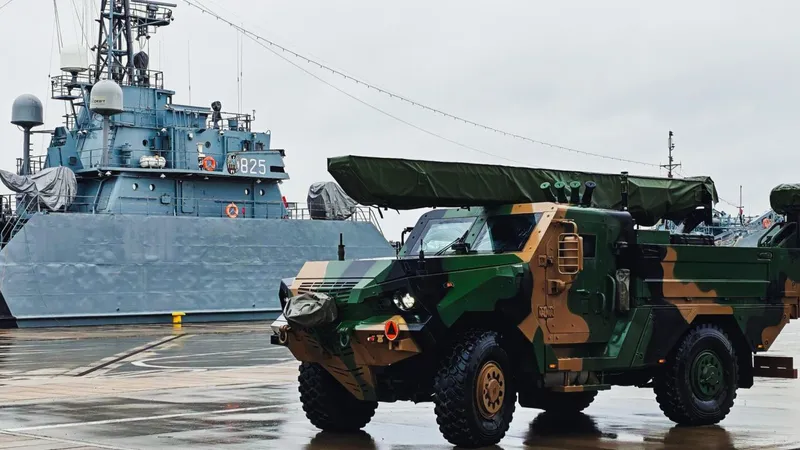
The Gladius unmanned system developed by Grupa WB was used operationally by the 1st Masurian Artillery Brigade during the Polish-Danish exercise Baltic Shield-26. Gladius combines FT-5 Łoś unmanned aerial vehicles, loitering munitions, mobile command posts and the TOPAZ fire control system into a single search-and-strike system. The FT-5 unmanned aircraft carried out reconnaissance, object identification and target designation, which is relevant for the protection of ports, energy terminals and offshore infrastructure.
Baltic operational environment drives modernization
The Baltic Sea region remains one of NATO’s most strategically exposed theatres. Protection of maritime infrastructure, logistics routes and offshore assets has become increasingly important amid elevated regional military tensions.
Baltic Shield-26, conducted jointly by Poland and Denmark, focuses on integrating ISR assets, artillery systems and unmanned capabilities in littoral and maritime scenarios. A notable component of the exercise is the deployment of the Gladius system by Poland’s 1st Masurian Artillery Brigade.
WB Group at the core of Polish defense innovation
WB Group is the industrial force behind Gladius.
As Poland’s leading private defense technology group, the company has built a strong position in battlefield digitization, unmanned systems and military communications.
Its portfolio includes:
- TOPAZ fire control system,
- Warmate loitering munition,
- FlyEye reconnaissance UAV,
- FONET military communication systems.
Gladius represents the next evolutionary step in this ecosystem, integrating reconnaissance and strike capabilities into a single operational framework.
Its deployment during multinational exercises also strengthens WB Group’s export credibility and industrial profile.
A full reconnaissance-strike ecosystem
Rather than a standalone UAV, Gladius is an integrated system composed of:
- FT-5 Łoś reconnaissance UAVs,
- loitering munitions,
- mobile command units,
- TOPAZ digital fire control integration,
- communications and logistics architecture.
This enables a complete operational chain from target acquisition to strike execution.
FT-5 provides ISR layer over the Baltic
During Baltic Shield-26, FT-5 UAVs support:
- reconnaissance missions,
- target identification,
- coastal surveillance,
- maritime object detection,
- battle damage assessment.
These capabilities are increasingly relevant for maritime infrastructure protection, offshore asset monitoring and hybrid threat response.
Industrial and operational significance
The testing of Gladius reflects lessons from Ukraine, where battlefield effectiveness increasingly depends on ISR quality, digital connectivity and shortened targeting cycles.
For Poland, the system signals a shift toward network-centric fires architecture. For WB Group, Baltic Shield-26 is also an industrial milestone, demonstrating that Polish-developed systems are transitioning from procurement programs into operational multinational environments.
In the Baltic theatre, this evolution may prove increasingly relevant for both national defense and allied interoperability.
Source: Gazeta Morska · Compiled by: Kamil Kusier
Related articles
 Safety and rescue Polish SAR’s new rescue vessel Mistral launched at Kewatec in Finland
 Safety and rescue Icelandic Coast Guard and police delegation visits Polish Border Guard’s Maritime Division
 Safety and rescue Polish Navy helicopter evacuates man from Baltic platform 100 km off Władysławowo
 Navy and defence SNMG2 joins Allied warships in PASSEX as Italy's Mare Aperto 2026 gets under way
 Safety and rescue From lightships to solar power: 160 years of the Grundkallen light station
 Education 254 people, manikins and life rafts: Maritime University of Szczecin joins national CPR record attempt
Comments (0)
The discussion is moderated by the editors: a comment appears after review. Your e-mail address is not published.
Nobody has commented on this article yet.