









German warship FGS Hamburg, recently in Gdynia, targeted by Russian provocation in the Baltic
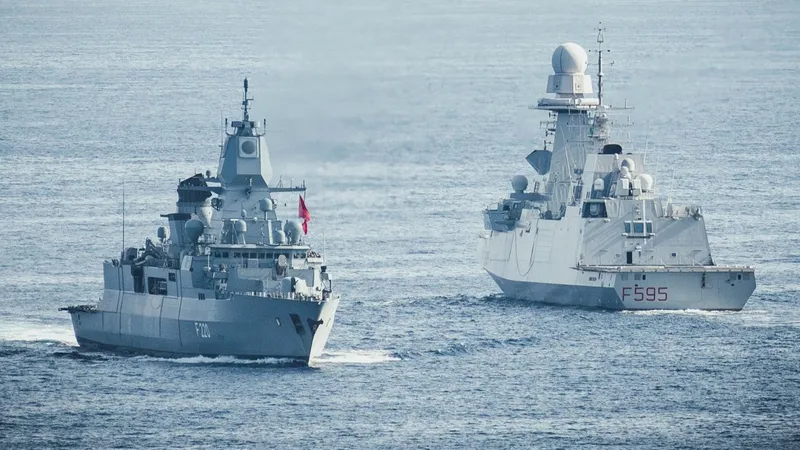
The German Navy’s air-defense frigate FGS Hamburg (F220) – which called at Gdynia’s Indian Quay just days ago – has been subjected to two provocative overflights by Russian military aircraft over the Baltic Sea, German Defence Minister Boris Pistorius told the Bundestag on Wednesday.
In brief
The German frigate FGS Hamburg (F220), which recently moored at Nabrzeże Indyjskie in the Port of Gdynia, became the target of two provocative overflights by Russian military aircraft over the Baltic Sea. German Defence Minister Boris Pistorius informed the Bundestag that Russian reconnaissance aircraft flew over the vessel at an altitude below 100 metres, ignoring attempts to establish radio contact. FGS Hamburg, a Sachsen-class frigate with a displacement of more than 5,800 tonnes and a length of 143 metres, is taking part in the NATO Neptune Strike manoeuvres in the Baltic.
According to dpa, the first incident occurred shortly before last weekend, with a second flyover taking place during the weekend itself. The Russian reconnaissance aircraft reportedly flew at an altitude of less than 100 meters, ignoring radio calls. The German Armed Forces have classified the incidents as deliberate provocations.
Speaking before lawmakers, Pistorius linked the incidents to other recent Russian activities, including drone intrusions into Polish airspace and fighter jet violations over Estonia. “Russia is literally testing the limits,” he warned, adding that President Vladimir Putin seeks to provoke NATO members and probe for perceived vulnerabilities.
FGS Hamburg is currently participating in NATO’s Neptune Strike exercise, which integrates allied naval and air assets across the Baltic theatre.
FGS Hamburg is a Sachsen-class (F124) air-defense frigate with a displacement of over 5,800 tons and a length of 143 meters. She is equipped with SM-2 and ESSM surface-to-air missiles, Harpoon anti-ship missiles, and SMART-L/APAR radar suites, making her a key pillar of Germany’s seaborne air-defense capability.
Source: Gazeta Morska / PAP · Compiled by: Kamil Kusier
Related articles
 Safety and rescue Polish SAR’s new rescue vessel Mistral launched at Kewatec in Finland
 Safety and rescue Icelandic Coast Guard and police delegation visits Polish Border Guard’s Maritime Division
 Safety and rescue Polish Navy helicopter evacuates man from Baltic platform 100 km off Władysławowo
 Navy and defence SNMG2 joins Allied warships in PASSEX as Italy's Mare Aperto 2026 gets under way
 Safety and rescue From lightships to solar power: 160 years of the Grundkallen light station
 Education 254 people, manikins and life rafts: Maritime University of Szczecin joins national CPR record attempt
Comments (0)
The discussion is moderated by the editors: a comment appears after review. Your e-mail address is not published.
Nobody has commented on this article yet.