









From a German U-boat to the Scottish cliffs, fire from a Portuguese frigate. How NATO rehearses support from the se
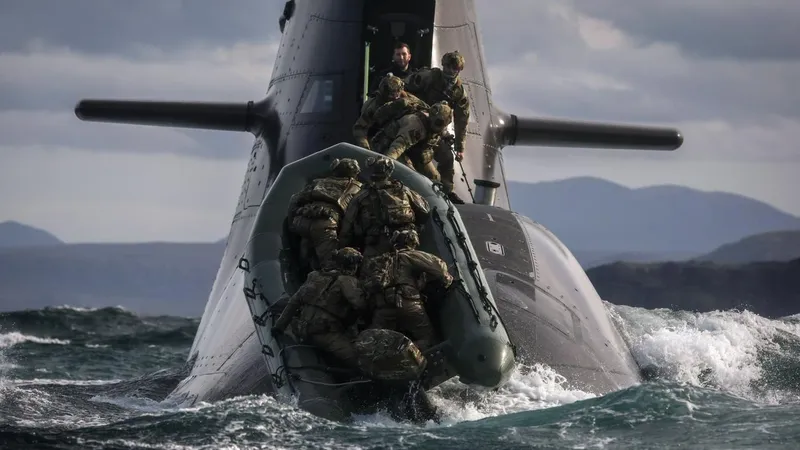
British commandos emerged from the depths of the Atlantic aboard a German submarine, paddled inflatable raiding craft to a beach at Cape Wrath, the most north-westerly point of mainland Britain, climbed the cliffs and from an observation post directed the gun of a Portuguese frigate onto enemy positions. It was one serial of Exercise Strike Warrior 26, the largest test of the UK Commando Force in fifteen years and the first time since the war in Afghanistan that all the formation's specialist elements have worked together.
In brief
British commandos from 148 (Meiktila) Commando Forward Observation Battery landed from the German submarine U36 near Cape Wrath and directed fire from the 76 millimetre gun of the Portuguese frigate NRP Dom Francisco de Almeida. The sequence was part of exercise Strike Warrior 26, held in Scotland from 28 September to 9 October with more than two thousand troops from six countries, eight ships and 19 aircraft. Strike Warrior 26 is the largest test of British commando forces in fifteen years.
The exercise, held across Scotland from 28 September to 9 October, brought together more than two thousand personnel from six nations, eight warships and 19 aircraft. NATO's Joint Force Command Norfolk, responsible for the Atlantic and the High North, describes the Cape Wrath serial as one integrated Allied effect, from the seabed to the shoreline.
Three nations, three domains, one mission
The full mission profile ran as follows. The German Type 212A submarine U36 approached Cape Wrath submerged, tasked with reconnoitring the coast and identifying targets. Aboard was a team from 148 (Meiktila) Commando Forward Observation Battery, an Army unit of 29 Commando Regiment Royal Artillery permanently attached to the Royal Marines; its soldiers pass full commando training and specialise in one thing: getting ashore unseen behind enemy lines and directing the fire of ships, artillery and aircraft. The name commemorates the battle of Meiktila in Burma in 1945.
After the submarine surfaced, the observers slipped away in inflatable raiding boats, made a tactical landing on a remote beach and established a concealed observation post on the cliffs. From there they called in live naval gunfire: the Portuguese frigate NRP Dom Francisco de Almeida engaged the targets with her 76 mm gun. The team was then extracted, and according to the Royal Navy one variant of the return to the submarine involved driving the raiding craft at speed up the stern casing over the propeller in a heavy swell.
- The submarine operation showed the powerful combination of bringing allies together, with the German U-boat charged with identifying targets, commandos discreetly landing ashore and the Portuguese bringing the firepower onto the target - the Royal Navy said in its statement.
According to 148 Battery, this degree of coordination with live assets had not been achieved by the unit for nearly thirty years. The serial was deliberately built so that each element came from a different nation: British observers on a German boat calling fire from a Portuguese frigate is harder than the same sequence run entirely with British assets, because it demands shared procedures, communications and trust that cannot be rehearsed on paper.
Cape Wrath, the only range of its kind in Europe
The choice of location is no accident. Cape Wrath is the only range in Europe where warships can fire live ammunition at targets on land and aircraft can drop thousand-pound bombs. That is why the Royal Navy completes the training of its carrier strike groups there before they sail, and why allies come there to practise naval fire support that cannot be done for real anywhere else.
Earlier in the exercise 148 Battery controlled the gunfire of ships from Standing NATO Maritime Group One, the same group that regularly operates in the Baltic, including the Dutch frigate Van Amstel and the Canadian St. John's. The British describe Strike Warrior as a major rehearsal for Allied crisis-response operations across the High North and North Atlantic, and JFC Norfolk's presence in the communications shows that NATO treats it as part of its own planning, not merely British training.
What Poland is building from this scenario today
For a Polish reader the serial is interesting because all three of its elements are taking shape in Polish programmes right now. The Miecznik frigates, the first of which, Wicher, was launched in August, will carry 76 mm guns, the same calibre the Portuguese frigate fired at Cape Wrath, with modern fire-control systems that allow precise support from the sea. The A26 submarines chosen in the Orka programme have a lock-out chamber for divers and underwater vehicles designed precisely for special operations; the Swedes who build them have rehearsed such scenarios in their own waters for decades, and Polish crews began training this year. Formoza and Agat have boat-borne elements that already train for such scenarios with allies in the Baltic.
One link is still missing, and that is the lesson of the exercise worth writing down: specialised naval gunfire observers on the model of 148 Battery, people who can leave a submarine, reach the shore and talk to the gun on a frigate's deck. The British rebuilt that capability after a thirty-year gap. Poland has until 2029, when Wicher enters service, to build it for the first time, and exercises like Strike Warrior, in which Polish special forces can take part on allied platforms before their own arrive, are where that starts.
The Cape Wrath serial shows what ships are bought for, not just which ones. A frigate is worth as much as the observer who finds its target; a submarine as much as the team that can leave it. Poland is building both today, and this is the moment to learn the third from its allies.
Source: Gazeta Morska · Compiled by: Kamil Kusier
Related articles
 Safety and rescue Polish SAR’s new rescue vessel Mistral launched at Kewatec in Finland
 Safety and rescue Icelandic Coast Guard and police delegation visits Polish Border Guard’s Maritime Division
 Safety and rescue Polish Navy helicopter evacuates man from Baltic platform 100 km off Władysławowo
 Navy and defence SNMG2 joins Allied warships in PASSEX as Italy's Mare Aperto 2026 gets under way
 Safety and rescue From lightships to solar power: 160 years of the Grundkallen light station
 Education 254 people, manikins and life rafts: Maritime University of Szczecin joins national CPR record attempt
Comments (0)
The discussion is moderated by the editors: a comment appears after review. Your e-mail address is not published.
Nobody has commented on this article yet.