









French Navy increases operational activity from the Mediterranean to the Arctic
In early March the Marine nationale significantly intensified its operational presence across several key maritime theatres, ranging from the Eastern Mediterranean to the North Atlantic and the Indian Ocean. Recent updates released by the French Navy indicate a broad spectrum of simultaneous deployments, reflecting both France’s global naval posture and its commitments within NATO and the European Union.
In brief
The French Marine nationale increased its operational activity in the first days of March in the Mediterranean Sea, the Indian Ocean, off the coast of Norway and in the Gulf of Guinea. Since 3 March a French frigate has been supporting the air defence of Cyprus, and on 6 March a carrier group with the aircraft carrier Charles de Gaulle and frigates from the Netherlands, Spain and Italy arrived in the Mediterranean. Off the coast of Norway the French patrol vessel Commandant Blaison took part in the NATO exercise Dynamic Guard 26. In French Guiana the patrol vessel Antilles-Guyane seized over four tonnes of illegally caught fish from a Brazilian fishing boat.
French naval units are currently engaged in operations related to regional security in the Mediterranean, maritime security missions in the Indian Ocean and Gulf of Guinea, as well as multinational exercises in northern Europe. Together, these activities illustrate the operational flexibility and geographical reach of the French fleet.
Reinforcement of naval presence in the Eastern Mediterranean
The most significant concentration of French naval forces is currently taking place in the Eastern Mediterranean. Acting on instructions from the French authorities, naval units have been deployed to contribute to the reinforcement of the defensive posture in the region and to support the protection of European interests.
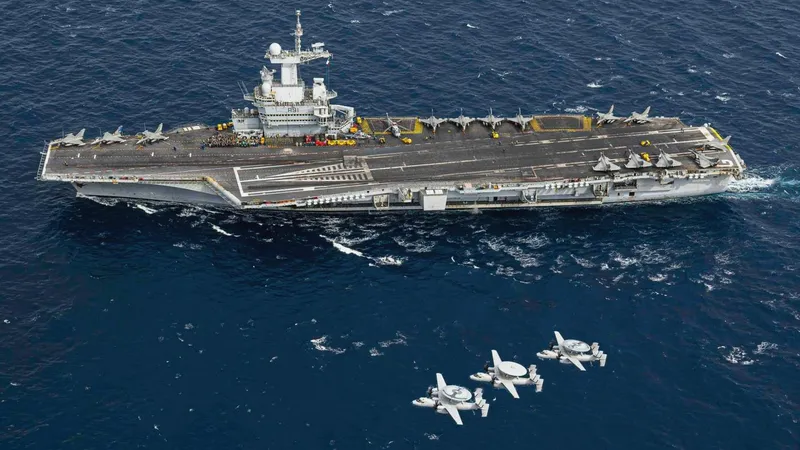
Since 3 March, a French frigate has been involved in air defence operations linked to the protection of Cyprus. A few days later, on 6 March, the French carrier strike group centred on the aircraft carrier Charles de Gaulle entered the Mediterranean Sea.
The carrier group is accompanied by allied frigates from the navies of the Netherlands, Spain and Italy, highlighting the multinational dimension of the deployment and the level of coordination among European naval forces operating in the region.
On the same day, additional French naval units departed from Toulon, including an amphibious assault ship and a La Fayette-class frigate. These vessels are currently conducting patrol operations in the central and eastern Mediterranean, further strengthening France’s naval presence in the area.
At the same time, a French La Fayette-class frigate continues to participate in the European Union naval mission Operation IRINI. The operation is responsible for monitoring the implementation of the United Nations arms embargo on Libya and contributes to maritime surveillance in the central Mediterranean basin.
Operations in the Indian Ocean and the Red Sea
Beyond the Mediterranean theatre, French naval forces remain active in the wider Indian Ocean region. The amphibious group conducting the annual Jeanne d'Arc mission has recently taken part in activities linked to the European maritime security operation EUNAVFOR Atalanta.
The mission focuses on enhancing maritime security in the Western Indian Ocean and along key shipping routes in the Red Sea area. For more than a decade, Operation Atalanta has played a major role in protecting international commercial shipping from piracy threats in the region.
The participation of French amphibious forces in the mission demonstrates the continued importance of multinational naval cooperation in securing critical sea lines of communication.
NATO exercises off the Norwegian coast
French naval units have also been active in northern European waters, taking part in the NATO exercise Dynamic Guard 26 conducted off the Norwegian coast.
Among the participating vessels was the offshore patrol vessel Commandant Blaison. During the exercise, crews were exposed to a range of simulated high-intensity scenarios including radar jamming, electronic attacks and coordinated air defence operations.
Such exercises are designed to improve interoperability between allied naval forces and to enhance readiness for operations in contested electromagnetic environments, which are increasingly considered a critical aspect of modern naval warfare.
In parallel, French amphibious forces are also involved in the multinational NATO exercise Exercise Cold Response taking place in Norway. The large-scale manoeuvres focus on joint operations in Arctic and sub-Arctic conditions, including amphibious landings and multinational coordination in harsh climates.
Maritime security operations in West Africa
France also maintains a permanent naval presence in the Gulf of Guinea through Operation Corymbe. The mission supports regional maritime security and provides operational cooperation with partner navies in West Africa.
As part of this deployment, French naval units recently conducted joint activities with the Ghanaian Navy, strengthening operational ties and contributing to efforts aimed at improving maritime security in a region affected by piracy and illegal maritime activities.
Law enforcement missions in overseas waters
In addition to combat and security missions, the French Navy also carries out law enforcement tasks in overseas territories. Off the coast of French Guiana, the patrol vessel responsible for the Antilles–Guiana maritime zone recently inspected a Brazilian fishing vessel suspected of illegal activity.
The boarding operation resulted in the seizure of approximately 4.2 tonnes of fish caught illegally, as well as fishing equipment used by the vessel. Such actions form part of regular patrol activities aimed at protecting marine resources and enforcing maritime regulations in France’s overseas waters.
Unusual airborne operation aboard the aircraft carrier
An unusual aviation event also took place aboard the aircraft carrier Charles de Gaulle. For the first time, three airborne early warning aircraft E-2C Hawkeye from Flottille 4F were launched simultaneously from the carrier’s flight deck.
Under normal circumstances the French carrier air wing operates with two Hawkeye aircraft. However, due to a rotation of personnel and equipment intended to maintain operational continuity, all three aircraft belonging to the squadron were temporarily present aboard the carrier.
This unique opportunity allowed the aircraft to conduct a rare formation flight. The E-2C Hawkeye plays a crucial role within the carrier strike group, providing airborne surveillance, early warning capabilities and coordination of air operations.
A globally deployed navy
The recent deployments highlight the global reach of the Marine nationale. French naval forces are currently operating simultaneously across several strategic maritime regions, including the Mediterranean Sea, the Indian Ocean, northern European waters and the Gulf of Guinea.
Such a level of operational activity reflects France’s role as a major European naval power and underlines the importance of maritime forces in maintaining international security, protecting sea lines of communication and supporting multinational operations conducted under NATO and European Union frameworks.
Source: Gazeta Morska · Compiled by: Kamil Kusier
Related articles
 Safety and rescue Polish SAR’s new rescue vessel Mistral launched at Kewatec in Finland
 Safety and rescue Icelandic Coast Guard and police delegation visits Polish Border Guard’s Maritime Division
 Safety and rescue Polish Navy helicopter evacuates man from Baltic platform 100 km off Władysławowo
 Navy and defence SNMG2 joins Allied warships in PASSEX as Italy's Mare Aperto 2026 gets under way
 Safety and rescue From lightships to solar power: 160 years of the Grundkallen light station
 Education 254 people, manikins and life rafts: Maritime University of Szczecin joins national CPR record attempt
Comments (0)
The discussion is moderated by the editors: a comment appears after review. Your e-mail address is not published.
Nobody has commented on this article yet.