









Five British aerial mines a kilometre from the LNG terminal. Navy divers close beaches from Ahlbeck to Międzyzdroje
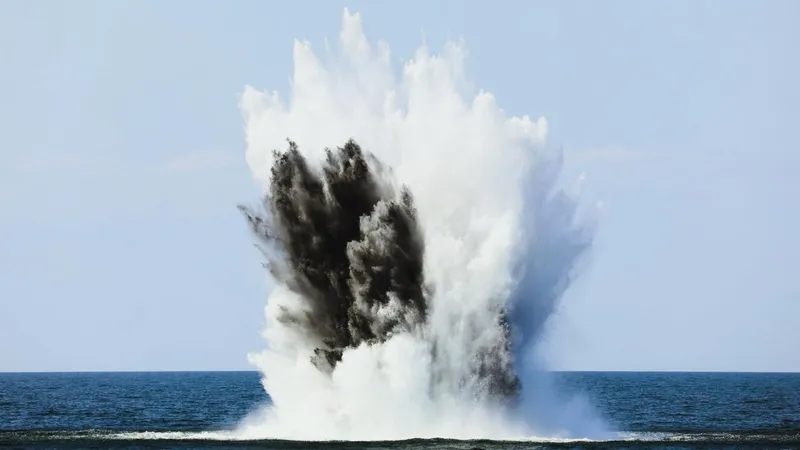
Close to 3,500 kilogrammes of Second World War ordnance, found on the construction site of the breakwater for the new outer port in Świnoujście, will be neutralised by clearance divers of the Polish Navy's 8th Coastal Defence Flotilla. The operation begins on Monday 5 October and is due to last until Thursday 8 October. For its duration an absolute ban on entering the water applies along the shore from Ahlbeck in Germany through Świnoujście to Międzyzdroje.
In brief
Mine clearance divers from the 8th Coastal Defence Flotilla will neutralise five British air-dropped Mark IV, V and VI mines found on the breakwater construction site of the outer port in Świnoujście. The mines in Świnoujście lie at a depth of about 10 metres, about a thousand metres from the LNG Terminal breakwater, and together equal about 2500 kilograms of TNT. The operation will run from 5 to 8 October between 8:00 and 15:00. A ban on entering the water applies from Ahlbeck to Międzyzdroje and up to 8.8 kilometres out to sea.
The objects lie at a depth of about 10 metres, around a thousand metres from the breakwater of the Świnoujście LNG terminal. That is no coincidence: the fairway and approaches to Świnoujście were among the most heavily mined waters of the Baltic in the final months of the war.
Mark IV, V and VI: three metres of steel and half a tonne of explosive
The ordnance was found during work commissioned by the Maritime Office in Szczecin on the site of the future integrated breakwater of the outer port. Identification was carried out by underwater specialists of the 8th Coastal Defence Flotilla. After inspection and analysis the objects were classified as British aerial sea mines of the Mark IV, V and VI types.
Each is a cylinder about 3 metres long containing 350 to 550 kilogrammes of explosive. The five objects together carry a charge equivalent to around 2,500 kilogrammes of TNT. During the war mines of this type were dropped from aircraft to close an area to shipping; they reacted to the acoustic and magnetic signatures of passing vessels. Eighty years on they remain a real hazard to navigation and to the investment planned at the site.
The neutralisation will be carried out by the Clearance Diver Group of the 12th Minesweeper Squadron.
What is and is not allowed during the operation
Given the mass of the charges and their radius of effect, safety zones have been established under Order No. 4 of the director of the Maritime Office in Szczecin of 24 September.
In the Pomeranian Bay, from 5 to 8 October between 8:00 and 15:00, along the shore from Ahlbeck through Świnoujście to Międzyzdroje and up to 8.8 kilometres out to sea, being in the water is life-threatening. That covers bathing, swimming, surfing and any other activity in the water. The operation may finish early, but the ban applies until lifted.
On land, being on the beaches and in their vicinity, on open and unsheltered ground, poses no danger. The beaches remain open to walkers.
On the water, the safety zone for vessels is 821 metres from the neutralisation site, and an absolute ban on underwater and diving work applies in the port for the duration.
Safety is being coordinated by the West Pomeranian Voivodeship Office, the Świnoujście city authority, the municipality of Międzyzdroje, the Maritime Office in Szczecin, the Regional Directorate for Environmental Protection, the 14th West Pomeranian Territorial Defence Brigade, the police, the Border Guard and the State Fire Service.
A port being built on a minefield
The new outer port in Świnoujście, with its deep-water container terminal, is one of the largest port investments in Poland. The breakwater on whose site the mines were found is being built by the Maritime Office in Szczecin as part of the access infrastructure. Every metre of seabed has to be checked first, because in 1945 the Allies mined the approaches to what was then Swinemünde from the air, and on 12 March of that year the town suffered one of the heaviest air raids in Pomerania.
Świnoujście has recent experience here. In October 2020 clearance divers of the 8th Coastal Defence Flotilla neutralised a British Tallboy bomb of more than five tonnes in the Piast Canal, the largest piece of unexploded ordnance ever found in Poland. The operation ended in an underwater detonation with no damage to the town, but required the evacuation of thousands of residents. This time the objects are smaller and lie at sea, so there will be no evacuation, but the scale of the charge, 2,500 kilogrammes in TNT equivalent, explains why the zone reaches almost 9 kilometres from the shore.
For the LNG terminal, a kilometre from the site, the operation means four days of work under a special regime. The proximity of a key energy security facility and five mines from 1945 is the shortest description of what every investment faces on waters where a war was fought eighty years ago.
Source: Gazeta Morska · Compiled by: Kamil Kusier
Related articles
 Safety and rescue Polish SAR’s new rescue vessel Mistral launched at Kewatec in Finland
 Safety and rescue Icelandic Coast Guard and police delegation visits Polish Border Guard’s Maritime Division
 Safety and rescue Polish Navy helicopter evacuates man from Baltic platform 100 km off Władysławowo
 Navy and defence SNMG2 joins Allied warships in PASSEX as Italy's Mare Aperto 2026 gets under way
 Safety and rescue From lightships to solar power: 160 years of the Grundkallen light station
 Education 254 people, manikins and life rafts: Maritime University of Szczecin joins national CPR record attempt
Comments (0)
The discussion is moderated by the editors: a comment appears after review. Your e-mail address is not published.
Nobody has commented on this article yet.