









Fire over the Baltic. Poland strengthens Integrated air defence training in Ustka
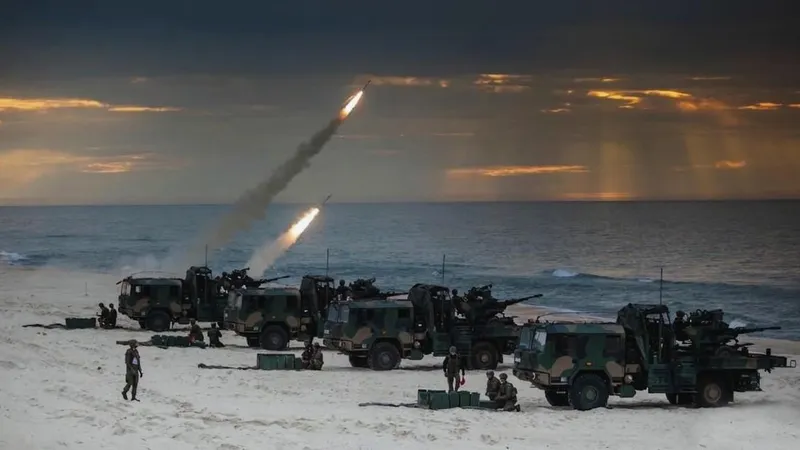
The Polish Armed Forces continue to expand operational air defence capabilities through large-scale exercises conducted at the Central Air Force Training Range in Ustka on the Baltic coast. Recently released materials from the Polish Armed Forces General Staff show training activities involving soldiers from the 3rd Warsaw Air Defence Missile Brigade, including the 35th Air Defence Missile Squadron from Skwierzyna, operating alongside units of the 16th Pomeranian Mechanised Division.
In brief
Soldiers of the 3rd Warsaw Air Defence Missile Brigade are training in air defence at the Central Air Force Training Ground in Ustka, as shown in footage released by the General Staff of the Polish Armed Forces. The exercise involves the 35th Air Defence Missile Squadron from Skwierzyna and sub-units of the 16th Pomeranian Mechanised Division, with firing positions deployed directly on the coast. The PSR-A Pilica systems in use combine 23 mm cannons with Grom and Piorun missiles and engage drones, helicopters and cruise missiles. The Polish Armed Forces are developing a multi-layered air defence comprising Pilica, Narew and Wisła.
The exercises focused on the deployment and live-fire use of PSR-A Pilica very short-range air defence systems positioned directly along the Baltic shoreline. Ustka remains one of Poland’s most important training areas for live-fire air defence drills and operational integration between air defence formations and land forces.
Growing focus on drone and low-altitude threats
The PSR-A Pilica system is designed to counter low-altitude aerial threats, including unmanned aerial systems, helicopters, low-flying aircraft and cruise missiles. The platform combines twin 23 mm anti-aircraft guns with Grom and Piorun missiles, creating a mobile protection system for military infrastructure, air bases and operational troop formations.
Recent conflicts have demonstrated the growing importance of layered short-range air defence and counter-drone capabilities on the modern battlefield. As a result, the Polish Armed Forces are increasingly focusing on interoperability between air defence systems and manoeuvre units operating close to the frontline.
The participation of the 16th Pomeranian Mechanised Division indicates that the drills also included battlefield protection scenarios involving moving armoured and mechanised units, convoy security and the defence of command positions against aerial attacks.
Poland expands layered air defence network
The exercises in Ustka form part of Poland’s broader military modernisation effort aimed at building a fully integrated multi-layered air defence architecture. The system currently under development combines Pilica very short-range systems, the Narew short-range programme and the Wisła air and missile defence system based on Patriot batteries.
The 3rd Warsaw Air Defence Missile Brigade remains one of the key formations responsible for Poland’s ground-based air defence network. The participating 35th Air Defence Missile Squadron operates within the brigade’s structure and plays an important role in strengthening national air defence readiness.
With security tensions continuing to increase across the Baltic Sea region, live-fire exercises conducted on the Polish coast are gaining strategic importance for both Poland and NATO’s eastern flank.
Source: Gazeta Morska · Compiled by: Kamil Kusier
Related articles
 Safety and rescue Polish SAR’s new rescue vessel Mistral launched at Kewatec in Finland
 Safety and rescue Icelandic Coast Guard and police delegation visits Polish Border Guard’s Maritime Division
 Safety and rescue Polish Navy helicopter evacuates man from Baltic platform 100 km off Władysławowo
 Navy and defence SNMG2 joins Allied warships in PASSEX as Italy's Mare Aperto 2026 gets under way
 Safety and rescue From lightships to solar power: 160 years of the Grundkallen light station
 Education 254 people, manikins and life rafts: Maritime University of Szczecin joins national CPR record attempt
Comments (0)
The discussion is moderated by the editors: a comment appears after review. Your e-mail address is not published.
Nobody has commented on this article yet.