









Evening SAR operation in the Baltic. Two kitesurfers stranded offshore
An evening search and rescue operation was launched in the Baltic Sea after two kitesurfers were unable to make their way back to shore near Kołobrzeg. The incident triggered a coordinated response involving harbour authorities and Poland’s maritime SAR service.
In brief
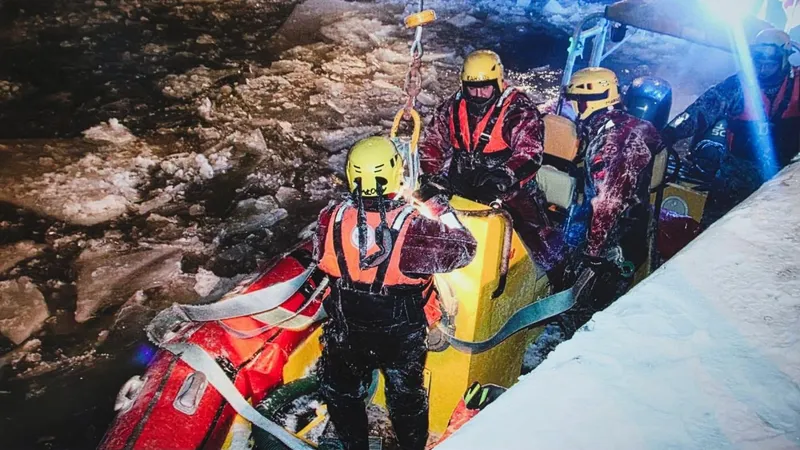
Two kitesurfers who were unable to return to shore after dark near the approach to the port in Kołobrzeg were rescued following a report received at 17:46. The Szczecin Emergency Notification Centre passed the information to the Maritime Rescue Coordination Centre, which dispatched the rescue vessel m/s Szkwał and the crew of the Kołobrzeg Coastal Rescue Station. Both kitesurfers were brought ashore and handed over to an emergency medical team, with hypothermia as the main threat. The operation was the 49th intervention of the Polish Maritime Search and Rescue Service SAR in 2026.
At 17:46 local time, CPR Szczecin relayed information to the Morskie Ratownicze Centrum Koordynacyjne (MRCC) regarding two kitesurfers who had lost the ability to safely return to land due to strengthening winds and fading daylight.
A rescue vessel, Szkwał, together with a coastal rescue unit from BSR Kołobrzeg, was dispatched to the scene. The local harbour master’s office played a key role in identifying the developing risk and alerting emergency services.
Coordinated response in reduced visibility
The incident occurred near the port approaches to Kołobrzeg, an area frequently used for recreational water sports. As daylight diminished and wind conditions shifted, the margin for a safe return narrowed significantly.
This deployment marked the 49th operation of the current season carried out by MSPiR SAR. According to its director, Sebastian Kluska, a growing proportion of missions involve leisure users rather than commercial maritime traffic.
Recreational activity and seasonal exposure
The Baltic Sea during transitional and winter months presents a distinct risk profile: short daylight windows, low water temperatures and rapidly changing wind patterns. In such conditions, exposure time becomes critical, and physical fatigue can quickly escalate into a life-threatening situation.
Both individuals were safely brought ashore and assessed by medical personnel. No serious injuries were reported, though the risk of hypothermia was evident.
Rising SAR workload linked to leisure use
From an industry perspective, the case reflects a broader operational trend. Recreational maritime activity — including kitesurfing and small craft operations — is accounting for an increasing share of SAR deployments.
The incident once again underlines the importance of weather monitoring, daylight planning and reliable communication equipment when operating in Baltic waters outside peak summer months.
Source: Gazeta Morska · Compiled by: Kamil Kusier
Related articles
 Safety and rescue Polish SAR’s new rescue vessel Mistral launched at Kewatec in Finland
 Safety and rescue Icelandic Coast Guard and police delegation visits Polish Border Guard’s Maritime Division
 Safety and rescue Polish Navy helicopter evacuates man from Baltic platform 100 km off Władysławowo
 Navy and defence SNMG2 joins Allied warships in PASSEX as Italy's Mare Aperto 2026 gets under way
 Safety and rescue From lightships to solar power: 160 years of the Grundkallen light station
 Education 254 people, manikins and life rafts: Maritime University of Szczecin joins national CPR record attempt
Comments (0)
The discussion is moderated by the editors: a comment appears after review. Your e-mail address is not published.
Nobody has commented on this article yet.