









Eastern Flank Watch: EU-NATO cooperation on drone wall and integrated defense
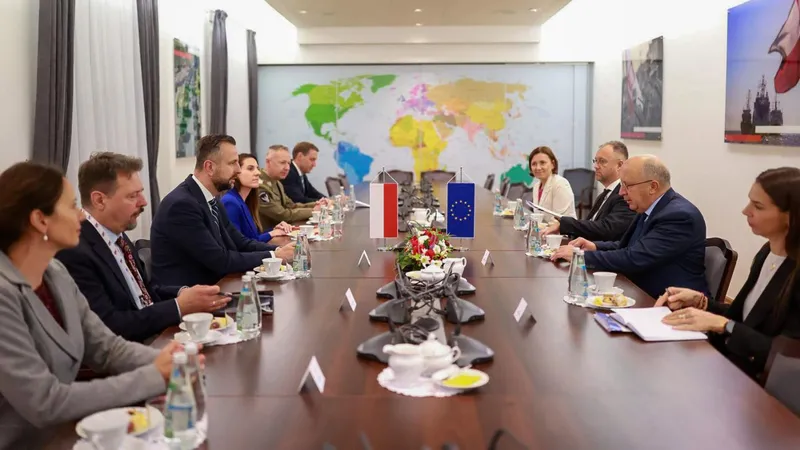
Polish Deputy Prime Minister and Minister of National Defence Władysław Kosiniak-Kamysz met with EU Commissioner for Defence and Space Andrius Kubilius to discuss the newly proposed Eastern Flank Watch initiative. The project aims to strengthen the EU’s eastern border security through integrated air, land, and maritime defence – with a particular focus on a so-called “drone wall.”
In brief
EU Commissioner for Defence Andrius Kubilius presented the concept of a drone wall, an anti-drone system protecting the eastern flank of the European Union. Deputy Prime Minister and Minister of National Defence Władysław Kosiniak-Kamysz fully supported the proposal, noting that the project must cover all countries of NATO's eastern flank. Władysław Kosiniak-Kamysz listed the Polish elements of the system: Barbara aerostats, passive radars, mobile communication stations and Apache AH-64 attack helicopters, and pointed to the possibility of acquiring new systems within three, six or at most twelve months. The Eastern Flank Watch initiative comprises a ground, air and maritime component.
Kosiniak-Kamysz underlined that Poland has already launched national capabilities that could form part of the broader European effort, including Barbara aerostats, passive radars, mobile communications stations, and Apache AH-64 attack helicopters.
– These assets will not only serve Poland but will also be a pillar of the wider anti-drone shield for our allies. Security must remain the top priority for Europe – without air and missile defence, no other investment can truly matter, he stated.
The Minister highlighted that the initiative must evolve rapidly, taking into account lessons learned from Ukraine:
- We do not need to wait years to deploy anti-drone systems. Europe must act within months. The experience of Ukrainian forces is invaluable, and we must transfer this knowledge into EU defence planning.
Commissioner Kubilius emphasized that the Eastern Flank Watch is designed as a comprehensive EU framework complementing NATO, ensuring that national capabilities are interconnected:
- Our goal is to strengthen deterrence and defence across the EU. We need to build detection and counter-drone systems in frontline countries, integrating both sensors and effectors to protect critical infrastructure. This is the right moment to leverage Ukrainian battlefield experience and accelerate industrial development.
The initiative foresees three main components: air (drone and missile defence), ground (fortifications and surveillance), and maritime (protection against sea-borne provocations). For Baltic and Black Sea states, the maritime element will play a crucial role in countering hybrid threats.
If implemented, Eastern Flank Watch could become one of the EU’s most significant defence undertakings in the coming years, reinforcing NATO while addressing the fast-growing challenge of drone warfare.
Source: Gazeta Morska · Compiled by: Kamil Kusier
Related articles
 Safety and rescue Polish SAR’s new rescue vessel Mistral launched at Kewatec in Finland
 Safety and rescue Icelandic Coast Guard and police delegation visits Polish Border Guard’s Maritime Division
 Safety and rescue Polish Navy helicopter evacuates man from Baltic platform 100 km off Władysławowo
 Navy and defence SNMG2 joins Allied warships in PASSEX as Italy's Mare Aperto 2026 gets under way
 Safety and rescue From lightships to solar power: 160 years of the Grundkallen light station
 Education 254 people, manikins and life rafts: Maritime University of Szczecin joins national CPR record attempt
Comments (0)
The discussion is moderated by the editors: a comment appears after review. Your e-mail address is not published.
Nobody has commented on this article yet.