









Eagle S tanker officers face charges over Gulf of Finland undersea cable damage
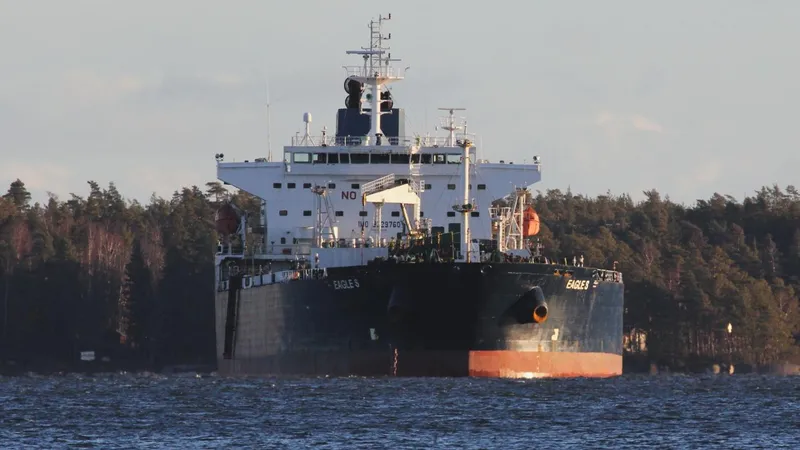
The master, first officer, and second officer of the tanker Eagle S, a vessel linked to Russia’s so-called “shadow fleet,” have been formally charged in Finland for the destruction of five subsea cables – including one power interconnector and four high-capacity telecom lines – in an incident that occurred on Christmas Day 2024. The announcement was made by the Finnish Office of the Prosecutor General.
In brief
The captain and first officers of the tanker Eagle S have been charged in Finland with damaging five undersea cables in the Gulf of Finland on Christmas Day 2024. According to investigators, the anchor of the vessel sailing from Ust-Luga with a cargo of oil was dragged along the seabed for about 90 km, and operators' losses amount to at least 60 million euros. Transmission through the EstLink2 link between Estonia and Finland was interrupted for six months, and energy exchange fell by around 650 MW. The defendants deny guilt and contest Finland's jurisdiction, and the case has gone to Helsinki District Court.
According to the investigation, the damage was caused by the vessel’s anchor dragging along the seabed for approximately 90 kilometres in the Gulf of Finland. The Eagle S, registered under the Cook Islands flag, was sailing from the Russian port of Ust-Luga laden with crude oil. Senior officers were responsible for navigation, safe passage, and vessel operations at the time of the incident.
Technical and economic impact
The most critical disruption affected the EstLink2 electricity interconnector between Estonia and Finland, which was taken out of service for six months. Several high-capacity telecom cables were also severed, posing significant risks to regional communications security.
Prosecutors estimate total losses for cable operators at no less than €60 million, covering repair costs and operational downtime. The EstLink2 outage temporarily reduced electricity transfer capacity between Estonia and Finland by approximately 650 MW.
Interception and detention
On 25 December, the Eagle S was intercepted by Finnish authorities in a night-time joint operation involving the Finnish Border Guard, police rapid-response units, and armed forces. More than 20 crew members were on board, mostly Georgian and Indian nationals.
After two months in port, the tanker departed Finland in March 2025, though several crew members – including the accused officers – remain under a travel ban pending trial.
Jurisdiction dispute and NATO involvement
The defendants deny the charges and contest Finland’s jurisdiction, arguing that the damaged cable segments were located outside Finnish territorial waters. The case will be heard before the Helsinki District Court.
The incident has become a catalyst for strengthened NATO measures to safeguard undersea critical infrastructure. In early 2025, the Baltic Sentry mission was launched, deploying allied naval units to patrol the Baltic Sea and Gulf of Finland, conducting routine seabed inspections and deterrence operations.
Source: Gazeta Morska / PAP · Compiled by: Kamil Kusier
Related articles
 Navy and defence Norwegian submarine Utstein completes NATO patrol guarding offshore oil and undersea infrastructure
 Safety and rescue Polish SAR’s new rescue vessel Mistral launched at Kewatec in Finland
 Safety and rescue Icelandic Coast Guard and police delegation visits Polish Border Guard’s Maritime Division
 Safety and rescue Polish Navy helicopter evacuates man from Baltic platform 100 km off Władysławowo
 Navy and defence SNMG2 joins Allied warships in PASSEX as Italy's Mare Aperto 2026 gets under way
 Safety and rescue From lightships to solar power: 160 years of the Grundkallen light station
Comments (0)
The discussion is moderated by the editors: a comment appears after review. Your e-mail address is not published.
Nobody has commented on this article yet.