









Dutch Coastguard charters a patrol vessel from a private owner. Enforcer, 53 metres and two RHIBs
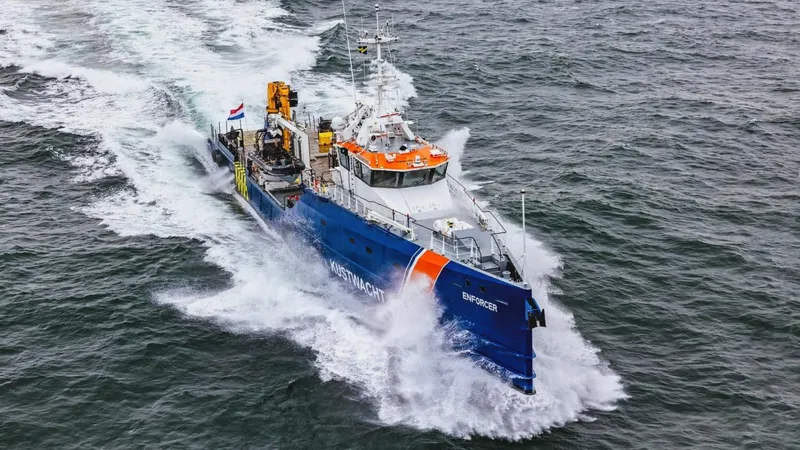
The new patrol vessel Enforcer has entered Den Helder, home base of the Netherlands Coastguard, for the first time. The 53-metre vessel, built by Damen Shipyards in Gorinchem, was handed over to the Coastguard on 15 September by its owner, Multraship of Terneuzen, acting on behalf of the state fleet operator Rijkswaterstaat Rijksrederij. Enforcer remains Multraship's property, with the company providing the nautical crew and maintenance, while the Coastguard holds operational command. Boarding officers from the police, customs and the Royal Netherlands Marechaussee embark for enforcement duties. The coming weeks will be spent on trials and working up the crew before the vessel takes up duties in the North Sea.
In brief
The 53-metre patrol vessel Enforcer has entered Den Helder, base of the Dutch coastguard Kustwacht Nederland, for the first time. Damen Shipyards in Gorinchem built the vessel, and Terneuzen shipowner Multraship, which still owns, crews and maintains it, handed it over on 15 September, with Kustwacht in operational command. Enforcer has two fast RHIBs, a crane, a towing device and a FiFi 1 firefighting system, makes about 27 knots and runs on renewable HVO100 fuel. The charter, announced in November 2025, bridges the gap until the delayed new generation of coastguard vessels enters service.
The Dutch have chosen a model that barely exists in Poland: the state does not buy the vessel but charters it from a private towage and salvage company together with its crew, while the government services supply only the personnel exercising public powers. Multraship already provides the Coastguard with three emergency response and towing vessels, Guardian, Commander and Protector. Enforcer is the fourth vessel in the arrangement and the first designed from the outset as a patrol ship.
Two RHIBs, a crane, towing gear and FiFi 1
Enforcer is a multi-role vessel. For inspections and boardings it carries two fast RHIBs, allowing inspection teams to reach other ships quickly and go aboard. It also has a large crane, towing equipment, a FiFi 1 fire-fighting system and salvage pumps, so beyond surveillance and enforcement it can take part in rescue operations and assist at incidents. Top speed is around 27 knots.
The vessel meets the Tier III emission standard and runs on HVO100 renewable diesel, which the owner and Rijkswaterstaat highlight as part of a shared policy of cleaner shipping in the North Sea.
A gap to be closed
The reason for the charter is simple. The Coastguard's tasks in the North Sea are growing: wind farms, critical infrastructure, supervision of ever denser traffic around Rotterdam and Antwerp, and border and customs checks. At the same time the new generation of coastguard vessels, including three methanol-electric emergency towing vessels, is delayed. Enforcer is to guarantee continuity until they enter service. The charter was announced in November 2025 and the vessel was delivered ten months later.
The Netherlands Coastguard is not a separate service but an organisation in which several agencies cooperate: police, customs, the Marechaussee, the navy and Rijkswaterstaat. Its operations centre in Den Helder coordinates vessels belonging to different owners, including those chartered from private companies. Since June the Coastguard has had a new director, Klaasjan Schipper.
What it means for Poland
Poland's maritime services, the Border Guard, the maritime offices and SAR, face the same growing tasks in the Baltic: offshore wind farms, cables, terminals, the shadow fleet, and ever more frequent inspections, tows and assistance operations. New patrol and rescue vessels are planned or under construction, but each of those programmes runs to years. The Dutch model shows that the gap between today and the delivery of new ships can be closed with a vessel chartered from a domestic owner, with its crew and maintenance, under the operational command of the service.
Poland has towage and salvage operators that could play that role, and Damen has a yard in Gdynia. The question is whether the state is prepared to separate ownership of a vessel from authority over it, as the Dutch have done, or whether it will wait for hulls of its own.
Source: Gazeta Morska · Compiled by: Kamil Kusier
Related articles
 Safety and rescue Polish SAR’s new rescue vessel Mistral launched at Kewatec in Finland
 Safety and rescue Icelandic Coast Guard and police delegation visits Polish Border Guard’s Maritime Division
 Safety and rescue Polish Navy helicopter evacuates man from Baltic platform 100 km off Władysławowo
 Navy and defence SNMG2 joins Allied warships in PASSEX as Italy's Mare Aperto 2026 gets under way
 Safety and rescue From lightships to solar power: 160 years of the Grundkallen light station
 Education 254 people, manikins and life rafts: Maritime University of Szczecin joins national CPR record attempt
Comments (0)
The discussion is moderated by the editors: a comment appears after review. Your e-mail address is not published.
Nobody has commented on this article yet.