









Drones instead of divers. Belgian mine hunter Oostende advances toward full operational capability
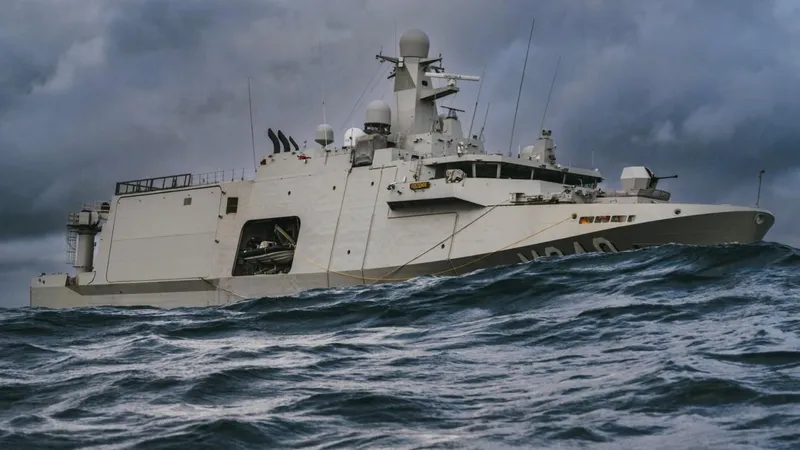
The Belgian Navy has reached another milestone in the development of its next-generation mine warfare capabilities. During a series of sea trials conducted off the coast of Brittany, the mine countermeasures vessel M940 Oostende successfully tested its integrated unmanned systems package directly from the ship for the first time. The trials underline a broader transformation taking place across NATO navies, where autonomous technologies are increasingly replacing traditional mine-hunting methods.
In brief
The Belgian mine countermeasures vessel M940 Oostende conducted the first sea trials of the full set of unmanned systems, known as the toolbox, in the Bay of Douarnenez off the coast of Brittany. The trials, involving the crew and specialists of the Mine Countermeasures Module Group, covered unmanned surface vessels USV, autonomous underwater vehicles AUV, ROV robots and sonar systems for detecting and neutralising mines. M940 Oostende is the first vessel of the Belgian-Dutch rMCM programme, in which Belgium and the Netherlands ordered twelve ships, carried out by the Belgium Naval & Robotics consortium with the participation of Naval Group and Exail.
A new phase of sea trials
Over recent weeks, M940 Oostende operated in the Bay of Douarnenez, a well-known French testing area frequently used for naval trials and underwater systems evaluations.
The vessel conducted operational tests involving the Mine Countermeasures Module Group (MMG) and the so-called “toolbox” - a comprehensive package of unmanned platforms designed to detect, classify and neutralize naval mines remotely.
While elements of the system had previously been evaluated ashore using a mobile command-and-control container replicating the vessel’s operational environment, the latest exercises marked a significant breakthrough. For the first time, the Belgian Navy executed these missions directly from the ship using its own crew and MMG operators.
The evolution of mine warfare
Mine warfare remains one of the most challenging domains in naval operations. Naval mines continue to pose threats to commercial shipping, naval deployments, offshore energy infrastructure and strategic maritime chokepoints.
Traditional minehunters were required to enter potentially dangerous waters and conduct slow, methodical searches using onboard sonars and remotely operated vehicles. Modern concepts, however, are changing this paradigm entirely.
The Oostende is designed to remain at a safe distance from hazardous areas while deploying multiple unmanned systems capable of carrying out detection, identification and neutralization missions autonomously or through remote control.
This approach significantly reduces risks to personnel while increasing operational efficiency and coverage.
The "toolbox" concept
At the heart of the Belgian-Dutch replacement Mine Counter Measures (rMCM) programme lies the concept of a modular unmanned systems package.
The toolbox includes unmanned surface vehicles (USVs), autonomous underwater vehicles (AUVs), remotely operated vehicles (ROVs) and advanced sonar systems capable of surveying large seabed areas with high precision.
Once suspicious objects are detected, dedicated robotic systems can conduct detailed inspections and, if necessary, deploy neutralization charges without exposing divers or crew members to direct danger.
The model represents one of the most advanced operational concepts currently being introduced within NATO mine warfare forces.
Strategic programme for Europe
The Oostende is the first Belgian vessel delivered under the Belgian-Dutch rMCM programme - one of Europe’s most ambitious naval modernization projects in the field of mine countermeasures.
The programme aims to replace the ageing Tripartite-class minehunters that have served both navies for decades. In total, Belgium and the Netherlands have ordered twelve next-generation vessels equipped with advanced unmanned capabilities.
The project is being delivered by Belgium Naval & Robotics, a consortium bringing together French defence companies Naval Group and Exail.
Beyond fleet modernization, the programme is widely viewed as a benchmark for future mine warfare developments across Europe and NATO.
Lessons for the Baltic Sea region
The successful sea trials are particularly relevant for countries operating in the Baltic Sea, where mine warfare remains a critical security concern.
The region contains large quantities of historical mines and unexploded ordnance dating back to both World Wars. At the same time, recent concerns regarding the protection of subsea infrastructure, energy assets and communication cables have renewed attention on maritime security and seabed surveillance capabilities.
Advanced autonomous mine countermeasure systems, such as those being tested aboard Oostende, could become increasingly important for ensuring freedom of navigation and protecting critical maritime infrastructure in Northern Europe.
Towards operational readiness
The latest trials demonstrate that the Belgian Navy is steadily progressing toward full operational deployment of its new flagship mine warfare capability.
As autonomous technologies continue to reshape naval operations, vessels such as Oostende illustrate how future fleets may rely less on traditional platforms and more on networks of unmanned systems operating across the surface, underwater and digital domains.
For NATO navies facing increasingly complex maritime security challenges, the success of these trials offers a glimpse into the future of mine countermeasures at sea.
Source: Gazeta Morska · Compiled by: Kamil Kusier
Related articles
 Safety and rescue Polish SAR’s new rescue vessel Mistral launched at Kewatec in Finland
 Safety and rescue Icelandic Coast Guard and police delegation visits Polish Border Guard’s Maritime Division
 Safety and rescue Polish Navy helicopter evacuates man from Baltic platform 100 km off Władysławowo
 Navy and defence SNMG2 joins Allied warships in PASSEX as Italy's Mare Aperto 2026 gets under way
 Safety and rescue From lightships to solar power: 160 years of the Grundkallen light station
 Education 254 people, manikins and life rafts: Maritime University of Szczecin joins national CPR record attempt
Comments (0)
The discussion is moderated by the editors: a comment appears after review. Your e-mail address is not published.
Nobody has commented on this article yet.