









Deck landing over winch hoist. Polish naval helicopter evacuates 19-month-old from ferry Stena Estelle
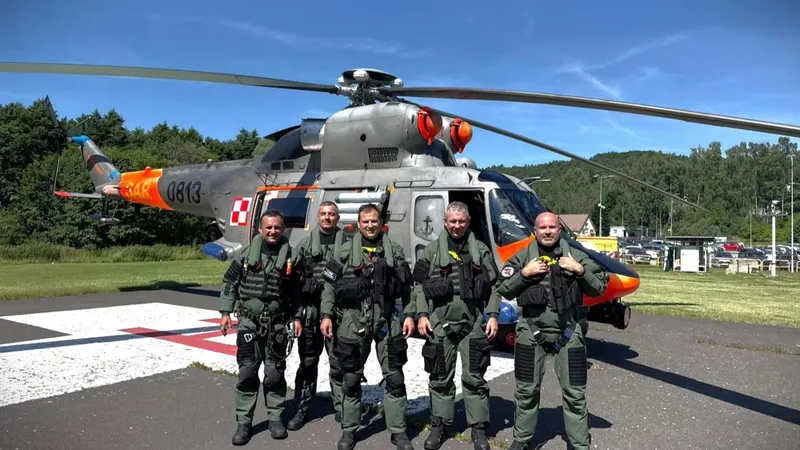
Shortly before 11:00, a W-3 WARM crew from the Polish Naval Aviation Brigade was scrambled to the ferry Stena Estelle. A 19-month-old child on board needed urgent medical help. Within roughly a quarter of an hour of pick-up, the patient was in hospital in Wejherowo, near Gdańsk.
In brief
The crew of a W-3 WARM helicopter of the Naval Aviation Brigade evacuated a 19-month-old child from the ferry Stena Estelle. The call came in just before 11:00, and the commander decided to land on the ferry deck rather than hoist the patient, after assessing weather conditions, fuel reserves and the child's condition. After a dozen or so minutes of flight, the child and mother were taken to hospital in Wejherowo. Since the start of 2026 the Naval Aviation Brigade has carried out 15 medical missions over the Baltic, and the unit has 841 rescue missions in total.
Why the crew put the aircraft on the deck
The defining call of the mission was how the patient came off the ship. Instead of the standard hover and winch extraction, the aircraft commander chose to land on the ferry's deck. The decision followed a rapid assessment of three variables at once: weather, fuel state and the child's condition. The child and his mother were treated on board the ferry and then taken into the helicopter.
For rescue crews, that distinction matters. Winching is the most demanding phase of any evacuation from a vessel under way, and with a patient of this age moved together with a parent, the risk profile rises on both ends of the cable. A deck landing removes that phase altogether and compresses the timeline. It also depends on conditions the commander has minutes to judge: a vessel with usable deck space, relative wind, deck movement and obstructions around the touchdown point.
The choice of platform carries its own logic. Large ferries on Baltic routes carry several hundred passengers with deliberately basic onboard medical provision. When a paediatric emergency develops mid-passage, the alternative to a helicopter is completing the voyage to port, a difference measured in hours rather than minutes.
A first operational mission for a new rescue crewman
The sortie had a second significance for the brigade. It was the first real-world rescue flight for a newly qualified rescue crewman. In rescue aviation, that debut closes a long training cycle, and drawing a paediatric patient on the first live task is not among the gentler introductions. The brigade described his conduct as composed and professional.
Fifteen medical sorties so far this year
The Stena Estelle evacuation sits within a running tally the brigade maintains. Since the start of 2026, Polish naval aviators have flown 15 medical missions over the Baltic. The unit's cumulative total stands at 841 rescue missions.
Fifteen sorties in under seven months averages out at more than two a month. Each represents a case in which onboard care or continuing to port stopped being sufficient.
Rescue flying is a standing task for the Naval Aviation Brigade. The W-3 WARM, the search and rescue variant of the PZL W-3 Sokół, stands duty in the Polish SAR region and covers both survivor recovery and medical evacuation from vessels. What determines the outcome is rarely the flight alone but the full chain: alert, extraction and handover to a hospital able to take the case.
The brigade did not comment on the child's condition following admission in Wejherowo.
Context for operators
Medical evacuation from passenger ferries is a recurring planning assumption for Baltic operators rather than an exceptional event. Two practical points follow from this mission. First, deck geometry is an operational asset: vessels with clear, certified or at least usable landing areas give rescue commanders an option that materially shortens the sequence. Second, the value of the flight is capped by what happens after it, which makes the standing arrangements between naval aviation and shoreside emergency medicine as important as aircraft availability.
Source: Gazeta Morska · Compiled by: Michał Iwański
Related articles
 Safety and rescue Polish SAR’s new rescue vessel Mistral launched at Kewatec in Finland
 Safety and rescue Icelandic Coast Guard and police delegation visits Polish Border Guard’s Maritime Division
 Safety and rescue Polish Navy helicopter evacuates man from Baltic platform 100 km off Władysławowo
 Navy and defence SNMG2 joins Allied warships in PASSEX as Italy's Mare Aperto 2026 gets under way
 Safety and rescue From lightships to solar power: 160 years of the Grundkallen light station
 Education 254 people, manikins and life rafts: Maritime University of Szczecin joins national CPR record attempt
Comments (0)
The discussion is moderated by the editors: a comment appears after review. Your e-mail address is not published.
Nobody has commented on this article yet.