









Daredevil jumps from Gdynia’s torpedo station highlight deadly risks of reckless behaviour at sea
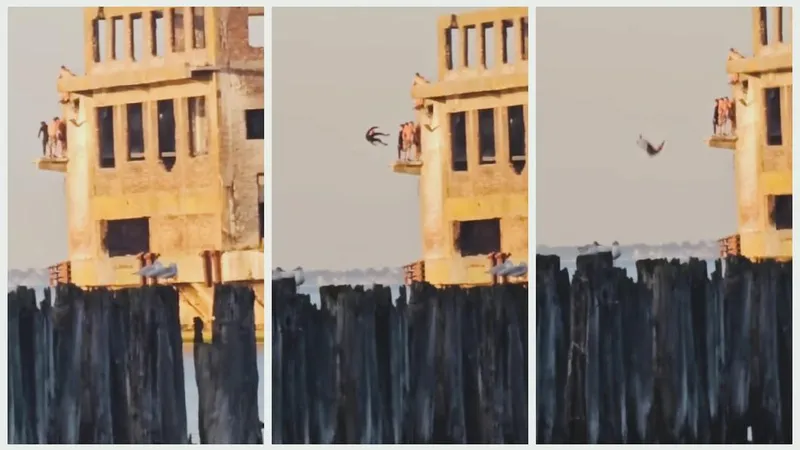
A recent police intervention in Gdynia, Poland, where a group of young people were caught jumping into the sea from the ruins of the former torpedo research station in Babie Doły, serves as yet another reminder of how dangerous reckless behaviour near water can be. This decaying World War II relic has long attracted thrill-seekers, but it has also become the site of countless accidents — some of them fatal.
In brief
Police in Gdynia intervened against a group of young people jumping into the water from the ruins of the torpedo station in Babie Doły, a site of accidents every year, including fatal ones. According to WOPR data, 187 drownings were recorded in 2024 and 131 in 2025, with 31 cases in June, 52 in July and 48 in August. WOPR lifeguards list swimming at unguarded spots, leaving children unattended, entering the water after drinking alcohol and ignoring the red flag, which means a ban on entering the water, as the most common mistakes.
Drowning statistics show improvement but risks remain
According to Poland’s national lifeguard service (WOPR), summer is always the most dangerous time of year on the water. It is during the holiday season that the majority of drownings occur. Yet this summer has shown a marked improvement.
- 2024: 187 drownings (52 in June, 83 in July, 52 in August).
- 2025: 131 drownings (31 in June, 52 in July, 48 in August).
That’s a significant drop of 56 fatalities. Cooler weather may have kept beachgoers away, but lifeguards also point to growing public awareness and increasing respect for safety rules as key factors. Still, every drowning is a tragedy — and every tragedy is one too many.
The red flag is not optional
One of the recurring issues lifeguards face is swimmers ignoring warnings. The red flag is not a suggestion, nor an attempt to spoil the fun — it is a direct signal that the sea is too dangerous for swimming. In such conditions, the water should only be admired from the safety of the beach, at a proper distance from the shoreline.
Lifeguards stress that a red flag is never raised lightly. It is always based on weather, current strength, or wave conditions that pose a genuine threat to life.
Common mistakes that cost lives
Despite repeated public safety campaigns, lifeguards say the same mistakes cause tragedies every year:
- Swimming at unguarded beaches where no lifeguards are present.
- Leaving children unattended even in shallow water.
- Alcohol consumption before swimming, often combined with blazing sun exposure — the single most common factor in adult drownings.
- Ignoring police or lifeguard instructions, forgetting that interventions are aimed at saving lives, not limiting freedom.
A shared responsibility
While the drop in drowning cases is encouraging, it must not lead to complacency. Each fatality is a stark reminder that water safety depends not only on lifeguards and police, but also on individual responsibility. Recklessness at sea, as seen at Gdynia’s torpedo station, can turn deadly in seconds.
To keep the positive trend alive, experts stress three essentials: awareness, caution, and respect for the rules. Only then can summer by the water remain a time of joy rather than tragedy.
Gdynia’s torpedo station – from Nazi Germany’s research hub to dangerous ruin
During World War II, Nazi Germany operated two torpedo research centres in Gdynia (then Gotenhafen): Torpedowaffenplatz Hexengrund in Babie Doły, run by the Luftwaffe, and Torpedo Versuchsanstalt Oxhöft in Oksywie, operated by the Kriegsmarine. Both facilities carried out intensive testing of aerial and acoustic torpedoes.
The Babie Doły torpedo station was built on concrete caissons sunk around 300 metres offshore. It housed assembly halls, engineering rooms and an observation tower used to track torpedo test runs. Torpedoes fired into the Bay of Gdańsk were later retrieved and analysed.
After the war, the facility was abandoned, stripped of equipment by the Soviet army and left to decay. Harsh winters in the late 1970s and 1980s caused the façade to collapse, while the remaining pier was demolished in the 1990s. Today, the ruins are unstable, hazardous and strictly unsuitable for recreation.
Despite this, the silhouette of the torpedo station remains a striking landmark on the Baltic coast, featured in Polish TV and films. But authorities warn: for those who treat it as a playground for daredevil stunts, it can easily become a death trap.
Source: Gazeta Morska · Compiled by: Kamil Kusier
Related articles
 Maritime economy Poland’s constitutional crisis is also a maritime story
 Navy and defence Norwegian submarine Utstein completes NATO patrol guarding offshore oil and undersea infrastructure
 Safety and rescue Polish SAR’s new rescue vessel Mistral launched at Kewatec in Finland
 Safety and rescue Icelandic Coast Guard and police delegation visits Polish Border Guard’s Maritime Division
 Safety and rescue Polish Navy helicopter evacuates man from Baltic platform 100 km off Władysławowo
 Navy and defence SNMG2 joins Allied warships in PASSEX as Italy's Mare Aperto 2026 gets under way
Comments (0)
The discussion is moderated by the editors: a comment appears after review. Your e-mail address is not published.
Nobody has commented on this article yet.