









A new era for Polish maritime SAR: MSPiR signs contract for six self-righting rescue vessels
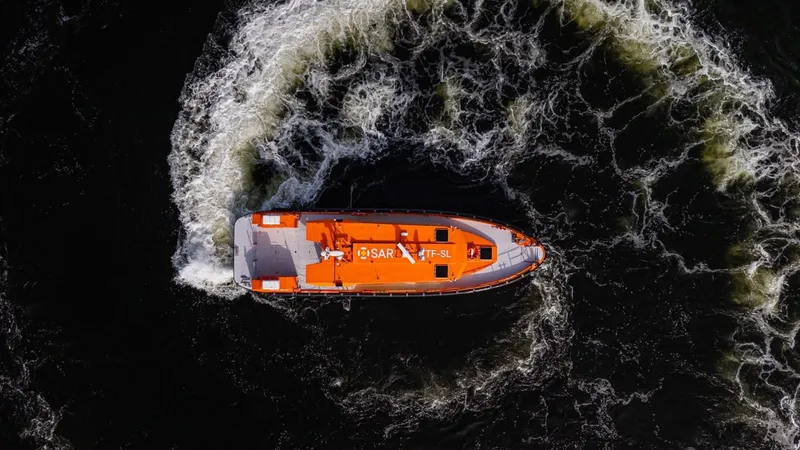
The Polish Maritime Search and Rescue Service (MSPiR SAR) has officially signed a contract with the Finnish shipbuilder Kewatec AluBoat for the construction and delivery of six new rescue vessels. In Poland, these craft will be designated SAR 2000, while in the builder’s catalogue they are known as the Rescue 1700 type.
In brief
The Maritime Search and Rescue Service has signed a contract with the Finnish manufacturer Kewatec AluBoat for the construction of six Rescue 1700 rescue vessels, designated SAR 2000 in Poland. First deliveries to the Maritime Search and Rescue Service are scheduled for October 2026, and the new vessels will replace the SAR 1500 units currently in service. The Rescue 1700 is about 16.9 m long, with two Scania DI13 engines of around 551 kW and HamiltonJet HJ403 waterjets giving 30 to 40 knots. Sebastian Kluska, director of the Maritime Search and Rescue Service, announced that two SAR 1500 vessels will be kept in reserve.
The first deliveries are expected in October 2026, with the remainder joining the fleet shortly after.
- The coming year will be a turning point in terms of modernizing our equipment, which directly translates into greater safety for people at sea and enhanced protection of the marine environment, said Sebastian Kluska, Director of MSPiR SAR.
Fleet renewal and generational shift
The arrival of the new SAR 2000s will mark the gradual replacement of the long-serving SAR 1500 units.
- The Rescue 1700 design, already proven in harsh operational environments such as Iceland, will replace our current SAR 1500 boats. However, we plan to keep two of the older units in reserve, Sebastian Kluska explained.
This transition represents a generational shift in Poland’s SAR capability, equipping the service with faster, more maneuverable, and significantly safer assets for maritime rescue.
Proven in Icelandic waters
The Rescue 1700 is already in operational use with ICE-SAR, the Icelandic Search and Rescue service. Six such vessels have been deployed in the North Atlantic, where crews face some of the world’s harshest maritime conditions — extreme waves, freezing spray, and frequent storms.
The fact that Poland’s MSPiR opted for the same design demonstrates the vessel’s credibility, resilience, and mission-ready pedigree.
Technical profile: Rescue 1700 (SAR 2000)
The Rescue 1700 is an aluminium self-righting rescue vessel (samoprostująca się jednostka ratownicza), engineered to continue operations even after a full capsize. This capability is essential for crews operating in adverse weather, where survivability of both rescuers and casualties depends on vessel stability.
The design adheres to international standards for search and rescue craft, providing robust performance in offshore conditions while maintaining agility close to shore.
Principal dimensions
- Length overall: ~16.9 m
- Beam: ~4.8–4.9 m
- Fuel capacity: 1,800–5,000 L (depending on configuration)
- Crew capacity: typically 12 persons
- Rescue capacity: up to 30–50 survivors in emergencies
Propulsion and performance
Each vessel is equipped with:
- 2 × Scania DI13 engines (~551 kW each)
- 2 × HamiltonJet HJ403 waterjets
This configuration delivers maximum speeds of 30–40 knots, allowing rapid response in time-critical SAR scenarios.
Thanks to waterjet propulsion, the Rescue 1700 can safely operate in shallow waters, with no risk of damaging conventional propeller shafts. The system also ensures superior maneuverability, enabling crash-stops, lateral moves, and high-precision approaches to survivors. Importantly, waterjets eliminate the hazard of exposed propellers, improving safety when operating near people in the water.
Variants and mission flexibility
The Rescue 1700 is offered in several versions:
- SAR configuration – optimized for maritime rescue operations.
- FiFi 1700 (fire fighting) – outfitted with advanced firefighting systems, capable of combating fires on vessels or offshore structures.
Standard fit-out includes:
- Integrated navigation and communication suites.
- Survivor recovery systems (including platforms and rescue baskets).
- Dedicated medical space for first aid and stabilization.
Safety and survivability
- Self-righting capability ensures vessel recovery after capsize.
- Aluminium construction provides corrosion resistance and durability.
- Proven track record – the type has already demonstrated reliability in extreme North Atlantic service with ICE-SAR.
Conclusion: a major step forward for Poland’s SAR
The acquisition of six Rescue 1700 vessels represents one of the most significant modernizations of Poland’s SAR fleet in decades.
- These vessels are not just an investment in hardware, but in the safety of everyone who uses Polish waters. With the SAR 2000, we will be faster, more effective, and better prepared to face the challenges of the Baltic Sea, Director Kluska emphasized.
With the first deliveries scheduled for 2026, the Polish MSPiR SAR is set to enter a new era of operational capability, strengthening maritime safety and environmental protection in the Baltic region.
Source: Gazeta Morska · Compiled by: Kamil Kusier
Related articles
 Safety and rescue Polish SAR’s new rescue vessel Mistral launched at Kewatec in Finland
 Safety and rescue Icelandic Coast Guard and police delegation visits Polish Border Guard’s Maritime Division
 Safety and rescue Polish Navy helicopter evacuates man from Baltic platform 100 km off Władysławowo
 Navy and defence SNMG2 joins Allied warships in PASSEX as Italy's Mare Aperto 2026 gets under way
 Safety and rescue From lightships to solar power: 160 years of the Grundkallen light station
 Education 254 people, manikins and life rafts: Maritime University of Szczecin joins national CPR record attempt
Comments (0)
The discussion is moderated by the editors: a comment appears after review. Your e-mail address is not published.
Nobody has commented on this article yet.