









Counter-terrorism exercise secures LNG Terminal in Świnoujście
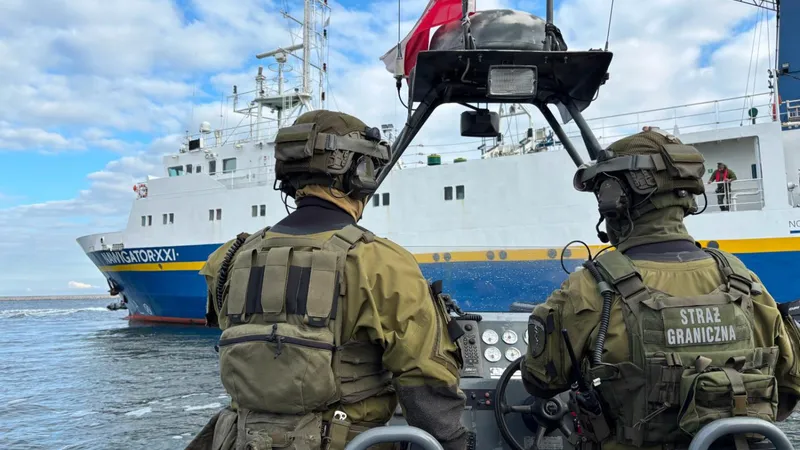
A week-long joint training operation has concluded in the port waters of Świnoujście, where Polish security forces tested their readiness to respond to threats against critical maritime infrastructure. The exercise brought together nearly one hundred officers from the Police Counter-Terrorist Units (BOA), the Border Guard and the Military Police.
In brief
A week-long critical infrastructure protection exercise concluded in the port waters of Świnoujście with nearly one hundred Police officers, Polish Border Guard officers and Military Gendarmerie soldiers taking part. The organiser was the Police Central Counter-Terrorism Unit BOA, and the scenario included storming a ship blocking tanker access to the LNG Terminal in Świnoujście, boarding from RIB boats and a landing from an S-70i Black Hawk helicopter. Minister of the Interior and Administration Marcin Kierwiński pointed to growing terrorist threats involving the use of drones and incidents inspired by Russian special services.
Simulated assault on hostile vessel
The central scenario focused on Poland’s LNG terminal – a strategic energy facility ensuring the country’s independence from Russian gas supplies. Special forces conducted a coordinated assault on a vessel blocking the fairway leading to the terminal.
The operation included boarding manoeuvres from RIB fast craft, helicopter insertions from a Police S-70i Black Hawk, and simultaneous deployment of assault teams onto the quay to retake control of port facilities. Specially trained service dogs supported the action, providing additional operational capabilities and realism.
Protection against emerging threats
The exercise, designed to enhance inter-agency cooperation, also tested rapid response capabilities against modern threats, including the use of drones. Minister of Interior and Administration Marcin Kierwiński, who observed the action at the terminal, highlighted the growing importance of such training:
- In the context of events beyond our eastern border, the September drone attack, and incidents faced by our EU and NATO partners – such as in Copenhagen – we see that terrorist threats, especially those involving drones, are constantly increasing. These incidents are inspired by Russian intelligence services. This is why joint training and cooperation between services are so crucial. Our counter-terrorists are a world-class elite – outstanding professionals who safeguard our security every day, said Minister Kierwiński.
The Minister further stressed the strategic role of the LNG terminal:
- The purpose of these exercises, with the participation of nearly one hundred officers from the Police, Border Guard and Military Police, is to ensure effective protection of critical infrastructure. They are taking place at a unique location – Poland’s LNG terminal – a strategic investment requiring special protection.
Strengthening maritime security
As part of the training, forces refined boarding techniques for various vessel types, including passenger ferries, and practised helicopter-borne insertions. The exercise also validated coordination protocols between maritime, airborne and land-based units, ensuring they can respond simultaneously to multi-domain threats.
Poland’s security agencies continue to invest in advanced systems for the detection, interception and neutralisation of unmanned aerial vehicles. The integration of such systems into maritime security operations reflects lessons drawn from recent incidents across Europe, underlining the necessity of resilient infrastructure defence.
Source: Gazeta Morska · Compiled by: Kamil Kusier
Related articles
 Safety and rescue Polish SAR’s new rescue vessel Mistral launched at Kewatec in Finland
 Safety and rescue Icelandic Coast Guard and police delegation visits Polish Border Guard’s Maritime Division
 Safety and rescue Polish Navy helicopter evacuates man from Baltic platform 100 km off Władysławowo
 Navy and defence SNMG2 joins Allied warships in PASSEX as Italy's Mare Aperto 2026 gets under way
 Safety and rescue From lightships to solar power: 160 years of the Grundkallen light station
 Education 254 people, manikins and life rafts: Maritime University of Szczecin joins national CPR record attempt
Comments (0)
The discussion is moderated by the editors: a comment appears after review. Your e-mail address is not published.
Nobody has commented on this article yet.