









Chinese fighter jet spotted over Saudi port hosting U.S. naval vessels
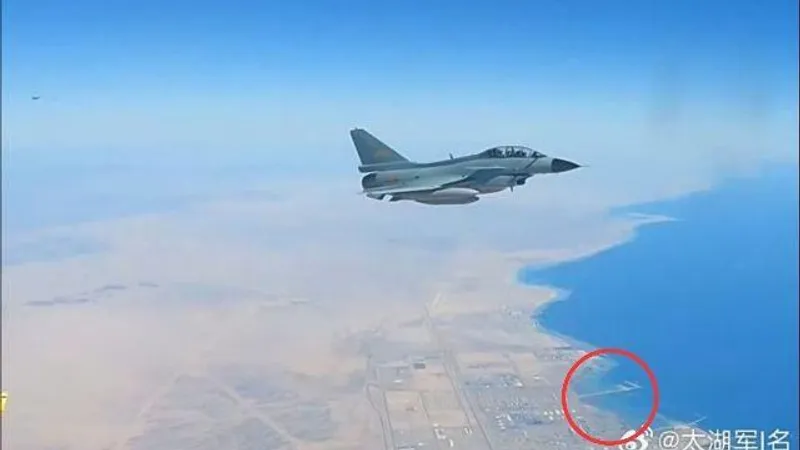
A Chinese J-10C fighter jet was recently photographed flying at low altitude over King Fahd Port in Yanbu, Saudi Arabia—a critical maritime hub that routinely services U.S. Navy vessels, including those supporting the nuclear-powered aircraft carrier USS Harry S. Truman.
In brief
A Chinese J-10C fighter was photographed flying at low altitude over King Fahd Port in Yanbu, Saudi Arabia, which services United States Navy vessels, including ships supporting the aircraft carrier USS Harry S. Truman. Four J-10C fighters, six Y-20 transport aircraft and a YU-20 tanker flew more than 6 thousand kilometres in mid-April from China to Egypt, where joint exercises with the Egyptian air force run until May. China's defence ministry denied reports that Egypt had ordered the J-10C.
Situated on the Red Sea, Yanbu Port is not only vital to Saudi Arabia—serving as a protective gateway to the holy city of Medina—but it is also considered one of the most strategically important U.S. logistical centers in the Middle East.
Photos circulating on social media over the past several days show the J-10C operating in close proximity to sensitive U.S. maritime infrastructure, raising eyebrows among defense analysts and Washington officials alike.
The overflight occurred during a long-range deployment of Chinese military aircraft, which included four PLAAF J-10Cs, six Y-20 strategic transport aircraft, and a YU-20 aerial refueling tanker. The mission, conducted in mid-April, covered a distance of over 6,000 kilometers from China to Egypt. A KJ-500 airborne early warning and control (AEW&C) aircraft—a high-end platform used for intelligence, surveillance, and reconnaissance—was also part of the deployment, though it was reportedly transported aboard one of the Y-20s. Chinese state broadcaster CCTV confirmed the aircrafts' arrival and presence in Egypt.
These aircraft are participating in joint exercises with the Egyptian Air Force through May—an event that has caused visible unease in Washington, given the United States’ long-standing defense partnership with Cairo. Even more concerning for U.S. defense circles is the participation of the J-10C fighters in the drills, amid growing speculation—fueled by regional media—that Egypt may have already placed an order for the jets.
While China’s Ministry of Defense has dismissed these reports as misinformation, Military Watch Magazine suggests that the deployment and flight activity strongly indicate Egypt is seriously evaluating the J-10C as part of a broader effort to modernize its aging air fleet and diversify away from U.S. suppliers.
The strengthening of Chinese-Egyptian defense ties comes at a time of increasing strain between Cairo and Washington—tensions that escalated in part due to the Trump administration’s proposal to relocate Palestinians from Gaza, an idea Egypt has repeatedly rejected.
The high-profile drills in Egypt, coupled with the provocative low-level flyby over a U.S.-linked Saudi port, highlight a growing trend: North Africa and the Middle East are fast becoming new arenas for strategic competition between China and the United States. Under President Xi Jinping, China has significantly expanded its footprint across the region, leveraging the gradual retreat of Western influence.
Source: PAP / Gazeta Morska · Compiled by: Tadeusz Brzozowski
Related articles
 Safety and rescue Polish SAR’s new rescue vessel Mistral launched at Kewatec in Finland
 Safety and rescue Icelandic Coast Guard and police delegation visits Polish Border Guard’s Maritime Division
 Safety and rescue Polish Navy helicopter evacuates man from Baltic platform 100 km off Władysławowo
 Navy and defence SNMG2 joins Allied warships in PASSEX as Italy's Mare Aperto 2026 gets under way
 Safety and rescue From lightships to solar power: 160 years of the Grundkallen light station
 Education 254 people, manikins and life rafts: Maritime University of Szczecin joins national CPR record attempt
Comments (0)
The discussion is moderated by the editors: a comment appears after review. Your e-mail address is not published.
Nobody has commented on this article yet.