









Canada's Arctic patrol ship HMCS William Hall visits London
The Royal Canadian Navy consistently frames the oceans as the link binding Canada to the wider world to its security, prosperity and future. A port visit by the patrol ship HMCS William Hall to London illustrates the practical side of that narrative: how Ottawa combines the defence of sovereignty in the High North with a forward military presence and naval diplomacy on the other side of the Atlantic.
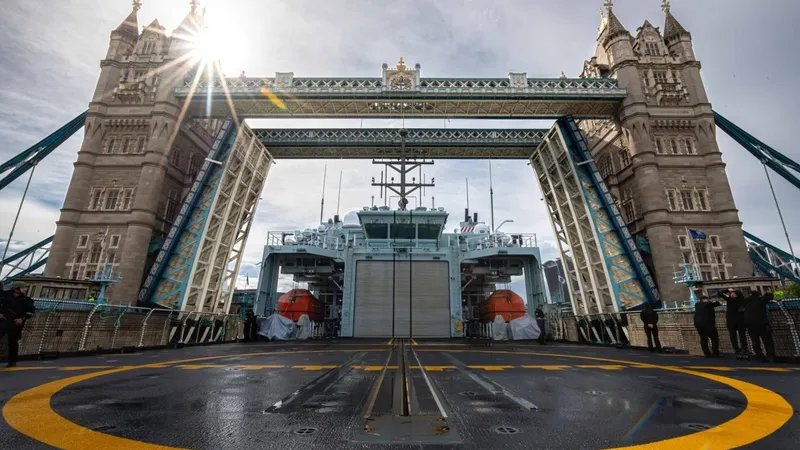
In brief
HMCS William Hall, the fourth Harry DeWolf-class Arctic patrol ship of the Royal Canadian Navy, called at London and moored alongside the museum cruiser HMS Belfast. The vessel, displacing about 6.6 thousand tonnes and more than 100 metres long, has a Polar Class 5 ice-class hull and diesel-electric propulsion. The deployment of HMCS William Hall in Europe supports exercises of the British Royal Navy. Earlier the ship transited the Northwest Passage, and in the Caribbean Sea together with the US Coast Guard contributed to the seizure of more than 1.3 tonnes of cocaine.
What HMCS William Hall is
HMCS William Hall is the fourth vessel of the Harry DeWolf class, an Arctic and Offshore Patrol Vessel (AOPV) of the Royal Canadian Navy. It is designed to operate in demanding conditions, including ice-covered waters. Ships of this class have a reinforced hull rated to ice class Polar Class 5, which allows independent navigation through thin ice — though it does not make them full-fledged icebreakers.
In terms of parameters, this is a large but lightly armed vessel built for patrol and support roles: roughly 6,600 tonnes displacement, more than 100 metres in length, diesel-electric propulsion, considerable range and high endurance. The design prioritises versatility, patrolling, carrying modular payloads on deck, supporting operations at sea, and maintaining a presence in areas where conventional warships operate less frequently. It is a tool for projecting state presence and enforcing the law, rather than a front-line combatant.
The London visit and its context
William Hall called at London, proceeding up the Thames and mooring near the museum cruiser HMS Belfast. The port visit forms part of the ship's deployment to the European side of the Atlantic, carried out in support of a Royal Navy exercise.
This is a routine yet significant element of naval activity: port visits build cooperation with partners and allies, sustain interoperability, and serve a representational function. For Canada, which places strong emphasis on transatlantic partnerships, the presence of one of its own vessels in a key European maritime capital carries both an operational and a diplomatic dimension.
Operational profile: from the Arctic to the Caribbean
The ship's task range best explains why Canada's argument about oceans "connecting Canada to the world" holds up in practice.
In the north, William Hall has conducted Canadian Arctic operations, including a transit of the well-known Northwest Passage, reinforcing the state's presence in waters subject to Canadian sovereignty claims. This is the core purpose of the class and a clear signal that Ottawa treats the Arctic as a priority.
In the south, the same ship operated in an entirely different theatre, a counter-narcotics operation in the Caribbean Sea, where, working alongside the United States Coast Guard, it contributed to the seizure of more than 1.3 tonnes of cocaine. Placing the two deployments side by side shows the flexibility of the platform: from enforcing sovereignty in the Arctic to cooperating against transnational crime in tropical waters.
The ship's namesake
The vessel is named after William Hall — a sailor who, as a member of a ship's company, was awarded the Victoria Cross for gallantry during the Relief of Lucknow in 1857. He was one of the first Canadians, and the first Black recipient among the Crown's subjects, to receive the decoration. A visit by a ship bearing his name to the British capital adds a further, historical layer to the event. The ship's motto reads Nec timemus nec vacillamus — "We do not fear or falter."
What it means for the maritime sector
From an industry standpoint, two conclusions follow from this visit.
First, Arctic-class patrol vessels, despite their modest armament, are becoming a versatile presence tool for maritime states — capable of combining sovereignty tasks, law enforcement, logistical support and port diplomacy within a single, relatively low-cost platform to operate. It is a trend worth watching given the growing importance of the Arctic and the need to maintain a sustained presence across vast sea areas.
Second, the case of William Hall demonstrates the coherence of Canada's maritime policy: defending sovereignty in the High North, keeping sea lanes open and secure, cooperating with allies on both sides of the Atlantic, and a stated commitment to the marine environment all add up to a single, legible strategic message. A single ship is rarely an entire national policy, but it can serve as an apt shorthand for one.
Source: Gazeta Morska · Compiled by: Kamil Kusier
Related articles
 Safety and rescue Polish SAR’s new rescue vessel Mistral launched at Kewatec in Finland
 Safety and rescue Icelandic Coast Guard and police delegation visits Polish Border Guard’s Maritime Division
 Safety and rescue Polish Navy helicopter evacuates man from Baltic platform 100 km off Władysławowo
 Navy and defence SNMG2 joins Allied warships in PASSEX as Italy's Mare Aperto 2026 gets under way
 Safety and rescue From lightships to solar power: 160 years of the Grundkallen light station
 Education 254 people, manikins and life rafts: Maritime University of Szczecin joins national CPR record attempt
Comments (0)
The discussion is moderated by the editors: a comment appears after review. Your e-mail address is not published.
Nobody has commented on this article yet.