









British commandos board the shadow fleet. A first-of-its-kind interdiction and charges for the captain
British commandos have for the first time seized a Russian shadow-fleet tanker at sea. In the early hours of 14 June, Royal Marines and NCA officers descended from helicopters onto the vessel Smyrtos in the English Channel, and her captain has been charged with breaching sanctions. The case, which traces back to the Baltic port of Ust-Luga, shows how far the West is prepared to go against the grey zone of Russian oil exports.
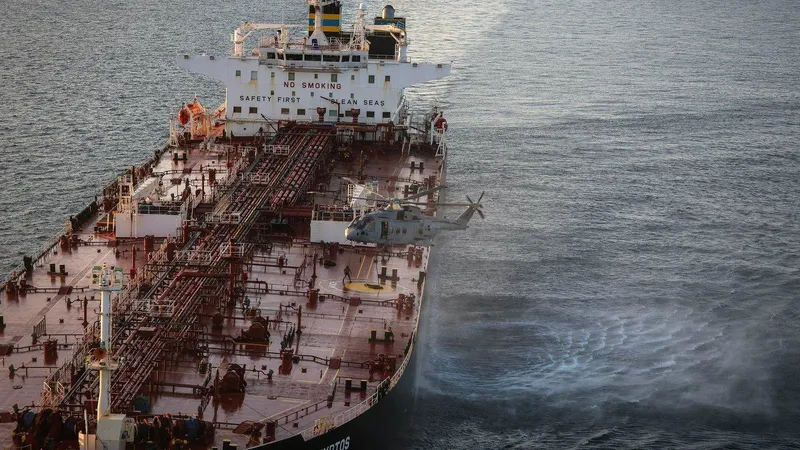
In brief
British Royal Marines commandos and NCA officers seized the tanker Smyrtos in the English Channel on the night of 14 June, detaining a vessel of Russia's shadow fleet for the first time. The Cameroon-flagged Smyrtos left the Baltic port of Ust-Luga on 5 June with a cargo of about 700 thousand barrels of Russian oil and was bound for Port Said. The vessel's master, 38-year-old Indian citizen Ajay Pant, was charged with breaching British sanctions, and the next court hearing in Bournemouth was set for 16 July. According to the British Ministry of Defence, the shadow fleet numbers more than 700 vessels and carries about 75 percent of sanctioned Russian oil.
A boarding in the English Channel
The operation was the first time British forces had boarded and detained a vessel of Russia's shadow fleet. In the early hours of 14 June, Royal Marine Commandos, alongside officers from the National Crime Agency (NCA), took control of the tanker, descending onto the deck on ropes from helicopters. Prime Minister Keir Starmer personally announced the action, framing it as another blow to the funding of Russia's war.
The vessel seized is the Smyrtos, sailing under a Cameroonian flag and carrying around 700,000 barrels of Russian oil. The ship had left the Baltic port of Ust-Luga on 5 June, bound for Port Said in Egypt. It had been on the UK sanctions list since October 2025 for its involvement in the shadow fleet; its registered owner is the Hong Kong company Zhao Yao Shipping, with its management listed in the Indian state of Tamil Nadu. The tanker is now at anchor off the south coast of England.
Charges for the captain
The vessel's master is Ajay Pant, a 38-year-old Indian national, detained on suspicion of sanctions offences. The Crown Prosecution Service (CPS) has charged him under the UK's Russia sanctions regulations with directly or indirectly supplying or delivering by ship prohibited Russian oil to a third country in June 2026. Pant appeared before Southampton Magistrates' Court by video link from custody, entered no plea, and the case was sent to the Crown Court in Bournemouth, where the next hearing is set for 16 July. The remaining 24 crew members, from Georgia and India, are still on board.
A wider sanctions push
The boarding came amid a broader wave of pressure. On 16 June London announced a new sanctions package covering 70 individuals and entities, including 27 ships carrying Russian oil and LNG to third countries, as well as insurers and shipping service providers. The day before, the Council of the EU adopted a further package, while the European Commission has proposed a 21st package that for the first time targets vessels providing services to the shadow fleet, including bunkering. The scale is considerable: according to the UK Ministry of Defence, the shadow fleet numbers more than 700 vessels and carries around 75% of Russia's sanctioned oil, and London has already placed restrictions on more than 500 ships. Russia's oil and gas revenues alone fell 24% year on year in 2025.
Law and risk
The interdictions rest on a combination of UK sanctions law and UNCLOS, which allows a warship to visit a vessel where there are reasonable grounds to suspect it has no nationality. Here lies a catch, however: recent analysis suggests shadow-fleet vessels are increasingly re-flagging as Russian in order to close that statelessness loophole. That would make detentions under UNCLOS harder and raise the risk of direct confrontation with Russia. Legal commentators are divided over whether carrying sanctioned oil negates the right of innocent passage at all. The issue also has a parliamentary dimension, with the UK's Armed Forces Bill before the House of Commons. The British precedent is not the first in Europe; French authorities have previously detained tankers including the Grinch and the Deyna.
Why it matters in the Baltic
The strongest local angle is the Smyrtos's point of departure. Ust-Luga, a Baltic port near St Petersburg, remains one of the shadow fleet's key hubs, and analysts expect Russia's response to be asymmetric: changes of route, including longer voyages around the British Isles to reduce risk. For Poland and the region, that means ageing, poorly insured tankers under false flags and with their AIS switched off will keep passing through the Baltic and the Danish straits on our doorstep, with all the attendant risk of breakdowns, spills and incidents. The British operation therefore sharpens the question of how the Baltic states will answer the same problem.
Source: Gazeta Morska · Compiled by: Michał Iwański
Related articles
 Safety and rescue Polish SAR’s new rescue vessel Mistral launched at Kewatec in Finland
 Safety and rescue Icelandic Coast Guard and police delegation visits Polish Border Guard’s Maritime Division
 Safety and rescue Polish Navy helicopter evacuates man from Baltic platform 100 km off Władysławowo
 Navy and defence SNMG2 joins Allied warships in PASSEX as Italy's Mare Aperto 2026 gets under way
 Safety and rescue From lightships to solar power: 160 years of the Grundkallen light station
 Education 254 people, manikins and life rafts: Maritime University of Szczecin joins national CPR record attempt
Comments (0)
The discussion is moderated by the editors: a comment appears after review. Your e-mail address is not published.
Nobody has commented on this article yet.