









Borsuks enter the water. Masurian test of new Polish Armed Forces equipment
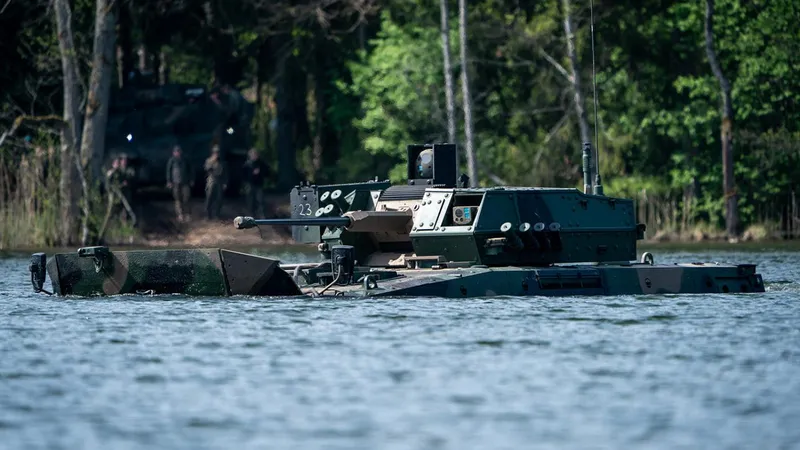
The first operational water crossings of Poland’s new Borsuk infantry fighting vehicles have taken place on Lake Kępno in the Masurian region. Conducted by the 15th Mechanised Brigade, the exercise tested amphibious performance, crew procedures, and vehicle behaviour in real lake conditions. The drills mark another stage in introducing the new platform into service with the Polish Armed Forces, while also underlining the continued operational importance of inland waters in Poland’s defence environment.
In brief
New Borsuk infantry fighting vehicles completed their first water crossings on Lake Kępno in Masuria. Exercises of the 15th Giżycko Mechanised Brigade tested swimming capability, vehicle behaviour on water and crew procedures for transitioning from land to water movement. The Borsuk, developed by Huta Stalowa Wola within Polska Grupa Zbrojeniowa, is intended to replace post-Soviet BWP-1 vehicles and is armed with the unmanned ZSSW-30 turret with a 30 mm cannon and Spike-LR missiles.
Masuria as a natural training environment
The area around Orzysz in north-eastern Poland has long served as one of the most important training grounds for the Polish Land Forces. Its dense network of lakes, wetlands, and limited road infrastructure creates a demanding environment that naturally shapes military training scenarios.
Within this setting, the recent amphibious exercises involving the Borsuk infantry fighting vehicles were conducted on Lake Kępno. The purpose was not only to validate technical performance, but also to assess crew coordination during transitions between land and water operations.
For soldiers of the 15th Mechanised Brigade, the drills represented an important step in adapting to a new generation of combat platforms, significantly different from the Soviet-era vehicles that are still being phased out.
Borsuk: a new generation of infantry fighting vehicle
The Borsuk infantry fighting vehicle is Poland’s first fully indigenous, clean-sheet design in this class. Developed under a national defence programme led by Huta Stalowa Wola and the Polish Armaments Group, it is intended to replace the long-serving BWP-1 platform.
One of its defining features is its amphibious capability without extensive preparation. Unlike many modern Western infantry fighting vehicles that have abandoned swimming capability in favour of heavier armour, Borsuk retains the ability to enter water directly after reaching the shoreline, without additional flotation equipment or lengthy preparation procedures.
This capability is particularly relevant in terrain-rich regions such as north-eastern Poland, where lakes, rivers, and marshlands often shape manoeuvre routes.
ZSSW-30 turret and networked combat capability
At the core of Borsuk’s combat system is the unmanned ZSSW-30 turret, developed by Poland’s defence industry in cooperation with WB Group.
The turret is equipped with a 30 mm automatic cannon and Spike-LR anti-tank guided missiles, providing a balanced capability against both infantry and armoured targets.
Equally important is its digital architecture. The system integrates sensors, fire control, and communications into a networked battlefield environment, allowing the vehicle to operate as part of a wider reconnaissance and command structure rather than as an isolated platform.
First operational experience with the 15th Mechanised Brigade
The first production vehicles have been delivered to units of the 15th Mechanised Brigade, part of Poland’s 16th Mechanised Division.
The brigade is responsible for a strategically significant area of north-eastern Poland, close to the borders with Russia’s Kaliningrad region and Lithuania. This area is widely regarded in defence planning as part of NATO’s critical eastern flank.
For crews, the Masurian exercises provide essential operational experience under conditions combining limited visibility, variable water depth, and complex shoreline terrain.
The transition from legacy infantry fighting vehicles to a modern digital platform requires not only technical training, but also a shift in tactical procedures and crew coordination.
Inland waters as an operational domain
While Masuria is widely known as a recreational and tourism region, from a defence perspective it represents one of the most complex operational environments in Poland.
Its dense hydrological network creates natural obstacles that significantly influence mobility planning. In this context, amphibious capability is not a niche feature but a practical requirement for rapid manoeuvre in fragmented terrain.
The ability of platforms such as Borsuk to cross water obstacles without engineering support reinforces the role of inland waterways as part of Poland’s broader mobility and defence infrastructure.
Industrial and strategic dimension
Beyond its operational role, the Borsuk programme is also one of Poland’s most important recent defence-industrial projects.
Led by Huta Stalowa Wola within the Polish Armaments Group, it involves a broad network of domestic industrial and research institutions. The programme strengthens national capacity in armoured vehicle production, electronics integration, and systems engineering.
It also contributes to the development of a domestic supply chain for advanced land systems, reducing dependence on foreign platforms in key capability areas.
A new phase of field deployment
The introduction of Borsuk into service with frontline units marks a transition from development and testing to operational deployment.
Each subsequent exercise, including the amphibious trials on Lake Kępno, provides additional data for both vehicle refinement and the evolution of operational procedures.
In this sense, the lakes of Masuria are becoming more than a training backdrop. They function as a living laboratory where Poland’s next-generation land mobility concepts are tested under real environmental conditions.
Source: Gazeta Morska · Compiled by: Kamil Kusier
Related articles
 Safety and rescue Polish SAR’s new rescue vessel Mistral launched at Kewatec in Finland
 Safety and rescue Icelandic Coast Guard and police delegation visits Polish Border Guard’s Maritime Division
 Safety and rescue Polish Navy helicopter evacuates man from Baltic platform 100 km off Władysławowo
 Navy and defence SNMG2 joins Allied warships in PASSEX as Italy's Mare Aperto 2026 gets under way
 Safety and rescue From lightships to solar power: 160 years of the Grundkallen light station
 Education 254 people, manikins and life rafts: Maritime University of Szczecin joins national CPR record attempt
Comments (0)
The discussion is moderated by the editors: a comment appears after review. Your e-mail address is not published.
Nobody has commented on this article yet.