









Border security supports the growth of offshore wind in the Baltic Sea
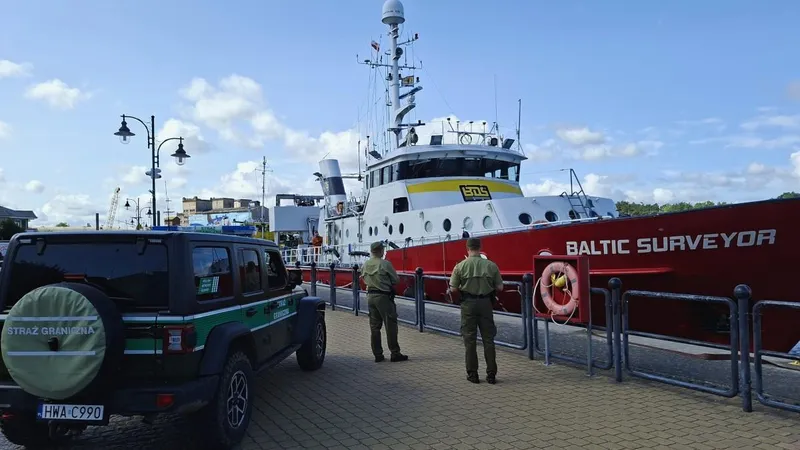
As Poland's offshore wind sector continues to expand, ensuring the secure and efficient movement of personnel to offshore installations has become an increasingly important operational challenge. Every day, crew transfer vessels (CTVs) and other service craft transport technicians, engineers and support teams from Polish ports to wind farm construction and maintenance sites in the Baltic Sea. Behind these operations lies a robust border control framework coordinated by the Maritime Unit of the Polish Border Guard.
In brief
The Maritime Unit of the Polish Border Guard is responsible for border checks on voyages serving the construction and maintenance of offshore wind farms in the Polish Exclusive Economic Zone. Crew Transfer Vessels heading for the wind farms are cleared by Border Guard posts in Gdańsk, Gdynia, Władysławowo and Ustka, and shipowners must report the crew and passenger lists in advance. Officers of the Maritime Unit of the Polish Border Guard carry out a risk analysis before the vessel departs and verify the travel documents and identity of persons on board. The checks use the Entry/Exit System with biometric data, including fingerprints and facial images.
Offshore operations beyond territorial waters
Poland's offshore wind farms are located more than 22 nautical miles from the coast, outside the country's territorial sea but within its Exclusive Economic Zone (EEZ). While these waters are not part of Poland's sovereign territory, the state exercises sovereign rights and jurisdiction over economic activities, including offshore renewable energy developments.
The growing number of daily offshore transfers requires well-defined procedures to ensure compliance with national and European Union regulations while maintaining the security of critical energy infrastructure.
Risk-based border control
Before vessels depart for offshore installations, officers of the Maritime Unit of the Polish Border Guard conduct a risk assessment to determine whether a border inspection is required. Where applicable, inspections include verification of crew and passenger lists, travel documents, identity and nationality of all persons on board.
These procedures allow authorities to confirm that offshore personnel movements comply with applicable border regulations while reducing the risk of irregular migration, document fraud and other security threats.
Responsibilities of vessel operators
Efficient processing depends largely on advance notification from shipowners and vessel operators. Planned offshore voyages must be reported to the competent Border Guard unit responsible for the relevant maritime border crossing point.
Border clearance for vessels serving offshore wind projects is carried out by Border Guard units operating in the ports of Gdańsk, Gdynia, Władysławowo and Ustka. Prior to departure, operators submit information on crew members and offshore personnel travelling to construction or maintenance sites.
All persons on board are required to carry valid travel documents. Depending on nationality, non-EU citizens may also need residence permits or other documents authorising entry and stay within the European Union.
Digital border management
Border inspections are supported by the European Union's Entry/Exit System (EES), a digital platform designed to register the entry and exit of third-country nationals travelling to the Schengen Area for short stays.
The system records travel document data, biometric identifiers, including fingerprints and facial images, as well as the time and place of border crossings and any refusal-of-entry decisions.
The use of biometric verification strengthens border security by improving identity checks, preventing the use of fraudulent documents and helping authorities monitor compliance with permitted lengths of stay.
Security as an enabler of offshore development
The rapid expansion of offshore wind in the Baltic Sea depends not only on engineering expertise and maritime logistics but also on effective border management and the protection of critical infrastructure.
As offshore operations continue to increase in scale, the role of the Maritime Unit of the Polish Border Guard will remain an integral part of the operational framework supporting Poland's offshore wind ambitions. Modern border procedures and digital control systems contribute to the safe movement of personnel while ensuring that one of Europe's fastest-growing offshore wind markets develops in a secure and regulated environment.
Source: Gazeta Morska · Compiled by: Kamil Kusier
Related articles
 Safety and rescue Polish SAR’s new rescue vessel Mistral launched at Kewatec in Finland
 Safety and rescue Icelandic Coast Guard and police delegation visits Polish Border Guard’s Maritime Division
 Safety and rescue Polish Navy helicopter evacuates man from Baltic platform 100 km off Władysławowo
 Navy and defence SNMG2 joins Allied warships in PASSEX as Italy's Mare Aperto 2026 gets under way
 Safety and rescue From lightships to solar power: 160 years of the Grundkallen light station
 Education 254 people, manikins and life rafts: Maritime University of Szczecin joins national CPR record attempt
Comments (0)
The discussion is moderated by the editors: a comment appears after review. Your e-mail address is not published.
Nobody has commented on this article yet.