









Belgian navy tests new asset in mine countermeasures: the R7 underwater drone
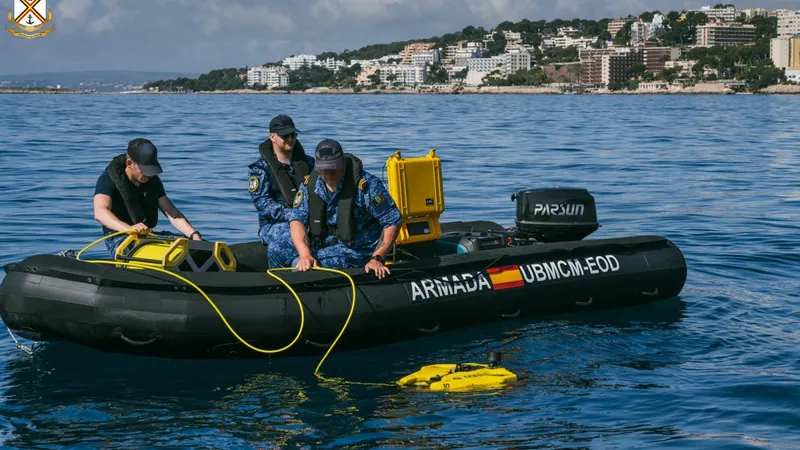
During the multinational mine warfare exercise Spanish Minex, the Belgian Navy had the opportunity to trial a new high-performance tool in its mine countermeasure (MCM) arsenal: the R7 Compact ROV, developed by Exail. This state-of-the-art remotely operated vehicle is designed for rapid and precise underwater mine identification and complements the existing fleet of REMUS autonomous underwater vehicles.
In brief
The Belgian Navy tested the R7 Compact ROV underwater drone made by Exail during the international Spanish Minex mine countermeasures exercise. The vehicle is 78 cm long, weighs 32 kg, is manually controlled and transmits video and sonar data via a 300-metre fibre-optic cable. In the tests the R7 detected Manta and Rockan exercise mines placed on the seabed and on wrecks, enabling identification without divers. Warrant Officer Rene, leader of the Very Shallow Water team, said the R7 supports the identification of suspicious objects when a dive team is not available.
Two technologies, one mission
The R7 stands out for its compactness—measuring just 78 cm and weighing 32 kg—allowing for swift deployment from ships or even directly from the shore. Unlike the autonomous REMUS, which follows pre-set sonar-based search patterns, the R7 is manually operated through an intuitive control console that combines real-time video with sonar imagery. This enables operators to investigate and confirm specific targets on the spot.
- It’s an ideal complementary platform, particularly valuable when no diver teams are available, explains Adjutant René, team leader of the Very Shallow Water (VSW) unit responsible for the evaluation.
Realistic testing in operational conditions
Spanish Minex provided a realistic operational framework for testing. The R7 was deployed against various types of training mines, including Manta and Rockan, as well as on simulated wrecks and seabed targets. Thanks to a 300-meter fiber optic cable, live footage and data were transmitted directly to onboard operators, facilitating immediate analysis.
The system proved its effectiveness by rapidly inspecting suspect objects without deploying divers. This significantly accelerates the response time from detection to identification and increases the efficiency of MCM operations over larger areas.
Modular design for future missions
The R7 is built on a digital open-architecture platform, enabling future upgrades with additional sensors, manipulator arms, or mission-specific tools. For instance, should a REMUS become entangled, the R7 can be used to cut or retrieve components using a robotic arm. It also has the capability to deploy explosives remotely in coordination with diver teams, expanding its operational scope.
- The R7 offers a versatile and future-proof capability package, notes the VSW team. - Technological adaptability is crucial for maintaining relevance in evolving maritime environments.
By investing in systems like the R7 Compact ROV, the Belgian navy reinforces its position as a leading expert in naval mine warfare, demonstrating a strong commitment to innovation, interoperability, and mission readiness in both current and future operations.
Source: Gazeta Morska · Compiled by: Kamil Kusier
Related articles
 Navy and defence ORP Gopło will not be preserved intact. Prototype laminate minesweeper passes to Poland's Military Property Agency
 Navy and defence HMS Prince of Wales takes on ammunition in Norway. First resupply outside the UK
 Navy and defence ORP Mewa marks four months with SNMCMG1. Poland's first Kormoran II deployment runs to year-end
 Shipbuilding industry Ex-Enterprise towed to Mobile under $418.5m contract. Test case for Nimitz-class disposal begins
 Navy and defence Norwegian submarine Utstein completes NATO patrol guarding offshore oil and undersea infrastructure
 History Polish Naval Museum in Gdynia opens its doors on Independence Day, 11 November
Comments (0)
The discussion is moderated by the editors: a comment appears after review. Your e-mail address is not published.
Nobody has commented on this article yet.