









BALTOPS 2026: polish-portuguese amphibious cooperation off Ventspils
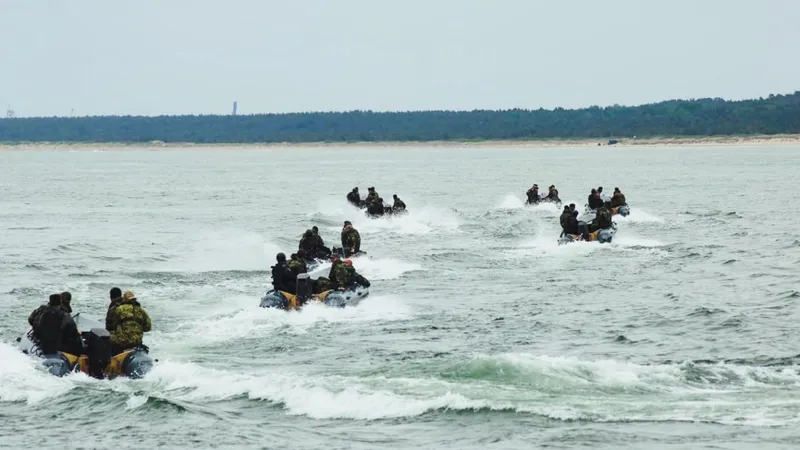
During the ongoing BALTOPS, one of NATO’s premier multinational maritime exercises in the Baltic Sea region, another key amphibious training event took place off the coast of Ventspils. Polish and Portuguese forces conducted a coordinated ship-to-shore movement, reinforcing allied interoperability in a realistic operational environment.
In brief
Polish and Portuguese troops carried out a joint ship-to-shore force transfer episode off the coast of Ventspils as part of the BALTOPS exercise in the Baltic Sea. The Polish Navy provided a transport and minelaying vessel as a landing platform for Portuguese marine subunits. The scenario involved a coordinated movement of troops from the ship's deck to land in conditions close to operational ones. Participants stressed that speed of action, efficient communication and precise execution of procedures proved crucial.
The exercise involved the Marynarka Wojenna RP, which provided a transport-minelayer vessel acting as a launch platform for Portuguese Marine Corps units. The scenario focused on the rapid and efficient transfer of troops from ship to shore, simulating conditions that closely mirror real-world amphibious operations.
Amphibious operations in a contested maritime environment
Ship-to-shore movements remain a core component of modern NATO maritime training. They test the ability of allied forces to project power from sea to land while maintaining synchronization across multinational units, command structures, and operational procedures.
In the Baltic Sea region, where environmental conditions, coastline complexity, and strategic sensitivity significantly influence operational planning, such drills are particularly relevant. BALTOPS provides a recurring framework for refining these capabilities under multinational command.
Enhancing NATO interoperability
The Polish and Portuguese cooperation highlights the importance of interoperability within NATO’s maritime forces. Successful execution of amphibious tasks requires seamless communication, standardized procedures, and precise timing across participating units.
According to participants, the operation was executed smoothly, with all elements fully aware of their roles within the tactical framework. This level of coordination underscores the maturity of joint NATO operational standards.
The Baltic Sea as a strategic training ground
The Baltic Sea remains a critical operational theater for NATO, regularly hosting large-scale exercises designed to test readiness, integration, and rapid response capabilities. BALTOPS has long served as a platform for validating new doctrines and strengthening multinational cooperation.
The involvement of both Polish and Portuguese forces in a shared amphibious scenario further illustrates NATO’s global character, bringing together navies and marine units with diverse operational backgrounds into a unified command structure.
Precision, speed, and coordination
Although conducted in a training environment, the exercise emphasized three core operational pillars: speed of execution, effective coordination, and procedural precision.
These factors remain essential in amphibious warfare, where timing and synchronization directly impact mission success. BALTOPS 2026 once again demonstrates NATO’s continued commitment to maintaining high readiness levels and strengthening allied maritime capabilities in the Baltic region.
Source: Gazeta Morska · Compiled by: Kamil Kusier
Related articles
 Safety and rescue Polish SAR’s new rescue vessel Mistral launched at Kewatec in Finland
 Safety and rescue Icelandic Coast Guard and police delegation visits Polish Border Guard’s Maritime Division
 Safety and rescue Polish Navy helicopter evacuates man from Baltic platform 100 km off Władysławowo
 Navy and defence SNMG2 joins Allied warships in PASSEX as Italy's Mare Aperto 2026 gets under way
 Safety and rescue From lightships to solar power: 160 years of the Grundkallen light station
 Education 254 people, manikins and life rafts: Maritime University of Szczecin joins national CPR record attempt
Comments (0)
The discussion is moderated by the editors: a comment appears after review. Your e-mail address is not published.
Nobody has commented on this article yet.