









Baltic Security in Action: BRACE 2025 Tests Maritime Readiness in Gdańsk Bay
The Baltic Sea witnessed a high-intensity maritime security drill as the Baltic Readiness and Coast Guard Exercise (BRACE 2025) unfolded in Gdańsk Bay. Designed to simulate a realistic security threat near critical infrastructure, the live exercise tested inter-agency coordination, response capacity, and operational interoperability among national and European maritime authorities.
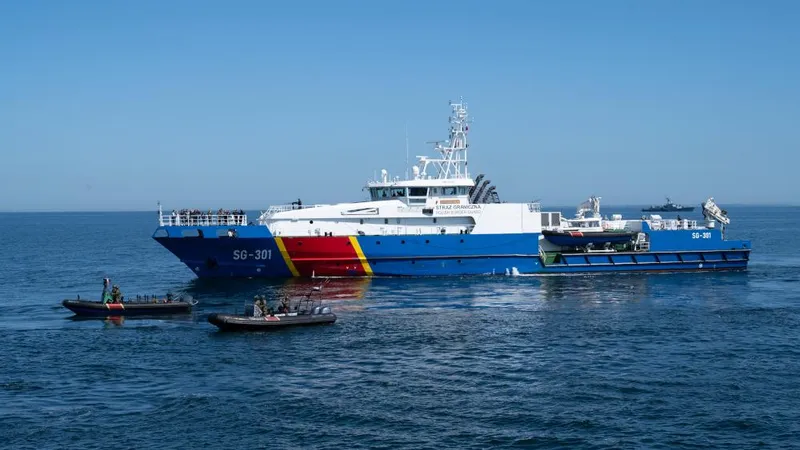
In brief
The international MME BRACE 2025 exercise was held in the Gulf of Gdańsk as part of the 8th Annual European Coast Guard Meeting. The scenario had the fishing vessel IVAN, of unknown flag and with AIS off, heading for the Naftoport terminal carrying ammunition and explosives, ending in a boarding by Maritime Border Guard officers. The patrol vessel SG-301 Gen. Józef Haller, ORP Kaszub, the SAR vessel Wiatr and the Zodiak II of the Maritime Office in Gdynia took part. Since 16 June the patrol vessel SG-301 has been conducting Operation Baltic Sea 2025, coordinated by Frontex until October 2025.
The exercise was held as part of the 8th Annual European Coast Guard Event (AECGE 2025) and brought together assets from Frontex, the European Fisheries Control Agency (EFCA), the European Maritime Safety Agency (EMSA), and various Polish services including the Maritime Border Guard, Navy, SAR units, and Maritime Administration.
- The scenario was based on a plausible real-world maritime threat targeting critical energy infrastructure, said Tadeusz Gruchalla, spokesperson for the Maritime Border Guard (MOSG). - A suspicious fishing vessel named IVAN, sailing without AIS and ignoring instructions, entered Polish waters and approached the Naftoport terminal, prompting immediate operational response.
The simulation unfolded approximately 3 nautical miles north of the Port of Gdańsk. The vessel IVAN—portrayed by the Zodiak II from the Maritime Office in Gdynia—was first identified via radar as it transited from Lithuanian waters without authorization. Communication attempts failed, triggering a coordinated response involving patrol vessel SG-301 "Gen. Józef Haller", a SAR aircraft, and specialized boarding teams from MOSG’s Tactical Unit.
As the vessel continued at 6 knots toward Naftoport, aerial surveillance observed a scuffle on deck, with two individuals falling overboard and a garbled distress signal: “Gdańsk help – Gdańsk help – Gdańsk help.” Search and rescue operations were immediately launched. A tactical boarding operation followed, revealing suspicious packages—some dumped overboard—suspected to contain contraband explosives and ammunition.
The boarding team secured the vessel, detained several hostile individuals, and cleared the ship for follow-up inspection by a fisheries control group from the Kaszub Border Guard Division. The IVAN was then escorted to port under armed supervision.
Naval vessel ORP Kaszub, operating independently in the area, remained on standby to support the operation if escalation occurred. Participating units included SG-301, ORP Kaszub, the SAR ship Wiatr, Zodiak II, and Border Guard RHIBs SG-005 and SG-009.
From the planning phase to execution, the exercise illustrated the growing importance of Multipurpose Maritime Operations (MMOs). EFCA contributed fisheries control expertise and operational insight, demonstrating the MMO model as an effective, cross-sector mechanism for enhancing EU maritime cooperation.
- Exercises like BRACE 2025 validate the interoperability between law enforcement, naval, safety, and surveillance actors under realistic, high-stakes conditions, EFCA officials noted. - This is precisely where MMO shows its value—aligning mandates for maximum operational synergy.
The exercise concluded at the Ziółkowski Quay in Gdańsk with a symbolic handover ceremony between participating agencies as part of the AECGE 2025 framework.
Meanwhile, since June 16, SG-301 has been deployed under Frontex’s Baltic Sea 2025 multipurpose operation, running through October and involving Lithuania, Latvia, Estonia, Finland, and Poland, alongside EFCA and EMSA. The mission covers internal waters, territorial seas, and exclusive economic zones of host countries, with goals ranging from maritime surveillance and traffic control to fisheries inspections, critical infrastructure protection, and environmental incident response.
Source: Gazeta Morska · Compiled by: Kamil Kusier
Related articles
 Maritime economy Poland’s constitutional crisis is also a maritime story
 Navy and defence Norwegian submarine Utstein completes NATO patrol guarding offshore oil and undersea infrastructure
 Safety and rescue Polish SAR’s new rescue vessel Mistral launched at Kewatec in Finland
 Safety and rescue Icelandic Coast Guard and police delegation visits Polish Border Guard’s Maritime Division
 Safety and rescue Polish Navy helicopter evacuates man from Baltic platform 100 km off Władysławowo
 Navy and defence SNMG2 joins Allied warships in PASSEX as Italy's Mare Aperto 2026 gets under way
Comments (0)
The discussion is moderated by the editors: a comment appears after review. Your e-mail address is not published.
Nobody has commented on this article yet.