









Baltic Sea as a key area for economic growth and security. Deputy PM visits Port of Gdańsk
The Port of Gdańsk was at the center of political and economic attention as Poland’s Deputy Prime Minister and Minister of Foreign Affairs, Radosław Sikorski, emphasized the Baltic Sea’s strategic role in both national prosperity and security.

In brief
Deputy Prime Minister and Foreign Minister Radosław Sikorski, speaking at a conference at the Port of Gdańsk, named the Baltic Sea a key area for economic growth and for the security of Poland and the Alliance. Deputy Infrastructure Minister Arkadiusz Marchewka said the 2025 state budget allocates PLN 2.4 billion to maritime economy investments, over PLN 400 million more than a year earlier. The Port of Gdańsk is building an offshore wind farm installation terminal, an FSRU gas terminal and a grain terminal that will raise cargo handling by nearly 1 million tonnes by the end of 2025. Polish ports handled over 3.27 million TEU in 2024, more than 9 percent above 2023.
- I am deeply impressed by the port’s dynamic growth and ambitious investment plans. The Baltic Sea is not only vital for economic development but also for ensuring the security of Poland and the Alliance, Radosław Sikorski stated.
Critical infrastructure under pressure
Highlighting the growing vulnerability of Europe’s critical infrastructure, Sikorski pointed to recent incidents of underwater cable disruptions and pipeline attacks, as well as the presence of Russia’s so-called “shadow fleet,” which continues to finance the war in Ukraine.
Against this backdrop, Polish ports play a strategic dual role: providing logistics for Ukraine while ensuring stable supplies of energy resources – oil, gas, and coal – to Poland.
- The success of our port industry drives nationwide growth, enabling Poland to rank today among the world’s top 20 economies, he noted.
Record investment in the maritime sector
At the conference, Deputy Infrastructure Minister Arkadiusz Marchewka announced that the 2025 state budget allocates PLN 2.4 billion to maritime investments – over PLN 400 million more than the previous year.
Current flagship projects at Port of Gdańsk include:
- construction of an offshore wind installation terminal, from which vessels will soon deliver massive components for PGE’s offshore wind farm in the Baltic,
- development of a floating LNG terminal (FSRU) on the Gulf of Gdańsk by Gaz-System,
- launch of a new grain terminal, boosting handling capacity by nearly 1 million tons by the end of 2025, with further expansion phases planned through 2027–2028.
Notably, the new grain terminal will be fully state-owned, operated by a subsidiary of the Port of Gdańsk Authority.
Cargo records and growth prospects
Polish seaports achieved record performance in 2024, with container throughput exceeding 3.27 million TEU, a 9% year-on-year increase.
The opening of the Baltic Hub T3 terminal is expected to accelerate further growth in the coming years.
Combined with expanding cargo infrastructure, new energy facilities, and offshore wind projects, these investments reinforce Gdańsk’s position as a strategic logistics hub of the Baltic Sea and a cornerstone of both economic and energy security for Poland and the region.
Source: Gazeta Morska · Compiled by: Kamil Kusier
Related articles
 Safety and rescue Polish SAR’s new rescue vessel Mistral launched at Kewatec in Finland
 Safety and rescue Icelandic Coast Guard and police delegation visits Polish Border Guard’s Maritime Division
 Safety and rescue Polish Navy helicopter evacuates man from Baltic platform 100 km off Władysławowo
 Navy and defence SNMG2 joins Allied warships in PASSEX as Italy's Mare Aperto 2026 gets under way
 Safety and rescue From lightships to solar power: 160 years of the Grundkallen light station
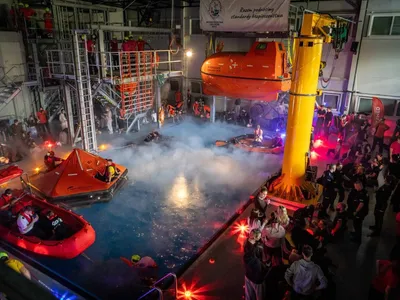 Education 254 people, manikins and life rafts: Maritime University of Szczecin joins national CPR record attempt
Comments (0)
The discussion is moderated by the editors: a comment appears after review. Your e-mail address is not published.
Nobody has commented on this article yet.