









Alon naval drills in the South China Sea. Philippines, Australia, and Canada project deterrence
The Philippine Armed Forces confirmed the completion of large-scale joint naval exercises east of Scarborough Shoal in the South China Sea, conducted together with Australia and Canada. According to the U.S. Naval Institute (USNI), the operation represented the largest military deployment in Southeast Asia since the 1999 East Timor crisis.
In brief
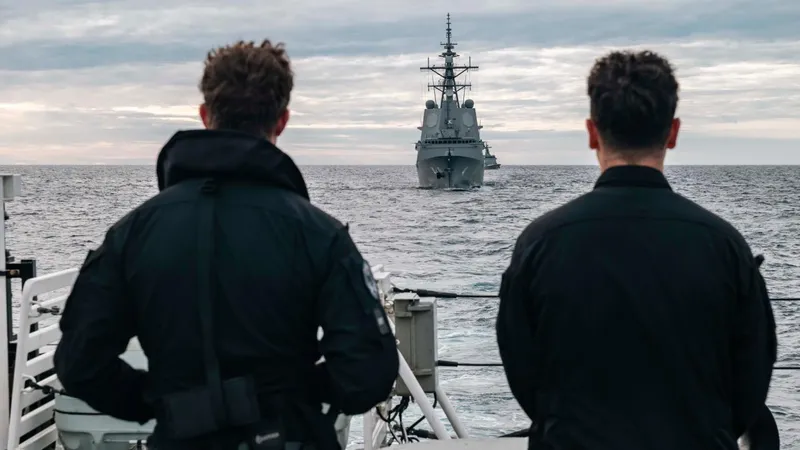
The joint ALON maritime exercise involving the Philippines, Australia and Canada concluded in waters east of Scarborough Shoal. More than 3.6 thousand soldiers and sailors took part in the ALON manoeuvres, including the Philippine frigate BRP Jose Rizal, the Australian destroyer HMAS Brisbane and the Canadian frigate HMCS Ville de Quebec. The United States Naval Institute assessed the ALON exercise as the largest military operation in Southeast Asia since the East Timor crisis of 1999. No Chinese warships or aircraft were observed during the ALON manoeuvres.
Codenamed exercise Alon, the drills carried a strong strategic message – a coordinated show of presence and deterrence aimed at Beijing, which continues to assert unilateral claims over disputed waters.
Assets and participants
Each nation committed key surface and air assets to the exercise:
- Philippines – missile frigate BRP Jose Rizal, seven infantry divisions, tanks, helicopters (S-70i Black Hawk, T-129 ATAK, AW109), and A-29 Super Tucano attack aircraft,
- Australia – destroyer HMAS Brisbane, F/A-18F Super Hornet and EA-18G Growler jets, C-130J Hercules transports, and a P-8A Poseidon patrol aircraft,
- Canada – frigate HMCS Ville de Québec with embarked CH-148 Cyclone helicopter.
In total, over 3,600 sailors and troops took part. Training scenarios included air defense against simulated strikes, amphibious landings, beach assaults, anti-submarine warfare, and integrated fighter and rotary-wing operations.
Strategic importance
Scarborough Shoal lies roughly 240 km from the Philippine coast and 900 km from mainland China. Situated along one of Asia’s most critical maritime trade routes, the area has been a flashpoint since Beijing asserted control in 2012, barring Filipino fishermen and triggering repeated stand-offs at sea.
Notably, during exercise Alon no Chinese naval or air assets appeared in the vicinity, a fact highlighted by the Philippine Armed Forces as allowing the full scope of operations without risk of escalation.
Implications
Alon underlines growing security cooperation among regional and extra-regional partners in response to China’s expanding maritime posture. For the Philippine Navy, participation in such a comprehensive, high-intensity drill marks a significant step toward enhanced operational readiness and interoperability with allied forces.
Source: Gazeta Morska · Compiled by: Kamil Kusier
Related articles
 Safety and rescue Polish SAR’s new rescue vessel Mistral launched at Kewatec in Finland
 Safety and rescue Icelandic Coast Guard and police delegation visits Polish Border Guard’s Maritime Division
 Safety and rescue Polish Navy helicopter evacuates man from Baltic platform 100 km off Władysławowo
 Navy and defence SNMG2 joins Allied warships in PASSEX as Italy's Mare Aperto 2026 gets under way
 Safety and rescue From lightships to solar power: 160 years of the Grundkallen light station
 Education 254 people, manikins and life rafts: Maritime University of Szczecin joins national CPR record attempt
Comments (0)
The discussion is moderated by the editors: a comment appears after review. Your e-mail address is not published.
Nobody has commented on this article yet.