









Air defence live firing at Ustka during Czarny Obrońca-26. Protecting the naval bases
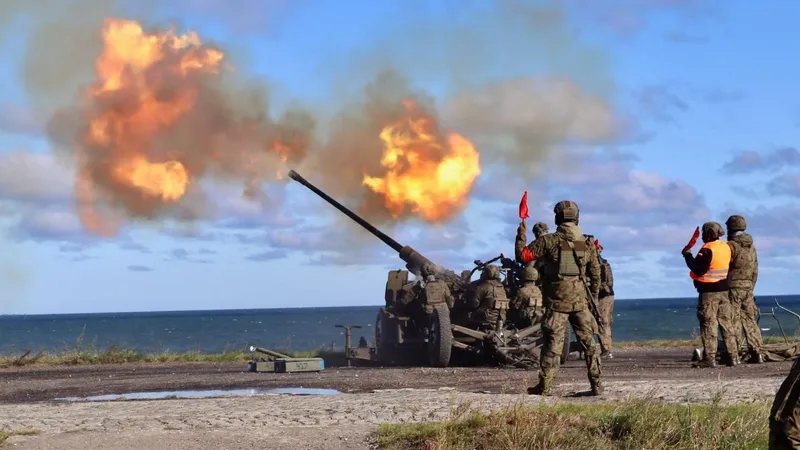
Poland's 9th Air Defence Squadron has carried out live firing at the Air Force Training Centre in Ustka as part of the Czarny Obrońca-26 exercise and the Dzielny Okoń-26 activity conducted within it. Crews engaged aerial targets with both missiles and guns, and all targets were hit.
In brief
All aerial targets were hit during missile and gun firings conducted by the 9 Air Defence Squadron at the Central Air Force Training Ground in Ustka. The firings took place within exercise Czarny Obrońca-26 and the embedded Dzielny Okoń-26, which covers the defence of Polish Navy facilities. The Ustka range is the only place in Poland where air defence units regularly fire at aerial targets over water, and sea areas are closed during the firings.
What is at stake in such firing is a question that has moved to the centre of debate about the Polish Navy in recent years: how to shield bases, ports and shore infrastructure from what flies low, small and cheap.
A range that fires out to sea
The Air Force Training Centre at Ustka is the only place in Poland where air defence live firing against aerial targets is conducted regularly over water. That is a matter of physics and safety rather than convenience. A missile that misses keeps flying, and fragments from a warhead have to fall somewhere. Only firing seaward allows a danger area of the size that cannot be closed over land.
For the maritime economy that has concrete effects. Sea areas are closed for the duration of firing and the details go into navigational warnings. Shipping, fishermen and sailors have to keep clear, which along the central Polish coast is noticeable. It is the price of having the one range in the country where crews can train in conditions close to their real tasks over the Baltic.
The range is used not only by the navy's air defence units but by army and air force units and by allied forces. For air defenders based on the coast it is the natural place to verify training, because the target's flight profile, the weather and the radar background match what they would face defending ports and bases.
Missiles and guns do different jobs
Combining missiles and gunfire in one exercise is not incidental. They are two layers of the same system, covering different phases of a threat.
Short-range missiles engage targets at greater distances and altitudes, before they reach the protected site. What counts there is detection range, reaction time and the ability to track a manoeuvring target. Gun artillery is the last line. It comes into play against targets that have closed in, and against small, slow objects for which a missile is uneconomical or simply ineffective because the target's thermal or radar signature is too small.
The importance of that second layer has grown sharply, driven by cheap drones and loitering munitions and by experience from Ukraine and the Red Sea, where a system relying solely on expensive interceptors lost the economic contest against an opponent sending targets costing a fraction of the effector. Navies that ran those operations have returned to gun systems and started looking for cheap effectors, including lasers and unguided rounds with programmable fuses.
Base defence as part of a wider system
Air defence of a naval base does not begin at the launcher. It begins with detection and identification, meaning radars, electro-optical systems and electronic surveillance, and often with electronic warfare intended to disrupt an uncrewed platform's control or navigation before any weapon is fired.
Gunfire is the last element of the chain and indicates that earlier layers did not work. In exercises of this kind, therefore, the most valuable measure is not the hit itself but the time from detection to the decision to engage, and the efficiency of passing information between command posts.
There is also a problem that does not show up in photographs of live firing: identification. Civil traffic moves above and around a naval port, from airliners to drones flown by photographers and inspection companies. Base air defence has to determine not only that an object is there but whether it is a threat, and to do so in seconds.
The wider exercise
Czarny Obrońca-26 is a large air defence exercise within which episodes involving different branches are conducted. Dzielny Okoń-26 covers the defence of naval facilities, and its September episodes concerned the security of naval ports.
Placing the two alongside each other makes practical sense. A naval base can be reached both from the water and from the air, and defenders have to maintain a single picture covering both directions. The firing at Ustka is one component of that, but the whole is only tested in a scenario where threats appear simultaneously.
It is worth remembering what coastal air defenders actually protect. Not only ships alongside, but stores, workshops, shipyards running naval programmes, fuel terminals and the infrastructure from which cables and pipelines run ashore. Such sites are fixed, well documented in open sources and impossible to move, so their protection depends directly on whether a working air defence system stands above them.
Source: Gazeta Morska · Compiled by: Kamil Kusier
Related articles
 Safety and rescue Polish SAR’s new rescue vessel Mistral launched at Kewatec in Finland
 Safety and rescue Icelandic Coast Guard and police delegation visits Polish Border Guard’s Maritime Division
 Safety and rescue Polish Navy helicopter evacuates man from Baltic platform 100 km off Władysławowo
 Navy and defence SNMG2 joins Allied warships in PASSEX as Italy's Mare Aperto 2026 gets under way
 Safety and rescue From lightships to solar power: 160 years of the Grundkallen light station
 Education 254 people, manikins and life rafts: Maritime University of Szczecin joins national CPR record attempt
Comments (0)
The discussion is moderated by the editors: a comment appears after review. Your e-mail address is not published.
Nobody has commented on this article yet.