









Advanced search and rescue exercises by Canadian Air Force and Coast Guard in Malaspina Strait
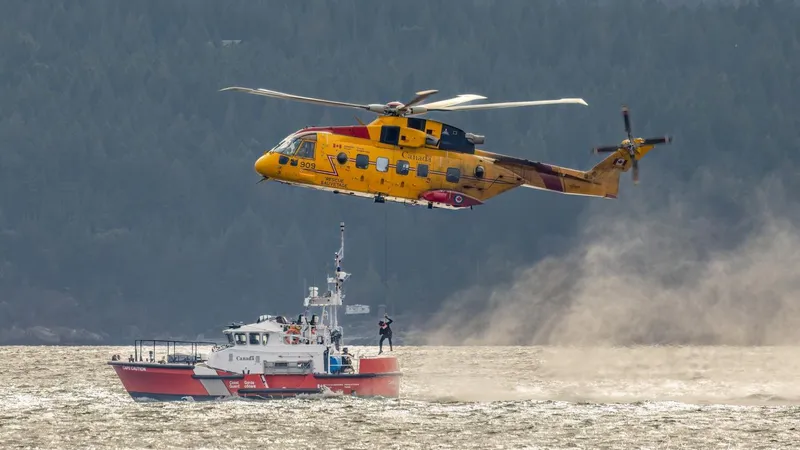
In the Malaspina Strait near Grief Point, British Columbia, Canadian Air Force and Canadian Coast Guard crews recently conducted advanced search and rescue exercises. The main goal of the drills was to test the new hoist system on the CH-149 Cormorant helicopter and to enhance coordination between air and sea crews in realistic operational scenarios.
In brief
The Royal Canadian Air Force and the Canadian Coast Guard conducted a search and rescue exercise in the Malaspina Strait area near Grief Point in British Columbia. The main aim of the manoeuvres was to test the new hoist system of the CH-149 Cormorant helicopter from 19 Wing Comox and cooperation with the vessel CCGS Cape Caution. Crews practised precise hovering over a moving vessel, recovery of a person in the water, response to a hoist failure and coordination of communications. CCGS Cape Caution operates in waves of up to 6 metres thanks to a self-righting design.
The exercises involved the Cormorant helicopter from 19 Wing Comox and the CCGS Cape Caution, a highly resilient Cape-class lifeboat. Coast Guard personnel practiced recovering individuals from a moving vessel, stabilizing the boat in challenging sea conditions, and synchronizing actions with airborne rescue teams.
The CH-149 Cormorant is one of Canada’s most advanced search and rescue helicopters, equipped with radar and electro-optical sensors as well as a modern hoist system for safe and efficient recovery in demanding conditions. It can operate in night missions, strong winds, and high waves, while providing space for medics to administer care during flight.
The CCGS Cape Caution serves as a reliable coastal rescue platform. Its self-righting design and ability to operate in waves up to 6 meters make it a key asset in high-risk maritime rescues, fully coordinated with helicopter operations.
Malaspina Strait, with its narrow channels, variable winds, and limited maneuvering space, offered realistic training conditions. Crews practiced precise helicopter hovering over a moving vessel, hoist operations, emergency procedures for hoist failure, and full communication coordination between air and sea units.
These joint exercises highlight the high level of operational readiness and safety maintained along Canada’s Pacific coast. They also demonstrate the critical importance of seamless cooperation between air and maritime services, where seconds can be decisive, and every action must be carefully synchronized.
Source: Gazeta Morska · Compiled by: Kamil Kusier
Related articles
 Safety and rescue Polish SAR’s new rescue vessel Mistral launched at Kewatec in Finland
 Safety and rescue Icelandic Coast Guard and police delegation visits Polish Border Guard’s Maritime Division
 Safety and rescue Polish Navy helicopter evacuates man from Baltic platform 100 km off Władysławowo
 Navy and defence SNMG2 joins Allied warships in PASSEX as Italy's Mare Aperto 2026 gets under way
 Safety and rescue From lightships to solar power: 160 years of the Grundkallen light station
 Education 254 people, manikins and life rafts: Maritime University of Szczecin joins national CPR record attempt
Comments (0)
The discussion is moderated by the editors: a comment appears after review. Your e-mail address is not published.
Nobody has commented on this article yet.