









A search and rescue exercise in Łeba. Crews from France, Finland, Estonia, Iceland and Norway on the Baltic
Poland's Maritime Search and Rescue Service is hosting rescuers from France, Finland, Estonia, Iceland and Norway as part of an international exchange run by the International Maritime Rescue Federation. Polish rescuers travel the other way, to Finland, Sweden, France, the Netherlands, Estonia, Germany and Iceland among others.
In brief
The Łeba Coastal Rescue Station held a search exercise on Sunday with rescuers from France, Finland, Estonia, Iceland and Norway. The Łeba exercise used the R-10 and R-15 boats, the R-9 rescue jet ski and the rescue vessel Monsun, with casualties recovered onto Monsun and onto RIBs. The foreign rescuers' visit is part of an exchange organised by the International Maritime Rescue Federation. In 2025 MSPiR signed a contract with the Finnish yard Kewatec AluBoat for six new SAR 2000 rescue units.
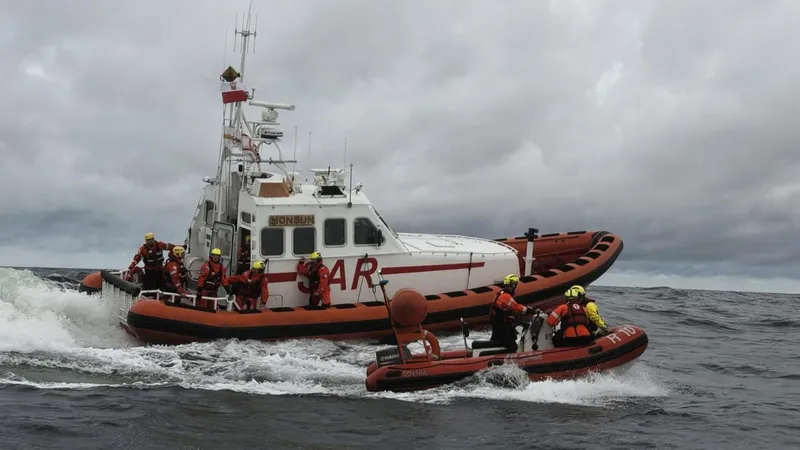
One item on the programme was an exercise in Łeba on the Polish Baltic coast, run on Sunday by the local coastal rescue station.
Searching with three units at once
The crews put to sea in two rescue boats, R-10 and R-15, and on the rescue watercraft R-9, working alongside the rescue vessel Monsun. The scenario was a simulated search: volunteers, together with one of the station's rescuers, were left in the water and then searched for.
The casualties were recovered both onto Monsun and onto the RIBs. That is the key part of the drill, because lifting a person from the water looks entirely different from the low freeboard of an inflatable and from the deck of a rescue vessel, where the casualty has to be raised several metres. Practising both in a single sortie answers the question of which unit to send to a given incident.
Two models of rescue at the same quay
The value of such an exchange comes from the difference between systems. Polish maritime rescue is a state service with professional crews on salaried posts, rescue vessels and coastal stations. Most organisations in the IMRF work differently and rely on volunteers: France's SNSM, the Finnish and Norwegian rescue societies and Iceland's ICE-SAR are structures whose crews hold other jobs day to day.
That produces different solutions in rostering, training, communications and equipment. Volunteer organisations have to account for the time it takes to muster a crew, but they maintain a dense network of small stations and strong local backing. A professional service offers constant readiness but is inevitably smaller in numbers. An exchange between these models teaches more than training among similar services.
There is a practical dimension too. Operations on the Baltic are run jointly, and coordination between national rescue coordination centres requires compatible procedures. A rescuer who has already sailed on a partner's unit knows what their equipment looks like, how their communications work and what to expect from them during a joint operation at sea.
Łeba after a demanding season
The exercise took place at a station that has had a hard summer. In August the Łeba crews, together with Monsun, ran a multi-day operation on a motor yacht aground about four nautical miles east of the port. Four people and a dog were on board, the vessel began taking on water and part of the crew was evacuated onto a rescue boat. Refloating the yacht took two days, with the rescue vessel Orkan from Ustka and excavator operators involved, as the weather deteriorated.
That is why search scenarios are practised. A person in the water in the Baltic in late summer has a survival window measured in hours, and in early spring or autumn in tens of minutes. Speed of recovery is the single most important parameter of the whole operation.
Changing equipment
The exchange comes as the Polish service renews its fleet. In 2025 it signed a contract with the Finnish yard Kewatec AluBoat for six new rescue units, provisionally designated SAR 2000, while further vessels, Mistral and Powiew, are under construction in a project co-financed by the EU transport projects centre CUPT.
New equipment changes the way crews work, and at such a moment the experience of partners whose countries have operated similar units for years is worth more than a manufacturer's catalogue.
Source: Gazeta Morska · Compiled by: Kamil Kusier
Related articles
 Safety and rescue Polish SAR’s new rescue vessel Mistral launched at Kewatec in Finland
 Safety and rescue Icelandic Coast Guard and police delegation visits Polish Border Guard’s Maritime Division
 Safety and rescue Polish Navy helicopter evacuates man from Baltic platform 100 km off Władysławowo
 Navy and defence SNMG2 joins Allied warships in PASSEX as Italy's Mare Aperto 2026 gets under way
 Safety and rescue From lightships to solar power: 160 years of the Grundkallen light station
 Education 254 people, manikins and life rafts: Maritime University of Szczecin joins national CPR record attempt
Comments (0)
The discussion is moderated by the editors: a comment appears after review. Your e-mail address is not published.
Nobody has commented on this article yet.