









A hole in the sand can delay a rescue: Polish lifeguards warn against hidden beach hazards
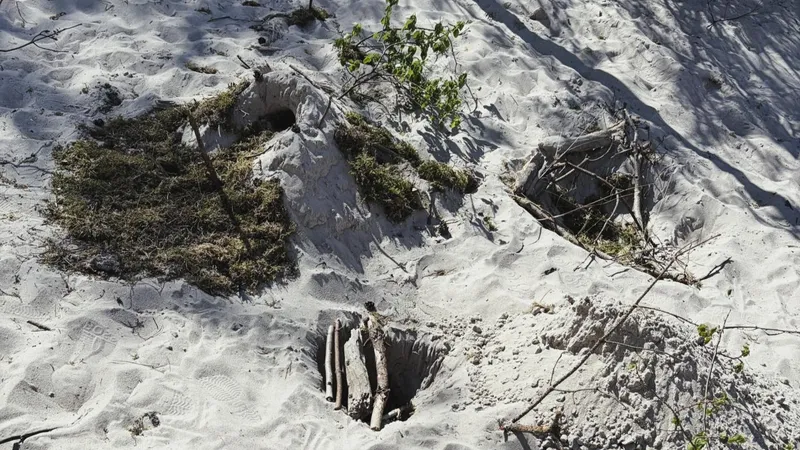
As Europe’s Baltic beaches prepare for another busy summer season, Polish maritime rescue professionals are drawing attention to a surprisingly underestimated safety threat: deep holes and tunnels dug in beach sand by tourists and left uncovered after play. According to Sebastian Kluska, director of MSPiR SAR, the issue becomes especially dangerous when excavations appear on technical access routes used by rescue vehicles.
In brief
Rescuers of the Polish Maritime Search and Rescue Service (MSPiR SAR) appeal to beachgoers not to dig deep holes and tunnels in the sand, especially on beach service roads. Sebastian Kluska, director of MSPiR SAR, points out that holes dug on rescue roads can tear off a wheel, damage a quad bike, or even overturn a rescuer riding to an operation. Collapsing walls of wet sand can bury a child playing in a tunnel. Filling in holes after playing can decide whether help arrives on time, Sebastian Kluska stresses.
Recreational beaches are also operational rescue zones
For most visitors, the beach represents leisure, tourism and family entertainment. For rescue services, however, the same environment functions as an operational corridor where mobility and rapid response are essential.
- Children obviously have the right to play on the beach. Nobody wants to ban digging in the sand, Sebastian Kluska says. - The problem begins when deep holes, trenches or tunnels are left behind, especially on rescue access routes.
Technical beach routes are routinely used by lifeguards, quad bikes, emergency transport vehicles and rescue teams carrying medical equipment. Even a single deep pit hidden in loose sand may immobilize a vehicle, damage suspension systems or overturn a quad during high-speed emergency deployment.
According to maritime safety professionals, these risks are often overlooked because beach infrastructure is perceived as informal and naturally safe.
Seconds matter during coastal emergencies
Water rescue operations remain among the most time-sensitive emergency response activities. In drowning incidents, cardiac arrest cases or severe trauma situations, survival probabilities decline rapidly with every minute of delay.
- During rescue operations, drivers already have to maintain maximum concentration and caution. If a quad hits a deep hole at speed, the rescuer may lose control or suffer injuries himself. That immediately affects response time, Sebastian Kluska explains.
Rescue personnel operating on beaches already face difficult terrain conditions, reduced traction and heavy pedestrian traffic during peak tourism periods. Additional obstacles created by unauthorized sand excavations increase operational risk and may directly affect response efficiency.
- Every second matters when someone’s life is at stake. People often don’t realize that something seemingly harmless can become a serious operational obstacle, Sebastian Kluska adds.
Hidden structural risks in sand excavations
The issue extends beyond vehicle access.
International safety experts have repeatedly warned about the danger of tunnel collapses and deep sand excavation accidents involving children. Wet compacted sand can behave similarly to unstable construction material, collapsing suddenly under pressure and trapping victims within seconds.
Although such incidents remain relatively rare, they are often severe and difficult to manage due to restricted access, unstable excavation walls and delayed detection.
Rescue organizations across multiple coastal regions have increasingly emphasized public education campaigns focused on preventive behavior rather than post-incident response.
Direct communication as a safety strategy
Kluska’s comments have attracted attention not only because of the operational concerns involved, but also because of their unusually direct tone.
Within emergency management sectors, professionals acknowledge a growing trend toward more emotional and highly visible public communication. Traditional administrative warnings frequently fail to gain traction on social media platforms or among mass tourism audiences.
By contrast, blunt language and vivid examples tend to generate wider public engagement and increase awareness of operational realities faced by rescue teams.
From a strategic communications perspective, such messaging reflects a broader challenge confronting maritime safety institutions: how to effectively communicate risk in recreational environments where danger is often psychologically minimized.
Shared responsibility on the coastline
Maritime rescue professionals stress that the solution is straightforward. Deep holes, trenches and tunnels should always be filled in after use, particularly near marked technical routes and rescue access corridors.
- The solution is simple: after playing, just fill the holes back in. A small action like that may one day help rescuers reach somebody in time, Sebastian Kluska says.
The broader message is not about restricting children’s activities on beaches. Rather, it concerns maintaining operational readiness in environments where emergency responders may need to act without warning.
As coastal tourism intensifies across the Baltic region, safety experts argue that even small acts of public awareness can have measurable consequences for rescue efficiency and ultimately for human life.
Source: Gazeta Morska · Compiled by: Kamil Kusier
Related articles
 Safety and rescue Polish SAR’s new rescue vessel Mistral launched at Kewatec in Finland
 Safety and rescue Icelandic Coast Guard and police delegation visits Polish Border Guard’s Maritime Division
 Safety and rescue Polish Navy helicopter evacuates man from Baltic platform 100 km off Władysławowo
 Navy and defence SNMG2 joins Allied warships in PASSEX as Italy's Mare Aperto 2026 gets under way
 Safety and rescue From lightships to solar power: 160 years of the Grundkallen light station
 Education 254 people, manikins and life rafts: Maritime University of Szczecin joins national CPR record attempt
Comments (0)
The discussion is moderated by the editors: a comment appears after review. Your e-mail address is not published.
Nobody has commented on this article yet.