









80 passengers, rough seas and seconds that decide between life and death: Ustka rehearses a passenger-ship disaster
A few nautical miles off Ustka, a passenger ship is going down. Eighty people are on board - and there is no way to save them except all at once. Churning seas, the roar of a helicopter overhead, casualties waiting for help on the deck, on the beach and on the quay. Fortunately it is only a scenario - but one staged exactly as the darkest day no one on the Baltic ever wants to see for real.
In brief
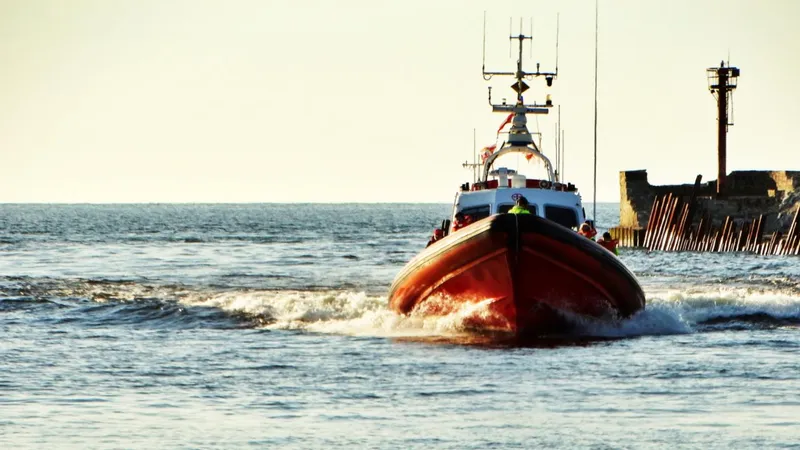
A Mass Rescue Operation exercise was conducted in Ustka with the evacuation of 80 simulated passengers from a sinking passenger ship. Over 120 people took part in the manoeuvres: rescuers of the Maritime Search and Rescue Service SAR, medical personnel and students of the Pomeranian University in Słupsk and the Karol Marcinkowski Medical University in Poznań. The ship Kapitan Poinc and the vessels Orkan from Ustka and Tajfun from Darłowo operated on the water. Director of the Maritime Search and Rescue Service SAR Sebastian Kluska stressed that there is no room for improvisation in maritime rescue.
The Polish port of Ustka hosted a Mass Rescue Operation (MRO) exercise - a large-scale rescue in which the number of casualties exceeds the immediate response capacity of standard forces. More than 120 people took part in total: rescuers of the Maritime Search and Rescue Service (SAR), crews of the rescue units, medical personnel and students playing the role of casualties. The manoeuvres ran from mid-afternoon until dusk.
The scenario: evacuating the entire deck
The premise was unambiguous - an urgent evacuation of every passenger from a vessel in distress. The rescuers' task was to bring 80 simulated passengers ashore from the sinking ship. It is precisely this scale that makes an MRO a different league of rescue work: you are not saving one person but dozens at once, under time pressure and with limited resources.
- In maritime rescue there is no room for improvisation, and an operation in which you save dozens of people at once is the hardest test of that. The students saw up close that on a rough sea, beneath the rotor of a helicopter, what counts is a cool head and carrying out the task step by step, says Sebastian Kluska, director of the Maritime Search and Rescue Service (SAR).
A rescue fleet and a helicopter in action
The exercise drew on the Baltic's real rescue strength. On the water were the multipurpose vessel Kapitan Poinc and the rescue boats Orkan from Ustka and Tajfun from Darłowo; ashore, the shore rescue stations of Darłowo and Ustka. The role-players were recovered from the water in cooperation with the crews of other units and with paramedics, while operations unfolded simultaneously on the open sea, on the beach and on the quay of the Ustka port.
- Evacuating several dozen passengers from a sinking vessel is a race against time. You have to bring people ashore and, at the same time, decide who needs help first - and there is no room for a mistake, the SAR director stresses.
Medical students and triage in practice
Universities were a key partner of the exercise - the Pomeranian University in Słupsk and the Poznań University of Medical Sciences. Students of medical faculties had the chance to practise, hands-on, the principles of first aid in mass-casualty incidents, where a victim's life is often decided by seconds. The central element of their task was triage - the medical sorting that classifies casualties for further treatment, carried out both at sea and inside the vessels.
It is the participation of the role-players that gives such manoeuvres a realism impossible to recreate on paper: it brings the chaos, the emotion and the unpredictability of a real operation.
- I am glad that future medics stood alongside our rescuers. The real strength in an operation like this is not a single unit but a whole system in which everyone knows their place - from the deck, through the helicopter, to the quayside, Sebastian Kluska notes.
Why drills like this matter
A Mass Rescue Operation tests not so much the equipment as the coordination - communications and the smooth flow of casualties from the scene, through the units, all the way to medical care on land. In a real large-scale operation no single service acts alone.
- Safety at sea begins long before an accident - at the planning table, on exercises, in conversations about procedures. Human life is of the greatest value to us, and it is what is at stake in every operation like this, says the MSPiR SAR director.
Source: Gazeta Morska · Compiled by: Kamil Kusier
Related articles
 Safety and rescue Polish SAR’s new rescue vessel Mistral launched at Kewatec in Finland
 Safety and rescue Icelandic Coast Guard and police delegation visits Polish Border Guard’s Maritime Division
 Safety and rescue Polish Navy helicopter evacuates man from Baltic platform 100 km off Władysławowo
 Navy and defence SNMG2 joins Allied warships in PASSEX as Italy's Mare Aperto 2026 gets under way
 Safety and rescue From lightships to solar power: 160 years of the Grundkallen light station
 Education 254 people, manikins and life rafts: Maritime University of Szczecin joins national CPR record attempt
Comments (0)
The discussion is moderated by the editors: a comment appears after review. Your e-mail address is not published.
Nobody has commented on this article yet.