Maritime University of Gdynia marks school day with focus on future training ship and international cooperation
The Maritime University of Gdynia officially inaugurated its annual School Day celebrations with a traditional flag-raising ceremony held at 8:00 a.m. at the university’s main building. In accordance with long-standing academic and maritime tradition, the Polish ensign was hoisted to the sound of the national anthem.
09 december 2025 | 00:11 | Source: Gazeta Morska | Prepared by: Kamil Kusier | Print
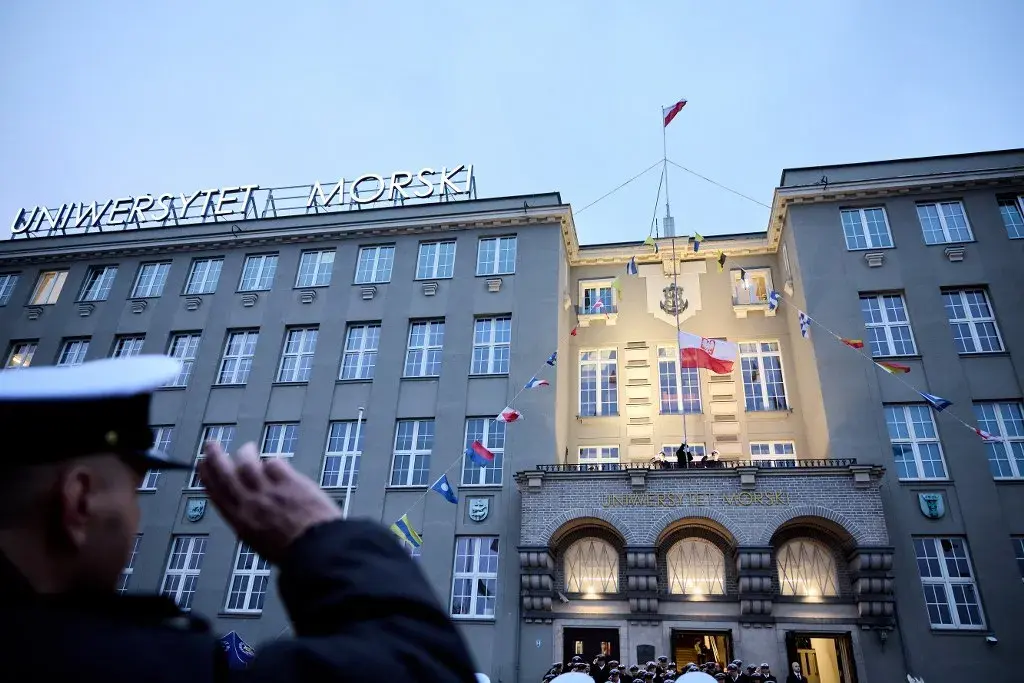
fot. Uniwersytet Morski w Gdyni
The ceremony began with the presentation of the University’s standard and the ensign of the Polish Merchant Navy, accompanied by the Representative Company of the Maritime University of Gdynia and the Polish Navy Representative Orchestra. University authorities, members of the senate, staff, students, doctoral candidates and alumni attended the event.
The roots of this tradition date back 105 years to the establishment of the Maritime School in Tczew. At that time, young cadets—many of whom were veterans of the Polish-Soviet War—raised the Polish ensign on the school building as a symbol of maritime identity, as the institution did not yet possess its own training vessel.
The morning ceremony concluded with a formal parade of the university’s representative company, accompanied by the navy orchestra, officially opening this year’s School Day celebrations.
At 9:00 a.m., a Holy Mass was celebrated for the academic community of the university in the chapel located in the Faculty of Mechanical Engineering building. During the service, the chapel was officially dedicated to Saint Peter the Apostle, patron saint of fishermen and seafarers.
The central part of the celebrations took place at 11:00 a.m. with a ceremonial meeting of the university senate in the Tadeusz Meissner Auditorium, attended by senate members, representatives of the university council, staff, students, alumni and invited guests.
In his address, Rector Adam Weintrit summarised the key developments of the past academic year, emphasising its breakthrough significance for the university—particularly the securing of funding for the construction of a successor to the legendary training ship Dar Młodzieży.
- The year 2025 was marked by numerous meetings, consultations and discussions with government representatives and experts involved in planning the new training vessel. The project received strong support from various institutions, professional communities and the media. Members of parliament were also actively engaged throughout the process, he said.
He stressed that the ambition is to deliver the new vessel to students by 2028. Despite being equipped with advanced technologies, the ship will continue to serve traditional seamanship training.
- Future officers of the merchant fleet will still undergo classic maritime training—working with sails, relying on physical strength, discipline and seamanship skills, Weintrit noted.
The rector also highlighted the university’s expanding international cooperation, underlining its importance for the development of maritime education and research.
- In recent months we have hosted delegations from numerous countries, and representatives of 83 states participated in the TransNav conference. Our active presence in the international maritime and scientific community is essential for the university’s future growth, he said.
Attention was also drawn to the university’s close relationship with the City of Gdynia.
- The port, the shipyard and the university have all played a city-building role in Gdynia. Many of our graduates remain here, building their careers and contributing to the city’s maritime identity, he added.
During the ceremony, Wojciech Gąsowski, director of the Department of Maritime Education, read a letter from Deputy Minister of Infrastructure Arkadiusz Marchewka. The letter recalled the Council of Ministers’ decision of 30 September to adopt a multi-year programme entitled Construction of ships for maritime universities 2025–2029, under which the new training sailing vessel will be built.
It was also announced that on 31 October the Prime Minister instructed the Ministry of Finance to transfer government bonds worth PLN 73 million to the Maritime University of Gdynia. These funds will cover the initial costs of the PLN 350 million investment.
Vice-governor of the Pomeranian Region Emil Rojek emphasised the university’s broad educational profile and its growing role in training specialists for various segments of the maritime economy, including the offshore sector. He expressed confidence that the continued development of the university would support not only the region but also Poland’s ability to keep pace with global changes in maritime industries.
A congratulatory letter from the Minister of Education, Barbara Nowacka, was also read out, conveying best wishes and appreciation for the achievements of the university community.
As part of the traditional senate meeting, awards and distinctions were presented to members of the academic community.
The School Day concluded with a solemn roll of remembrance, honouring directors, lecturers, staff, students and alumni of the Maritime School in Tczew and the Maritime University of Gdynia who have passed away, fallen in service or lost their lives at sea. The ceremony reaffirmed the continuity of maritime tradition and the enduring legacy of those who shaped Poland’s maritime education.
see also
Buy us a coffee, and we’ll invest in great maritime journalism! Support Gazeta Morska and help us sail forward – click here!
Kamil Kusier
redaktor naczelny
comments
Add the first comment
see also
StartupHack 3.0 at GPNT: Space and maritime technologies at the core of innovation
Polish technology powers zero-emission public transport. AREX secures largest municipal contract
Defence.Hub strengthens capabilities in technologies supporting maritime infrastructure security
From Gdynia to the Atlantic. Dar Młodzieży sets sail for Sail4th 250 marking U.S. independence anniversary
Mount Fuji as a natural lighthouse for seafarers. Its role in maritime navigation and coastal approaches to Japan
Hanseatic Global Terminals takes full ownership of Florida International Terminal
Aleksandra Kosiorek: The sea has always been a space of openness for us, and that will not change
Gdańsk to launch Baltic Sea monitoring center
Damen to build 13 SAR units for Turkey. Strengthening search and rescue in the Aegean Sea
Türkiye advances indigenous GNSS ambitions: what FGN-100-D3 means for the maritime sector
ADVERTISEMENT
ADVERTISEMENT