









Underwater espionage: Russia monitored British nuclear subs near UK waters
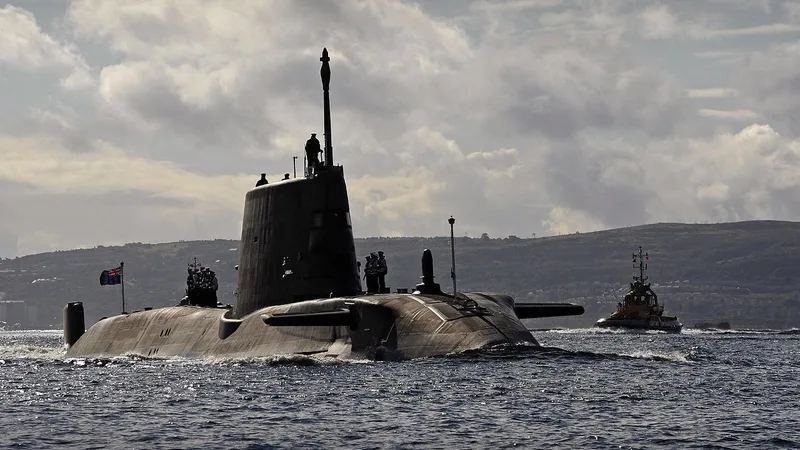
Russia deployed covert spy sensors in the waters surrounding the United Kingdom to track British nuclear submarines, The Sunday Times has reported. The alleged espionage operation is said to have involved even the use of “superyachts” owned by Russian oligarchs.
In brief
Russia has deployed spy sensors in the waters around the United Kingdom to track British submarines, the Sunday Times reported. The targets were reportedly the four strategic nuclear-powered Vanguard-class submarines armed with nuclear warheads, one of which always remains at sea. The discovery of the sensors was deemed a potential threat to national security, but the government never made it public. Former British Ministry of Defence official Tobias Ellwood estimated that 90 percent of British data comes via the sea and 60 percent of gas comes from Norway through a single line.
According to the newspaper, the discovery was considered a potential threat to national security, but the government never made the information public. The report also claims that Russian unmanned vehicles were detected near undersea communication cables.
The sensors were allegedly placed to gather intelligence on Britain’s four Vanguard-class nuclear-powered submarines, each armed with nuclear warheads. At least one of these vessels is continuously at sea as part of the UK's policy of continuous at-sea deterrence, The Sunday Times noted.
Last year, the Russian spy ship Yantar was spotted off the UK coast. The vessel is equipped for deep-sea missions, including mapping and potentially damaging subsea infrastructure.
According to the report, the Ministry of Defence received intelligence suggesting that Russian oligarch-owned superyachts were conducting underwater reconnaissance in British waters even before Russia’s 2022 invasion of Ukraine.
"Several of these vessels are equipped with so-called moon pools, which can be secretly used to deploy deep-sea reconnaissance equipment and divers," the paper wrote. One British warship, HMS Albion, was reportedly monitored by a Russian superyacht in Limassol, Cyprus, back in 2018.
Senior military officials have compared the technological race for undersea dominance to the Cold War-era space race between the United States and the Soviet Union.
The revelations underline how the UK is now operating in a “grey zone of warfare” with Russia, former defence minister Tobias Ellwood told The Guardian. He warned that the UK is highly exposed to maritime threats, noting that “90 percent of British data comes through the sea, and 60 percent of our gas arrives via a single pipeline from Norway.”
Ellwood called for an expansion of the modern Proteus-class vessels tasked with monitoring and protecting underwater infrastructure.
Privately, some Navy personnel believe the UK should even consider reintroducing its capability to deploy naval mines — a practice abandoned since the end of the Cold War — to boost maritime security.
“There should be no doubt: a war is raging in the Atlantic. It’s a cat-and-mouse game that’s been playing out since the Cold War ended — and now it’s heating up again,” one military source told The Sunday Times.
The report also noted that the UK government is considering new regulations requiring technology and energy firms to work more closely with the military and help fund the protection of undersea infrastructure.
Source: PAP / Gazeta Morska · Compiled by: Kamil Kusier
Related articles
 Maritime economy Poland’s constitutional crisis is also a maritime story
 Navy and defence Norwegian submarine Utstein completes NATO patrol guarding offshore oil and undersea infrastructure
 Safety and rescue Polish SAR’s new rescue vessel Mistral launched at Kewatec in Finland
 Safety and rescue Icelandic Coast Guard and police delegation visits Polish Border Guard’s Maritime Division
 Safety and rescue Polish Navy helicopter evacuates man from Baltic platform 100 km off Władysławowo
 Navy and defence SNMG2 joins Allied warships in PASSEX as Italy's Mare Aperto 2026 gets under way
Comments (0)
The discussion is moderated by the editors: a comment appears after review. Your e-mail address is not published.
Nobody has commented on this article yet.